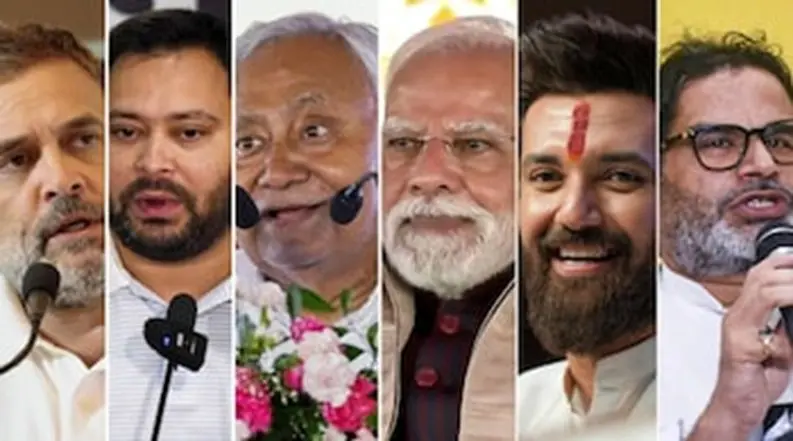


As the State prepares for a high-stakes electoral showdown, traditional alliances, new political forces like Jan Suraaj, and deeply rooted socio-economic concerns set the stage for one of India’s most consequential elections
By Nasir Khuehami / Peerzada Mahboob Ul Haq
As Bihar gears up for assembly elections later this year, the political atmosphere is charged with anticipation and uncertainty. While the contest primarily appears to be between the NDA and the INDIA alliance, the influence of other yet crucial players cannot be underestimated. Prashant Kishor’s ambitious Jan Suraaj movement is steadily gaining traction in parts of the State. Asaduddin Owaisi’s AIMIM has the potential to impact minority vote consolidation in select constituencies. Beyond alliances, deeply entrenched issues such as unemployment, migration, agrarian distress, caste dynamics, and governance quality will shape voter sentiment, making the 2025 Bihar elections one of the most sought-after political battles in the country.
The INDIA alliance’s Voter Adhikar Yatra, spearheaded by Rahul Gandhi and Tejashwi Yadav, appears to have altered political discourse on the ground, energising sections of the electorate and forcing other players to recalibrate their strategies. However, Bihar’s voters are astute; optics and mobilisation alone won’t suffice. What has further sharpened the contest is the controversy over the Special Intensive Revision (SIR) of electoral rolls. The opposition alleges that mass voter deletions are a deliberate attempt to disenfranchise vulnerable sections. With Bihar’s razor-thin electoral margins, such deletions could swing results in dozens of constituencies.
The INDIA alliance has seized this as an institutional issue, accusing the NDA of being scared of the people’s mandate. However, this alone may not be enough to defeat the NDA. The NDA has been systematically mobilising caste identities in Bihar. On an almost daily basis, it is holding caste-based rallies across the state, roping in influential leaders who draw their strength primarily from their caste bases. Programs such as Vishwakarma Samaj gatherings, Bhumihar-Brahmin Samaj rallies, and others are examples of this caste consolidation. Every community, in effect, is rallying behind its caste leader
Caste Arithmetic and Coalition Dynamics in Bihar Elections
The caste-wise reservation structure in Bihar reveals the state’s deep-rooted caste dynamics: Backward Class (BC): 18%, Extremely Backward Classes (EBC): 25%, Scheduled Castes (SC): 20%, Scheduled Tribes (ST): 2%, Economically Weaker Section (EWS): 10%, General (without EWS): 25%. Among these groups, the Other Backward Classes (OBCs) and particularly the EBCs play a decisive role. The EBCs constitute nearly 36% of Bihar’s population and remain the most crucial swing vote.
While in Uttar Pradesh, the BJP has successfully consolidated EBC support, in Bihar, most EBCs gravitate towards Nitish. The BJP’s traditional support base lies with the upper castes: Bhumihars, Rajputs, Brahmins, and Kayasthas, who form around 12–13% of the electorate and largely vote as a bloc. The challenge for the BJP is to expand its social coalition beyond these groups. Hence, the party has made the EBC vote bank its prime focus. However, Nitish Kumar remains the biggest obstacle.
Traditionally, Nitish Kumar’s JD(U) has commanded the loyalty of EBCs. As a Kurmi, Nitish has consistently mobilised Kurmis and Kushwahas, which roughly constitute about 2-3% and 4% of the population respectively, while also cultivating the smaller castes within the EBC umbrella by expanding welfare schemes and political representation. Yadavs, the single most dominant OBC caste at around 14–15%, remain firmly with Lalu Prasad Yadav’s RJD.
Since the 1990s, the Muslim-Yadav (M-Y) combination has formed the backbone of RJD’s politics. Muslims constitute around 17% of Bihar’s electorate, and together with Yadavs, they provide the RJD with a solid vote bank of about 30–32%. However, this alone is not enough to win power in the state, particularly when counter-polarisation takes place. Against the RJD’s M-Y base, the BJP-JD(U) combine mobilises upper castes, EBCs, Dalits, and non-Yadav OBCs. This counter-polarisation has repeatedly haunted the INDIA alliance, making it difficult for them to breach the NDA’s coalition arithmetic.
At the same time, the upper castes historically aligned with the BJP and JD(U) since the 1990s are showing signs of unease. A small segment has begun exploring alternatives. Some see the Congress as a potential option, provided it crafts a persuasive narrative; others view Prashant Kishor’s Jan Suraaj as a fresh alternative. In reality, the upper castes are in search of political space outside their decades-old alignments. If Congress fails to seize this moment, a portion of this disillusioned voter base could drift toward Jan Suraaj. This makes Kishor’s movement a potential spoiler not only for the NDA but also for the INDIA alliance, particularly the Congress.”
Jan Suraaj has indeed emerged as a growing factor in Bihar’s political landscape. The difference between Jan Suraaj and the INDIA alliance is striking; Jan Suraaj has consistently articulated its agenda on core governance issues such as unemployment, migration, education, healthcare and identity. These are deeply felt concerns, especially among the youth, and Jan Suraaj has tried to position itself as the voice of these frustrations.” By contrast, the INDIA alliance has so far anchored much of its campaign around the SIR issue and institutional accountability. In Bihar, electoral history shows that elections are not won by institutional narratives alone. Voters respond most strongly when their immediate concerns, such as those taken up by Jan Suraj, are addressed directly. On these issues, the India alliance has so far been relatively muted. For instance, when Nitish Kumar rose to prominence in the mid-2000s, it was on the back of promises around governance, roads, and law and order, not abstract institutional issues.
However, one thing is that Jansuraj’s political base is largely centralised around Prashant Kishor himself. The party is seen more as a leadership-centric vehicle and personality-driven, than a mass movement, and when people think of Jansuraj, they immediately associate it with Kishor alone. Besides, Jansuraj’s structure is more corporate in nature, with many paid workers rather than a deeply rooted ideological cadre. This makes sustaining long-term political momentum difficult.
On the other hand, the Rashtriya Swayamsevak Sangh (RSS), despite being the largest cadre-based organisation that manages elections on its own for the BJP, has historically struggled to exert decisive influence in Bihar’s electoral politics. Even after over seven decades of work, the BJP has failed to form a government in Bihar on its own strength and has always had to depend on allies. This is in stark contrast to states like Uttar Pradesh and Madhya Pradesh, where the BJP successfully leveraged both RSS’s organisational strength and its Hindutva narrative to consolidate a broad social coalition that cut across caste lines. In Bihar, however, the entrenched caste nexus continues to dominate electoral outcomes, limiting the RSS-BJP’s ability to replicate their UP model.
Another factor that cannot be overlooked in Bihar’s political landscape is Rajesh Ranjan, aka Pappu Yadav. His influence is particularly strong in the Seemanchal and Koshi regions, where he commands an enduring connection with the masses. Political observers argue that if the INDIA bloc seriously engages with Pappu Yadav, offering him due space and respect within its fold, it could significantly consolidate its prospects in Seemanchal and Koshi. Ignoring him, on the other hand, risks fragmentation of anti-BJP votes, which could benefit the NDA. His Lok Sabha victory in Purnia stands as a clear reminder of his relevance, that, despite contesting without the backing of a large organisational machinery, his personal outreach triumphed.
There are two dimensions that matter in Bihar: the political and the socio-economic aspects. Politically, INDIA must keep up the pressure on questions of democratic accountability and voter rights. But socio-economically, it must also provide a credible roadmap to address bread-and-butter concerns. Health indicators reveal the scale of the challenge: Bihar has the lowest doctor-population ratio in India (1:17,000), and its literacy rate, at just under 71% (Census 2011, projected 2025), remains below the national average. Unless the opposition speaks directly to these everyday struggles, it risks ceding political ground to the NDA and even to alternative platforms like Jan Suraaj, which is already attempting to fill this vacuum with a narrative of grassroots development and people-centric politics.
The battle of Bihar is surely not restricted by the NDA or INDIA binary; it’s evolved into three three-dimensional contest of caste arithmetic, economic aspiration, and institutional credibility. NDA traditionally banks on its finely crafted social coalition bloc, the INDIA alliance, trying to channel the anger over voter disenfranchisement and democratic accountability, while Jan Suraaj is tapping into the raw yet effective frustration of Bihar’s youth over jobs, education, and migration.
Whichever side is to be successful will be the one that clubs these 3D narratives into a single strand by acknowledging caste realities, prevailing livelihoods, miseries, and erosion of democratic rights. Therefore, in Bihar, the victory will not come from rallying behind a single narrative, but from channelising these diverse notes into a symphony that voters can tune with.
Nasir Khuehami is a political commentator and the National Convenor of the Jammu and Kashmir Students Association. Peerzada Mahboob-ul-Haq is a policy consultant and advisor to the Jammu and Kashmir Students Association.
(sm*****@***il.com) (kh***********@***il.com)