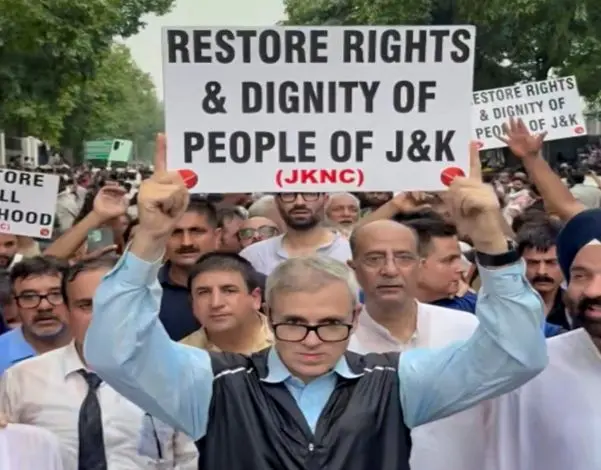


Regional politics in Jammu and Kashmir is entering a post-confrontation era where electoral credibility will depend less on rhetoric and more on delivery. Voters increasingly seek employment, infrastructure, investment, accountable governance, and restoration of democratic institutions. The true political shift may not lie in the National Conference’s journey to Delhi, but in the realisation that Kashmir’s politics is gradually moving from confrontation towards negotiation—a transition that will define the region’s democratic future more profoundly than any single visit ever could.
Er Ishfaq Khaliq
Politics is often understood not through what leaders say, but through where they choose to stand. In that sense, the National Conference’s recent engagement in New Delhi deserves attention not because a meeting itself is extraordinary, but because symbolism in Jammu and Kashmir has always carried greater political weight than ceremony.
For decades, the National Conference cultivated its identity as a party that balanced regional aspirations with constitutional engagement. It has opposed several decisions of the Union Government, particularly those affecting Jammu and Kashmir’s constitutional status, while simultaneously insisting that democratic politics requires dialogue with New Delhi. This paradox has always been central to its politics.
The latest visit, however, arrives in a changed political landscape. Since 2019, the constitutional, administrative, and electoral realities of Jammu and Kashmir have been fundamentally altered. Every regional party now faces a difficult question: Should it continue politics of resistance, or transition towards politics of accommodation? The National Conference appears to be navigating between these two poles.
Critics may interpret the Delhi outreach as evidence of ideological moderation or even political compromise. Yet such criticism overlooks a fundamental truth of democratic politics: dialogue is not surrender. No regional government can effectively govern while remaining institutionally isolated from the Centre. Roads, infrastructure, investment, employment, tourism, disaster relief, and administrative reforms all require engagement with New Delhi.
The more interesting question is not why the National Conference went to Delhi. The real question is what language it chose to speak there. If the discussions centered on restoring democratic institutions, securing developmental support, and protecting the political interests of Jammu and Kashmir within India’s constitutional framework, the visit reflects political maturity rather than ideological retreat. Statesmanship often requires conversation with those ones disagrees with.
However, politics is judged as much by consistency as by intent. If future actions begin to contradict the party’s long-held public positions, then today’s visit may eventually be remembered as the beginning of a strategic realignment. If, instead, the party continues to advocate its established constitutional positions while maintaining institutional dialogue, this visit will be seen as pragmatic governance rather than political transformation.
Regional politics in Jammu and Kashmir is entering a post-confrontation era where electoral credibility will depend less on rhetoric and more on delivery. Voters increasingly seek employment, infrastructure, investment, accountable governance, and restoration of democratic institutions. Parties that remain trapped in symbolism alone risk political irrelevance.
The National Conference, therefore, stands at an inflection point. It must convince its supporters that engagement with New Delhi is a means to advance the interests of Jammu and Kashmir not an abandonment of its political philosophy. History teaches that successful regional parties are those capable of adapting without losing their ideological identity. Whether the National Conference is demonstrating such adaptability or quietly redefining itself is a question that only time and its future decisions can answer.
For now, the Delhi visit should neither be romanticized as a diplomatic breakthrough nor dismissed as a political surrender. It should instead be understood as a reflection of a larger transformation in Indian federal politics, where dialogue has become not a sign of weakness but a prerequisite for relevance.
The true political shift, therefore, may not lie in the National Conference’s journey to Delhi. It may lie in the realization that Kashmir’s politics is gradually moving from the politics of confrontation towards the politics of negotiation a transition that will define the region’s democratic future more profoundly than any single visit ever could.
Supporters of the move argue that statehood would strengthen democratic governance, improve local decision-making, and address the aspirations of the people of Jammu and Kashmir. They view the visit as a legitimate democratic effort to present these concerns at the national level. Critics, however, may question whether repeated protests and political appeals alone will lead to meaningful progress. They argue that dialogue, cooperation, and practical policy discussions between the Centre and regional parties are equally important.
Ultimately, the visit reflects the continuing significance of the statehood debate in Jammu and Kashmir’s politics. Whether or not it leads to immediate policy changes, it has kept the issue in public discussion and highlighted the need for continued democratic engagement between all stakeholders.
The writer is the author of the book ‘Silent Struggle’
is**************@***il.com