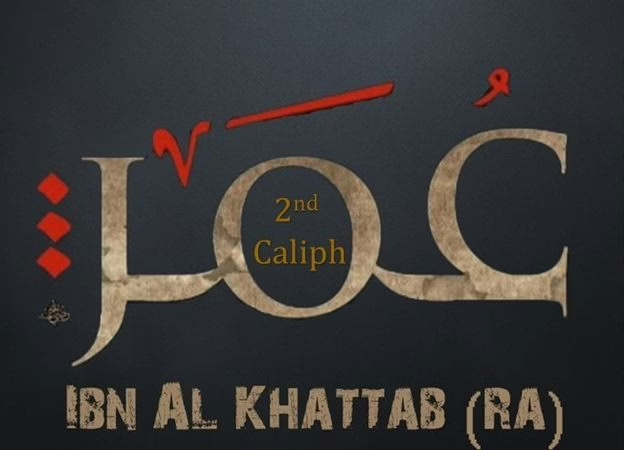


Umar’s (RA) legacy offers timeless lessons in justice, humility, and steadfast devotion—guiding humanity in an age of moral challenges
In the glorious tapestry of Islamic history, few names shine with as much radiance, reverence, and righteousness as Hazrat Umar ibn Al-Khattab (RA). The second Caliph of Islam, known as Al-Farooq — the one who distinguishes truth from falsehood — Hazrat Umar (RA) stands as a paragon of justice, administrative acumen, spiritual humility, and unwavering devotion to Allah (SWT) and His final Messenger, Prophet Muhammad (SAW).
Today, in an age of moral ambiguity and governance crises, his legacy serves not only as an Islamic ideal but also as a timeless guide for humanity at large.
Birth, Early Life, And Embrace Of Islam
Hazrat Umar (RA) was born in Mecca in 583 CE, into the respected Adi clan of the Quraysh tribe. A man of towering physical stature, eloquence, and sharp intellect, he was initially a staunch opponent of Islam, firmly entrenched in the customs of Jahiliyyah.
His heart, however, was destined for truth. The turning point came when he set out to confront the Prophet (SAW) but was instead moved to tears upon hearing the verses of Surah Taha (20:1–135) at his sister Fatimah’s house.
“O Allah, honour Islam through the more beloved of the two to You: Abu Jahl or Umar ibn Al-Khattab.”
(Sunan al-Tirmidhi, Hadith 3682)
This supplication of the Prophet (SAW) was accepted, and the entry of Umar (RA) into Islam marked a significant shift. The Muslims began to pray openly, and the young Islamic movement gained newfound strength.
Reference: Ibn Hisham, “Sirah an-Nabawiyyah”; Ibn Sa’d, “Tabaqat al-Kubra”
His Role In The Prophet’s Lifetime (SAW)
Following his conversion, Hazrat Umar (RA) became one of the most courageous defenders of Islam. He participated in all major expeditions — Badr, Uhud, Khandaq, Khaybar, Hunayn, and Tabuk — and was part of the elite Asharah Mubashsharah, the ten companions promised Jannah.
He was also among the closest advisors to the Prophet (SAW), whose insight the Prophet valued:
“Indeed, Allah has placed truth upon Umar’s tongue and heart.”
(Musnad Ahmad, Hadith 145)
His intense love for the Messenger (SAW), his knowledge of the Qur’an, and his keen sense of justice made him an indispensable figure in the nascent Muslim Ummah.
Caliphate: A Model OF Divine Governance (634–644 Ce)
When Hazrat Abu Bakr as-Siddiq (RA) passed away in 634 CE, he nominated Hazrat Umar (RA) as his successor. What followed was a decade of transformational leadership, marked by expansion, reforms, and deep-rooted justice — unmatched in world history.
Vast Expansion Of The Islamic World
Under his command, the Islamic empire spread across three continents, defeating the superpowers of the time:
Byzantines at the Battle of Yarmouk (636 CE)
Sassanids at Qadisiyyah and Nihawand
Conquest of Egypt, Syria, Iraq, Palestine, and Persia
Reference: Al-Tabari’s “Tarikh al-Rusul wa al-Muluk”; Baladhuri’s “Futuh al-Buldan”
Administrative Innovations
Hazrat Umar (RA) laid the foundation of the Islamic welfare state, initiating reforms that are still admired in modern governance:
Creation of Bait-ul-Mal (Public Treasury)
Establishment of the Hijri calendar (17 AH)
Creation of provinces and appointment of accountable governors
Setting salaries for Imams, soldiers, and public workers
Census and land revenue system
Public infrastructure: roads, canals, mosques, and inns
Reference: Abu Yusuf’s “Kitab al-Kharaj”; Shibli Nomani’s “Al-Farooq”
Justice Above All
The hallmark of Umar’s reign was absolute justice. He ruled by the Qur’an and Sunnah, applying law equally to rich and poor, Muslims and non-Muslims alike.
“By Allah! If a mule were to stumble in Iraq, Umar would fear being questioned by Allah: ‘Why did you not pave the road for it?’”
(Kanz al-Ummal, Hadith 36060)
He was accessible to all — walking the streets of Madinah at night to inspect the condition of his people, personally responding to complaints, and punishing even his own family if they erred.
Protection Of Minorities
The Treaty of Jerusalem, signed under his leadership, assured Christians of complete religious freedom, safety of churches, and protection of their lives and property — a document regarded as a pioneering charter of religious tolerance.
Reference: Baladhuri’s “Futuh al-Buldan”
Martyrdom: A Loss Beyond Measure
In 23 AH (644 CE), while leading the Fajr prayer in Masjid al-Nabawi, Hazrat Umar (RA) was fatally stabbed by a Persian fire-worshipping slave, Abu Lu’lu’ah. Even in his dying moments, he refused to appoint his own son as successor, choosing instead a Shura (council) of six eminent Sahaba to select the next Caliph — a precedent for future Islamic governance.
He was buried alongside Rasulullah (SAW) and Hazrat Abu Bakr (RA), in the Prophet’s chamber — a position of the highest honour.
Reference: Sahih al-Bukhari, Hadith 1392
Relevance Of Hazrat Umar’s (RA) Legacy In The 21st Century
Hazrat Umar (RA) offers enduring lessons for today’s world:
Justice for All: In an era of widespread injustice, Umar’s fearless application of the law serves as a gold standard.
Accountable Leadership: Unlike modern autocracies, Umar insisted on checks and balances. His governors were questioned publicly.
Welfare State Ideals: His system of public support — stipends for widows, orphans, and the elderly — predated modern welfare systems by centuries.
Pluralism and Tolerance: His treatment of minorities is a lesson for modern societies struggling with communal harmony.
Service-Based Leadership: His simplicity, humility, and refusal to exploit power stand in stark contrast to today’s self-serving rulers.
Conclusion: A Timeless Leader Of The Ummah
Hazrat Umar ibn Al-Khattab (RA) was not merely a Caliph; he was a reviver of prophetic governance, a champion of the oppressed, and a guardian of the Shari’ah. His visionary leadership illuminated the path of Islam at a critical juncture and continues to guide the Ummah even today.
As Muslims reflect upon global challenges — from social injustice to political corruption — the example of Al-Farooq offers both solace and direction. May Allah (SWT) be pleased with him and allow our leaders to emulate even a fraction of his noble character.
PeerzadaTariq
pe*************@***il.com