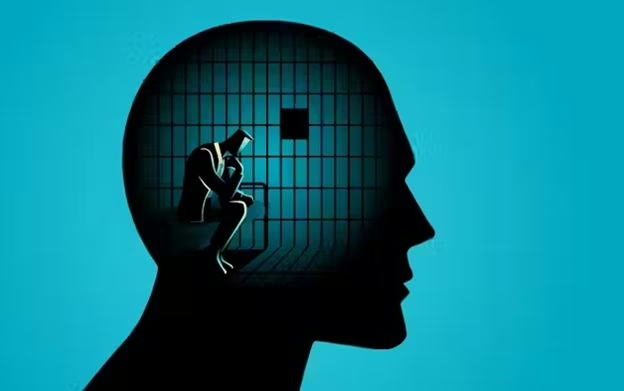


To preserve the soul of the republic, the nation must prioritise critical thinking, philosophical education, and informed discourse in an age of distraction and digital manipulation
In an era when freedom is often reduced to hashtags and holidays, we must pause to ask: What is freedom without thought? If liberty no longer demands introspection, responsibility, or reflection, has it lost its essence or worse, its danger?
Post-independence India, now well into its 78th year of freedom, celebrates political emancipation with pride. And rightly so. Yet, in the shadow of constitutional guarantees and growing civil liberties, we are perhaps witnessing a quiet crisis, the divorce between freedom and thought. This divorce is not loud, not even obvious. It occurs in classrooms that teach to perform, not to ponder; in media that entertains, but rarely informs; in a society that moves fast, but seldom inquires why it is moving, and where.
The burden of thinking in a distracted democracy
The philosopher Hannah Arendt once warned of the “banality of evil” that great harm can come not from hatred, but from the absence of thought. In the digital age, this absence is no longer confined to dictatorships or historical tragedies. It is creeping into democracies, powered by the speed of information and the ease of opinion. In India, the world’s largest democracy, we are witnessing a subtle narrowing of intellectual space. The question is not whether we are allowed to speak, but whether we are taught to think before we speak. The seduction of instant outrage, tribal allegiances, and performative patriotism is overpowering the slow, humble work of reasoning.
A republic of opinions, but not of ideas
India has never lacked in expression. Our people are expressive, emotional, and impassioned. But there is a critical difference between opinion and thought. Opinions are reactive; thoughts are cultivated. In this age of algorithms, what passes for civic participation is often mere emotional performance, curated by social media and stripped of context. We have become a nation that reacts more than it reflects. National debates on religion, gender, caste, and economy are shaped less by philosophical depth and more by viral memes. The shrinking attention span is not just a technological side-effect; it is becoming a civic crisis.
Education without awakening
One of the gravest casualties of this crisis is our education system. Schools and universities have become factories of credentials, not crucibles of critical thought. The ability to memorise has been rewarded over the ability to question. Students graduate with degrees in hand, but many lack the philosophical tools to confront uncertainty, complexity, or contradiction, the very things real freedom demands.
Tagore, in his poem ‘Where the Mind is Without Fear’, spoke of a nation “where knowledge is free…where the clear stream of reason has not lost its way into the dreary desert sand of dead habit.” The desert he warned of has expanded, ironically, in the time of greatest access to information. Information has grown; wisdom has thinned.
The illusion of choice
Modern freedom, especially in the liberal democratic model, is often defined as the freedom to choose your job, your beliefs and your identity. But what use is choice when it is uninformed, unexamined, or manipulated by invisible algorithms? What we face today is not censorship in the old authoritarian sense; it is manipulation by abundance. In drowning the mind in choices, we often silence the soul.
Why does thought matter more than ever?
In a country as plural and layered as India, the discipline of thinking is not a luxury; it is a survival tool. To live amid contradiction, diversity, and conflict without becoming cynical or violent requires deep thought. It demands empathy, philosophical humility, and the ability to sit with discomfort, qualities not nurtured by political rhetoric or mass media.
Thought is also resistance. To think is to rebel against simplification, against hatred, against the desire to otherwise. That is why thinking individuals have always made both society and the state uncomfortable. But they have also been its moral anchors.
Toward a More Thoughtful Freedom
If we are to preserve not just democracy, but the soul of this republic, we must restore thought to its rightful place. That means:
- Reviving philosophical education at all levels, especially in public institutions.
- Protecting spaces of disagreement without demonisation.
- Encouraging media that informs rather than inflames.
- Honouring those who think deeply, not just those who speak loudly.
In reclaiming thought, we do not reject freedom. We deepen it. Because freedom without thought is not freedom at all, it is drift, distraction, and ultimately, decay. As India moves toward its centenary of independence in 2047, it must remember: the future belongs not to those who shout the loudest, but to those who dare to think the deepest.
The writer is a lecturer in Educational Technology & ICT at Islamia Faridiya College of Education, Kishtwar
Mohd Salahuddin Qazi
mo****************@***il.com