In our globalized world, the prospect of working abroad is an enticing opportunity for many individuals seeking personal and professional growth. More power to you! However, before embarking on your adventure, it is crucial to consider several factors that can significantly impact one’s financial well-being, such as the cost of living and purchasing power in the host country. One essential tool for evaluating these aspects is the latter; PPP.
Purchasing power parity is a concept that compares the prices of goods and services between different countries, taking into account exchange rates and the relative cost of living. It enables individuals to understand how much their income in a foreign country can buy compared to their home country. In simpler terms, it assesses the real value of a currency in relation to its ability to purchase goods and services in different nations. PPP takes into account the price differences of essential items like housing, food, transportation, healthcare, and other daily expenses. By considering PPP, individuals can gain insights into the actual value of their earnings, helping them make informed financial decisions and maintain their desired standard of living.
Calculation of Purchasing Power Parity
The PPP formula can be derived by following the four steps below:
1. Find a commodity or basket of goods that is easily accessible in both of the countries under consideration.
2. Next, calculate the price of the basket in the first country’s currency. The cost of living in the nation will be reflected in the pricing.
3. The price of the basket in that other country’s currency should next be examined.
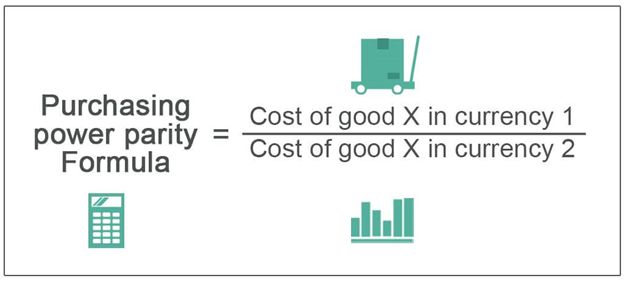
4. By dividing the cost of the good/basket in country 1 in currency 1 by the cost of the same commodity in country 2 in currency 2, as shown below, we can finally calculate the PPP formula of country 1 w.r.t. country 2. Hope that makes sense.
Purchasing Power Parity = Cost of good X in currency 1 / Cost of good X in currency 2
Let’s use the comparison of India and the United States’ purchasing power parity to serve as an example.
Let’s say an American travels to a specific market in India. The traveler discovered that cupcakes are far less expensive in India after purchasing 25 of them for INR 250. The guest stated that 25 of these cupcakes typically cost $6. Using the information provided, we can calculate the purchasing power parity between these two nations.
Given that 25 cupcakes cost INR 250 when 25 cupcakes cost $6 USD, we may determine India’s purchasing power parity in relation to the US as follows:
Purchasing power parity = Cost of 25 cupcakes in INR / Cost of 25 cupcakes in USD = ₹250 / $6
Purchasing Power Parity of India w.r.t U.S. = ₹41.67 per dollar.
Therefore, the purchasing power parity ratio of the exchange for cupcakes is USD1 = INR 41.67.
In the above case, the purchasing power parity (PPP) of India with respect to the United States is 41.67, which means that the Indian currency, the Indian Rupee (INR), has a lower purchasing power compared to the US dollar (USD). In other words, goods and services in India, when priced in Indian Rupees, are relatively cheaper than in the United States when priced in US dollars.
The PPP value of 41 suggests that, on average, it takes 41 Indian Rupees to purchase the same basket of goods and services in India that would cost 1 US dollar in the United States. This implies that the cost of living in India is significantly lower than in the United States. However, it’s important to note that PPP values are relative and should not be interpreted as an absolute measure of the strength or weakness of a currency. PPP takes into account not only the exchange rate but also the differences in the cost of living between countries. It helps provide a more accurate comparison of living standards and purchasing power across different economies. While a PPP value of 41 indicates a lower purchasing power for the Indian Rupee compared to the US dollar, it doesn’t necessarily mean that individuals in India are worse off. Factors such as local wages, availability of goods and services, and social and economic conditions also contribute to the overall standard of living. Additionally, it’s worth mentioning that PPP values can fluctuate over time due to changes in exchange rates and the relative cost of living between countries. Therefore, it’s essential to consider the specific time period and context when interpreting PPP values.
Here we will explore the importance of calculating purchasing power parity before accepting a job abroad and how it can help individuals make informed decisions about their international career prospects.
Evaluate Cost of Living: Calculating PPP provides a clearer understanding of the cost of living in a foreign country. While salary offers may seem attractive, they can be misleading if not evaluated in relation to the local economy. By analyzing PPP data, individuals can determine whether their potential salary will allow them to afford basic necessities, housing, healthcare, education, transportation, and other essential expenses. This knowledge can prevent unexpected financial strain and ensure a comfortable lifestyle while working abroad.
Maintain Financial Stability: Neglecting to consider purchasing power parity can lead to financial instability. If a person moves to a country where the cost of living is significantly higher than their home country, their salary may not stretch as far as they initially anticipated. This can result in financial stress, difficulties meeting financial obligations, and reduced quality of life. Conversely, relocating to a country with a lower cost of living may offer the opportunity to save money or enjoy a higher standard of living with the same income. Understanding PPP allows individuals to make informed decisions and avoid financial pitfalls.
Compare Salary Offers: Purchasing power parity is particularly crucial when comparing salary offers from different countries. Two job offers may appear to be similar in terms of gross income, but without considering PPP, it is challenging to determine their true value. By adjusting the salaries using PPP data, individuals can make an apples-to-apples comparison and understand which offer provides a higher purchasing power and a better standard of living.
Plan for the Future: Calculating purchasing power parity also aids in long-term financial planning. It helps individuals estimate their potential savings, investment opportunities, and retirement plans in a foreign country. By understanding the cost of living and projected expenses, individuals can make informed decisions about their financial goals and take appropriate steps to secure their future.
Conclusion: Considering purchasing power parity is a vital step before accepting a job abroad. By understanding the cost of living and evaluating the purchasing power of potential earnings, individuals can make informed decisions about their financial stability, lifestyle, and overall well-being. Calculating PPP provides a realistic picture of the value of income in a foreign country and enables individuals to plan effectively for their future. With this knowledge in hand, job seekers can embark on their international careers with confidence, ensuring a rewarding and financially secure experience.
Some useful links:
https://www.oecd.org/
https://www.economist.com/big-mac-index
https://www.wallstreetmojo.com/
The author is an MBA (HR, Marketing) and can be reached at sh*************@***il.com and https://www.linkedin.com/in/shahid-lone/
The importance of calculating the Purchasing Power Parity (PPP) before pursuing a job abroad