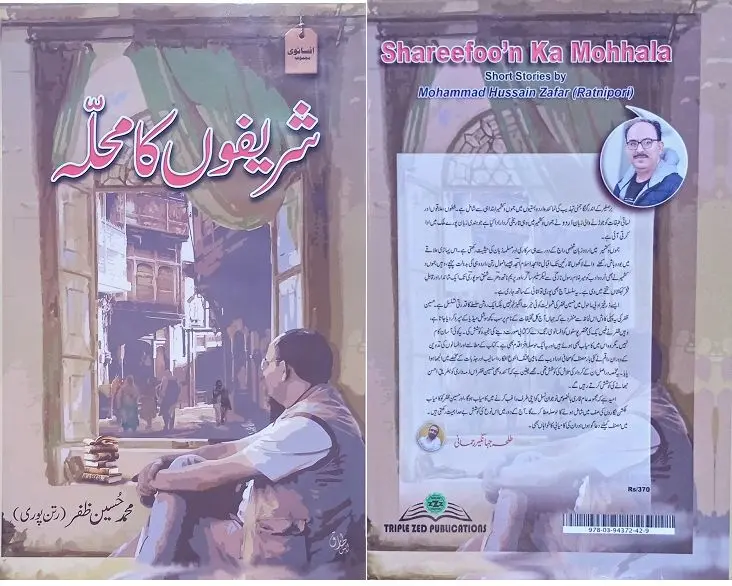


The collection of 31 short stories by Mohammad Hussain Zafar is not just a wonderful addition to Urdu literature but a gentle critique of different problems in modern society. The language is so simple that even a 5th-grade student can read it without trouble. Prof Danish Iqbal from Jamia Millia Islamia called it a landmark in Urdu short story writing.
The story ‘EHSAS’ is about a teacher and his student meeting after many years. They sit together and remember old times – the memories, the mistakes, and everything that happened after. The story is touching and makes readers emotional.
No matter how high you rise in life, you should never forget where you came from. Staying humble and connected to your roots is what makes you a true gentleman. The story ‘FAWDA’ teaches us this lesson.
All religions teach us to be kind and humane. But do the people who run religious places actually follow these teachings? The story ‘PANAAH’ asks this same question.
Parents do everything for their children – they work hard, sacrifice their own needs, and give them education. When children grow up, it is their turn to care for their parents. But what if they forget their duty? The story ‘MURDA AURAT KI ZINDA KAHANI’ shows this painful reality.
The story ‘DUNYA BADAL GAYI’ shows how some people now look at marriage not as a bond of love but as a transaction.
Violence destroys everything. It buries emotions under rubble and doesn’t let love survive. The short story ‘BANJARAN’ captures this pain beautifully.
Stories like JHOOT, HAZIR JAVAB, DO JANO, BASHEERA, ME TOO, BILA UNVAAN, and ASHRAF UL MAKHLOOKAT act like mirrors. They show us truths about our world that disturb us, but we can’t deny them. This debut book already shows the author’s creativity, strong command of language, and deep understanding of characters.
Manzoor Akash
Mohammad Hussain Zafar, also known as Ratanpori, is a name most people in Kashmir recognise. He is a well-known and talented person who wears many hats. He is a writer, broadcaster, playwright, poet, and powerful speaker—all at the same time. Many households know his voice from the popular radio program SHEHARBEEN.
Recently, his debut book “Shareefoo’n Ka Mohalla” was launched at Tagore Hall in Srinagar. The book is a collection of 31 short stories written in Urdu. What makes the book special is not just the stories themselves, but also the simple language he uses. It is so easy to understand that even a 5th-grade student can read it without trouble. In the introduction, Prof Danish Iqbal from Jamia Millia Islamia, New Delhi, praised Mohammad Hussain Zafar highly. He called the book a landmark in Urdu short story writing. Prof Iqbal also explained in detail how the author uses his stories to gently criticise different problems in modern society.
A good student isn’t just someone who studies hard, does well in life, achieves dreams, and makes family proud. A good student is also someone who never forgets the teacher who helped him get there. A real teacher is the person who overlooks your mistakes, forgives you, never embarrasses you in front of others, and gives all of their energy to build your future. They shape your life and personality. The story “EHSAS” is about this bond. A teacher and his student meet again after many years. They sit together and remember old times—the memories, the mistakes, and everything that happened after. The story is touching and makes readers emotional.
No matter how high you rise in life or how successful you become, you should never forget where you came from. Staying humble, remembering your past, and staying connected to your roots is what makes you a true gentleman. The story “FAWDA” teaches us this lesson. At first, you feel bad for Salman, the main character, when his father makes him carry a shovel, or fawda, to school. But when you understand why his father did it, you are amazed. The lesson his father wanted him to learn leaves both Salman and the reader speechless.
Mazhab Nahi Sikhaata Aapas Me Beir Rakhna (religion doesn’t teach us to keep hatred in our hearts). That’s a famous line from an Urdu poem, and it’s true—all religions teach us to be kind and humane. But the real question is: do the people who run religious places actually follow these teachings? The story “PANAAH” asks this same question. A man is out in the freezing winter cold, looking for a place to spend the night. He goes to several religious centres and asks for shelter, but every one of them turns him away.
Finally, he ends up at a brothel. In the morning, he wakes up warm, covered in blankets, with food kept beside his bed. The one place society looks down on is the place that shows him true humanity. Through this story, PANAAH questions how religious people practice the kindness their faith preaches. The bond between parents and children is one of the strongest and most emotional relationships in life. Parents do everything for their children—they work hard, give them a good education, fulfill their wishes, and sacrifice their own needs just to see them happy and successful.
When children grow up, it’s their turn to take care of their parents, support them, and treat them with love and respect. But what if they don’t? What if they forget their duty? The short story “MURDA AURAT KI ZINDA KAHANI” shows this painful reality. It ends with a heartbreaking line from a helpless parent: “TUM LIKHNA AUR LOGO SE KEHNA KI AWLAD E NA FALAQ HONE SE LAA VALAD HONA LAAKH BEHTER HAI.” In simple words: “Write this down and tell people—it’s a million times better to be childless than to have unworthy children.”
Marriage is a sacred relationship. It doesn’t just join two people—it brings two families together. For a marriage to work, both the husband and wife must take responsibility. They need to support each other, care for each other, and sometimes even sacrifice their own happiness or ego for their partner. Compromise is key. It’s what helps a marriage last a long time.
But when marriage is treated like a business deal, its true meaning is lost. When people make selfish demands like, “She doesn’t know how to cook anything except making tea, and that too only for herself, and she has no intention to learn!” or “You must buy me a good car before the wedding… if you agree to these terms, only then can we talk further,” then marriage becomes a burden.
The story “DUNYA BADAL GAYI” shows this reality. It paints a true picture of how some people in our society now look at marriage—not as a bond of love, but as a transaction. Violence destroys everything. It buries emotions under the rubble and doesn’t let love survive or grow in peace. It turns the world into a painful place for people in love, making them curse the very violence that took everything from them.
The short story “BANJARAN” captures this pain beautifully. Reshma, a nomadic girl, is killed in an explosion while clearing the debris of her lover’s house after it was destroyed in an encounter. Through her death, the author shows how violence crushes love.
We have all heard the saying, “Don’t judge a book by its cover.” It’s a powerful reminder for everyone. As humans, we should pause and think before we act on our careless thoughts. Even the Qur’an tells us not to gossip about other people’s private lives. The story “SHAREEFO’N KA MOHALLA” in this book brings out this lesson clearly. It exposes and makes fun of a certain group of people in our society – those who think they are better than everyone else. They look down on others based only on their own assumptions, without ever checking if something is true.
If we look at the world today, we see two sides. On one side, there are people who give up everything – their money, health, and feelings – for their loved ones. But on the other side, when those same people need help, no one stands by them. Their loved ones abandon them, leaving them to struggle alone. That’s when a fake friend appears. He pretends to care, but actually takes advantage of them. The character JOOLI plays exactly this cruel role.
The book “Shareefoo’n Ka Mohalla” is a wonderful addition to Urdu literature. It has 31 short stories, and each one touches on sensitive problems in our society. Stories like JHOOT, HAZIR JAVAB, DO JANO, BASHEERA, ME TOO, BILA UNVAAN, and ASHRAF UL MAKHLOOKAT act like mirrors. They show us truths about our world that disturb us, but we can’t deny them.
The author has written these stories beautifully. This is his first book; yet, it already shows his creativity, strong command of language, and deep understanding of characters. Of course, no one is perfect. “To err is human, to forgive is divine.” A few stories in the book have spelling mistakes. Some dialogues and sentences could have been even better with one more round of editing. I want to point the author toward the story “BETA”. It’s a beautiful story. It flows smoothly and keeps the reader hooked until page 147, paragraph 2. After that point, the story suddenly changes direction. It becomes confusing, and the reader starts losing interest. I feel the author should read it again. He might find that the story feels incomplete. Still, the rest of the stories are very engaging. They speak volumes about his talent. I congratulate him on this work and wish him all the best for his future writing.
Manzoor Akash
Educator, Columnist (Kashmir Reader), and author of several books; recipient of the National Peace Award
ma*********@******co.in