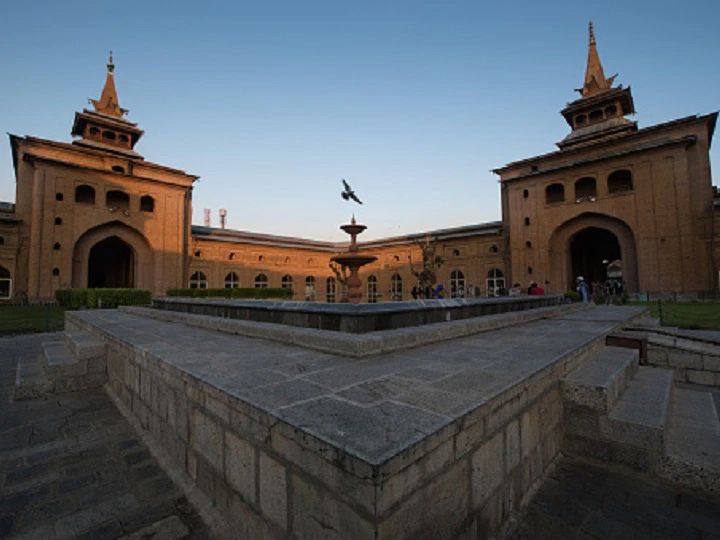


The mosque should once again embody Islam’s comprehensive vision — nurturing faith, intellect, and social responsibility. It should provide space for worship and for dialogue, learning, and empowerment.
By Prof Hamid Naseem Rafiabadi
The Masjid (mosque) has always occupied a central position in the spiritual, social, and intellectual life of Muslim communities. In the time of the Prophet Muhammad (SAW), the mosque was not confined merely to ritual worship; rather, it was the core of collective Muslim life, serving as a centre for worship, education, consultation (shura), and social welfare. It was the locus of both religious and worldly affairs — a place where faith, knowledge, and community life harmoniously intersected (Nasr, 1987).
Historical and Prophetic Model
The Masjid al-Nabawi in Madinah, established by the Prophet (SAW) shortly after the Hijrah, serves as the ideal archetype of a mosque as a comprehensive community centre. Within its precincts, the Prophet (SAW) taught Qur’an and Sunnah, trained companions for leadership, managed community affairs, received delegations, resolved disputes, and cared for the poor and needy. The Ahl al-Suffah, a group of devoted learners who lived within the mosque, represented Islam’s first residential educational institution, integrating spiritual, intellectual, and practical learning (Al-Mubarakpuri, 2002).
The Qur’an itself frames the mosque as a centre of moral and social regeneration: “In houses (of worship) which Allah has ordered to be raised, in them His Name is remembered; therein glorify Him in the mornings and in the evenings—men whom neither trade nor sale distracts from the remembrance of Allah…” (Qur’an, 24:36–37).
This verse not only highlights worship but also underscores the mosque’s connection with economic and ethical life, indicating that worldly activity must coexist with remembrance of Allah. Similarly, another verse declares: “The mosques of Allah shall be maintained only by those who believe in Allah and the Last Day, perform prayer, and give zakat, and fear none but Allah” (Qur’an, 9:18).
The maintenance (imarah) of mosques, according to classical exegetes like Ibn Kathir (1998), includes not only physical upkeep but also the revitalisation of their social, educational, and moral functions.
Educational Role of the Masjid
The Prophet (SAW) transformed the mosque into a centre of continuous learning. His companions would gather there for religious instruction, memorisation of the Qur’an, and the discussion of worldly matters related to governance, trade, and justice. As the Prophet (SAW) said, “The best of you are those who learn the Qur’an and teach it” (Sahih al-Bukhari, Hadith 5027).
Following this model, the early Caliphs and Muslim scholars used mosques as centres for disseminating both religious and scientific knowledge. The Umayyad and Abbasid eras saw mosques develop into hubs for rational and empirical learning—where disciplines like astronomy, mathematics, and medicine were discussed alongside fiqh and tafsir (Makdisi, 1981). Institutions like Al-Qarawiyyin in Fez (founded 859 CE) and Al-Azhar in Cairo (founded 970 CE) evolved directly from mosque-based educational circles, proving the deep interconnection between masjid and madrasa (Pedersen, 1984).
Social and Economic Empowerment
Historically, mosques also fulfilled vital social and welfare functions. The Prophet (SAW) initiated charity, organised welfare support for the needy, and supervised the distribution of zakat and sadaqah within the mosque (Ibn Sa‘d, Tabaqat al-Kubra). During the Caliphate of ‘Umar ibn al-Khattab (RA), mosques functioned as centres of administration, social justice, and economic planning, ensuring welfare for orphans, widows, and travellers (Al-Tabari, Tarikh al-Rusul wa al-Muluk).
Contemporary Muslim thinkers like Said Nursi (d. 1960) emphasised that scientific and practical education is a collective duty (fard al-kifayah), just as essential as religious learning. Nursi urged Muslims to integrate ‘ilm al-din (religious sciences) and ‘ilm al-madani (modern sciences) to overcome intellectual stagnation (Nursi, The Letters, 1995). Similarly, AbdulHamid AbuSulayman (1993) advocated reviving mosques as centres of ethical and civic education, where youth can learn leadership, moral reasoning, and professional skills grounded in Islamic values. He argued that the disconnection between faith and worldly knowledge had led to intellectual dualism and economic dependency within Muslim societies.
Colonial Legacy and the Decline of the Mosque’s Broader Role
The colonial encounter, particularly after the Revolt of 1857 in India, marked a rupture in the mosque’s community function. British authorities viewed mosques as political centres of resistance and often restricted their activities. In response, Muslim scholars, particularly those who founded Darul Uloom Deoband (1866), prioritised preserving Islamic learning and identity amid colonial pressure (Metcalf, 1982). However, this necessary isolation from modern sciences led to a dual educational structure—madrasa versus secular school—that weakened the holistic Islamic educational paradigm.
Today, with colonial constraints long gone, this separation is no longer justified. Muslim communities urgently need to reintegrate spiritual and worldly education within mosque frameworks. As Jasser Auda (2021) notes in Re-envisioning Islamic Scholarship: Maqasid Methodology as a New Approach, true reform must be maqasid-driven—reviving the mosque’s role as a means to achieve the higher objectives of Shari‘ah: knowledge (‘ilm), justice (‘adl), welfare (maslahah), and human dignity (karamah).
Revitalising the Mosque for Contemporary Challenges
In the 21st century, the mosque must evolve into a centre of socio-economic empowerment while maintaining its spiritual core. Programs such as computer literacy, vocational training, language instruction, entrepreneurship workshops, and career counselling can be organised within mosque complexes to support youth employment and empowerment. This vision aligns with the Prophetic model, where worldly skills were not separated from spiritual growth.
Modern initiatives in countries like Malaysia, Indonesia, and Turkey have successfully transformed mosques into community development centres offering social services, microfinance guidance, and counselling. Such efforts resonate with the Qur’anic injunction to “cooperate in righteousness and piety” (Qur’an, 5:2).
For Indian Muslims in particular, reviving mosques as community centres could counter socio-economic marginalisation and promote educational inclusion. As Salman Mohammad Khan (2024) suggests, empowering mosques to serve as platforms for skill-building and modern education can bridge the gap between tradition and modernity, restoring the masjid to its original, holistic purpose.
Conclusion
Reviving the mosque as a community centre is not a modern innovation but a restoration of its authentic Islamic character. The mosque should once again embody Islam’s comprehensive vision — nurturing faith, intellect, and social responsibility. It should provide space for worship and for dialogue, learning, and empowerment. In doing so, the mosque reclaims its role as the heart of Muslim civilisation — a beacon of light guiding both individual and communal transformation.
As the Prophet Muhammad (SAW) said: “The most beloved places to Allah are the mosques” (Sahih Muslim, Hadith 671) — and the most beloved communities are those that make them centres of worship, knowledge, and service to humanity.
References
Al-Mubarakpuri, S. (2002). Ar-Raheeq al-Makhtum (The Sealed Nectar). Riyadh: Darussalam.
Auda, J. (2021). Re-envisioning Islamic Scholarship: Maqasid Methodology as a New Approach. London: Claritas Books.
AbuSulayman, A. H. (1993). Crisis in the Muslim Mind. Herndon: IIIT.
Ibn Kathir, I. (1998). Tafsir al-Qur’an al-‘Azim. Cairo: Dar al-Hadith.
Makdisi, G. (1981). The Rise of Colleges: Institutions of Learning in Islam and the West. Edinburgh: Edinburgh University Press.
Metcalf, B. D. (1982). Islamic Revival in British India: Deoband, 1860–1900. Princeton: Princeton University Press.
Nasr, S. H. (1987). Traditional Islam in the Modern World. London: Kegan Paul International.
Nursi, B. S. (1995). The Letters. Istanbul: Sozler Publications.
Pedersen, J. (1984). “Madrasa.” In The Encyclopaedia of Islam, Vol. 5. Leiden: Brill.
Salman Mohammad Khan. (2024, November 15). “Reviving Mosques as Community Centres.” Muslim Mirror.
—Dr Hamid Naseem Rafiabadi (also known as Dr Hamidullah Marazi) is a distinguished contemporary Islamic scholar whose work significantly contributes to the dialogue between Islamic philosophy and modern Western thought. He is the author of several books. Through a rigorous comparative methodology and an emphasis on epistemological integrity grounded in Tawhid (the oneness of God), Marazi critiques secular paradigms and advocates for an integrative intellectual tradition. His scholarship not only critiques Western thought but also calls for mutual enrichment between traditions, emphasising Islamic metaphysics, ethics, and educational reform as central to contemporary challenges.
ha*********@***il.com