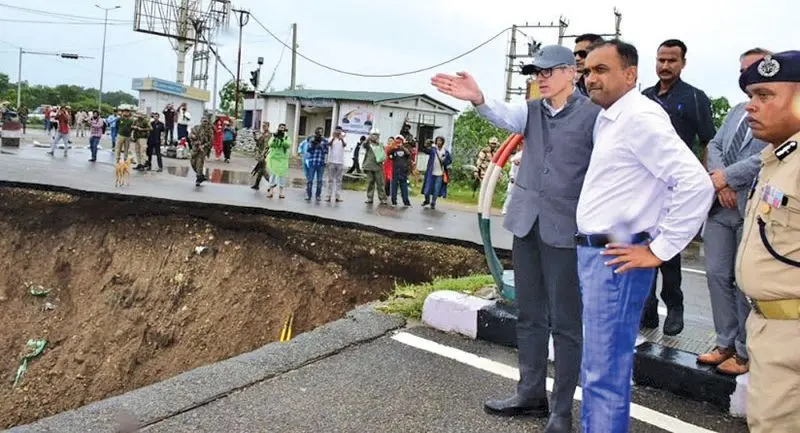


When Nature Strikes Back
Innovative people-led initiatives, coupled with robust government support, offer a pathway toward sustainable recovery and resilience in the face of devastating floods
Disasters have always been a recurring chapter in the history of Kashmir, a region perched on the fragile folds of the Himalayas. From the devastating 2005 earthquake to the catastrophic 2014 floods, the valley has repeatedly witnessed the sheer power of nature. The most recent episode, the August 2025 floods, caused by record-breaking rainfall and compounded by landslides, has once again exposed the vulnerability of the region. At least 36 people lost their lives (Reuters, 2025; UPI, 2025), communication networks collapsed, and vital roadways, including the Jammu-Srinagar highway, were washed away (India Today, 2025). Pilgrims at Vaishno Devi were trapped in landslides, schools were closed, and tens of thousands were displaced. Such events raise a critical question: Are we truly prepared for the next disaster whether another flood, a massive earthquake, or a climate-induced catastrophe? This paper uses the 2025 floods as a case study to reflect on preparedness, gaps in the existing disaster management framework, and future strategies for building resilience in Kashmir.
The 2025 Floods: A Case Study in Vulnerability
The 2025 floods were not merely the outcome of heavy rainfall but the convergence of several systemic issues. Jammu received 296 mm of rainfall in 24 hours, surpassing records from 1973, while Udhampur received 629.4 mm, almost double its historical record (The Print, 2025). Such extreme precipitation overwhelmed natural drainage systems, leading to flash floods, swollen rivers, and destructive landslides.
The disaster claimed dozens of lives and inflicted widespread damage:
- Infrastructure collapse: Roads, bridges, and rail tracks were washed away (Times of India, 2025).
- Communication breakdown: Mobile networks and internet connectivity were disrupted for days (Outlook India, 2025).
- Healthcare disruption: Hospitals were cut off, delaying trauma care and critical interventions.
- Pilgrimage disaster: The Vaishno Devi pilgrimage route was buried under a landslide, resulting in over 30 casualties (Reuters, 2025).
Despite early warnings by meteorological departments, the response was largely reactive, with rescue teams arriving after significant damage had already occurred (AP News, 2025). This mirrors the failures seen in the 2014 floods, suggesting that lessons from the past remain unimplemented. Hon’ble Chief Minister Omar Abdullah also underscored this in a post on X.com, where he compared images from the 2014 and 2025 floods and asked: “What, if anything, did we learn from the 2014 floods? What corrective steps were taken in the last 11 years? What flood mitigation measures have been implemented since October 2014? … The last 48 hours have been a shocking eye opener” (Abdullah, 2025).
Man as the Destroyer of the Universe
While nature triggers disasters, human activity has intensified their scale. Kashmir’s rivers once flowed through wide floodplains and natural canals that acted as buffers. Today, much of this space has been encroached upon by construction and urban sprawl (NDMA, 2019). Trees that once stabilised slopes have been cut, making hills more prone to landslides. Riverbeds are clogged with plastic and waste, reducing water-holding capacity.
This human-made destruction makes disasters more deadly than they naturally would be. Floods and earthquakes are unavoidable, but their impact becomes catastrophic because man has disrupted the balance of the universe. Deforestation, unregulated construction, and disregard for environmental warnings have converted what could be manageable natural events into humanitarian crises.
Disaster Preparedness: Where Do We Stand?
- Infrastructure Fragility
Unregulated urbanisation in flood-prone zones, poor drainage planning, and encroachment of floodplains have amplified risks (The Hindu, 2024). Embankments along the Jhelum and Tawi rivers remain weak, while many residential structures and hospitals are built without earthquake-resistant designs, despite Kashmir’s location in seismic Zone V (NDMA, 2020).
- Weak Early Warning Systems
Although forecasts were issued, dissemination to local communities was poor. Most affected populations learned of the impending flood only when the waters began rising (India Today, 2025). Unlike Japan or Bangladesh, where community-level alerts are standard, Kashmir lacks a localised, multilingual alert system.
- Healthcare Unpreparedness
Floods cut access to hospitals, and many facilities were unequipped to handle a sudden influx of trauma cases. There are no designated disaster-ready hospitals with surge ICU capacity or stockpiles of emergency supplies (WHO, 2023). Mental health care, critical in a conflict-affected region, is often overlooked.
- Response Bottlenecks
Blocked highways delayed rescue teams. Local authorities lacked boats, earth-moving equipment, and satellite communication devices (Outlook India, 2025). Relief was largely dependent on ad-hoc arrangements.
- Policy and Governance Gaps
Despite the Disaster Management Act (2005), enforcement is weak. District Disaster Management Authorities exist on paper but remain underfunded (NDMA, 2020).
Parallel Threats: Earthquakes and Climate Change
While floods dominate headlines, earthquakes pose an equally existential risk. Kashmir lies in one of the most seismically active zones in South Asia. The 2005 earthquake that killed over 80,000 people across the region remains a stark reminder (UNDP, 2006). Yet, building codes are rarely enforced, and critical infrastructure – bridges, schools, and hospitals remain vulnerable. Adding to this is the spectre of climate change. The Himalayas are experiencing faster warming than global averages (IPCC, 2023). Glacial melt, unpredictable monsoons, and increased frequency of cloudbursts mean that extreme floods are no longer rare, but recurrent. Kashmir, therefore, sits at the intersection of two high-risk domains: seismic hazards and climate-induced floods.
Discussion: Lessons Unlearned and Lessons Needed
The 2025 floods highlight a troubling reality: despite repeated disasters, our approach remains reactive, not preventive. Relief efforts dominate headlines, while resilience building seldom receives attention.
A comparison with the 2014 floods reveals striking similarities: infrastructure collapse, communication breakdown, and inadequate preparedness (NDMA, 2015). In over a decade, little has changed.
Global examples offer critical lessons:
- Bangladesh reduced cyclone deaths dramatically through community-level early warnings and cyclone shelters (Paul & Rashid, 2017)
- Japan enforces strict earthquake-resistant codes and drills, making even megaquakes less deadly (Shaw, 2014)
Kashmir, however, lags in both technological readiness and community engagement.
Recommendations for a Resilient Kashmir
- Strengthen Infrastructure
- Enforce earthquake-resistant building codes
- Construct flood-resilient embankments and improve drainage
- Ban construction in floodplains
- Build Robust Early Warning Systems
- Community-based alerts via SMS, radio, mosque loudspeakers
- Real-time monitoring of floods and landslides
- Disaster-Ready Healthcare
- Identify and equip key hospitals as Disaster Preparedness Centres
- Stock emergency supplies and create mobile health units
- Integrate mental health services in response
- Community Empowerment
- Train volunteers
- Regular drills in schools and villages
- Encourage citizen reporting via mobile apps
- Policy and Governance Reform
- Fully fund District Disaster Authorities
- Establish a Himalayan Disaster Research & Preparedness Institute
- Integrate climate change adaptation in policies
Conclusion
The 2025 Kashmir floods are not an isolated event; they are a warning. Nature has repeatedly shown the fragility of life in the Himalayas, but human behaviour, deforestation, unregulated construction, and the destruction of river canals have magnified the risks. Unless disaster management shifts toward resilience building and proactive preparedness, Kashmir will continue to oscillate between tragedy and relief. The time has come to act, not after the next flood or earthquake strikes, but now.
Resilient infrastructure, empowered communities, responsive governance, and climate-smart planning are the pillars on which Kashmir’s future must rest. Preventive measures must include strict enforcement of land-use policies, a ban on construction in floodplains, and large-scale afforestation drives to restore ecological balance. Investment in modern flood forecasting systems, early warning dissemination through mobile networks and local governance structures, and well-equipped, decentralised disaster response units is vital. Schools, hospitals, and public buildings must be retrofitted to withstand floods and earthquakes, while community-level training programmes should prepare citizens for emergency response.
Ultimately, prevention lies in respecting nature’s boundaries. If Kashmir integrates sustainable development with disaster preparedness, learning from the lessons of 2014 and 2025, it can transform future crises into opportunities for resilience. The choice is stark: either repeat cycles of destruction, or build a safer, stronger Kashmir for generations to come.
The government must also make strong arrangements to tackle future adversities through high-tech infrastructure, well-formulated policies, and adequate funding for departments dealing with emergencies. Regular training programs for frontline disaster workers, awareness seminars, and training videos for the general public should be institutionalised. Special attention must be directed toward rural and vulnerable villages that are more prone to devastation, ensuring that disaster preparedness is not just a theoretical plan but a practical reality.
The writer, a PhD in Clinical Psychology, is a researcher and mental health professional
Suhail Rashid
su***********@***il.com