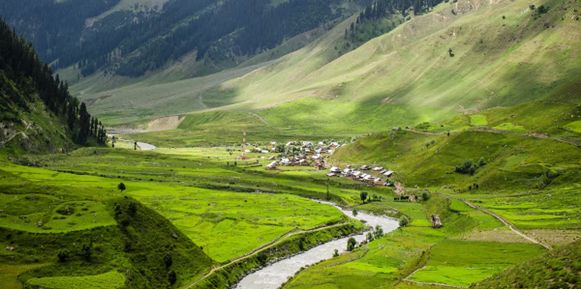


In Wardwan, even silence sings—the mountains hum lullabies, the rivers whisper legends, and the meadows bloom with memories that time forgot
Wardwan Madwa, nestled in a hush between towering pine-ribboned slopes of the Pir Panjal range, is not merely a region—it is an experience, a sanctuary carved by time and touched by grace. It sits as if in conversation with the clouds, cradled within folds of ancestral wisdom and wrapped in natural poetry. The valley unfurls like a sacred scroll of green pastures, alpine trails, and crystalline rivulets that whisper the hymns of ages long gone. Here, nature seems to breathe with purpose. Each sunrise bathes the meadows in light so soft it feels sentient, as if the sun pauses to admire its own reflection in the dewdrops hanging off wildflowers. These flowers—mustard yellows, orchid lilacs, and poppy reds—dot the landscape like brushstrokes from an artist in love with serenity.
Towering walnut and chinar trees stand silent, yet expressive, guarding the wisdom of centuries. The foliage responds to the wind with a rustle that evokes lullabies, while the rivers, some glacial-fed, sing with a language that transcends translation. Summer lends the valley a pastoral charm, with fields brimming with saffron and apple orchards ablaze in ripening fruit. But it’s in winter—when snow settles like whispered stories on rooftops and pine cones crackle underfoot—that Wardwan Madwa transforms into a realm both surreal and sacred, cloaked in white silence that elevates the soul.
Geography here is not just terrain—it’s testimony. The land speaks through its quiet formations: limestone ridges etched by time, mysterious caves where shepherds seek refuge, and boulders that carry ancient etchings no historian has yet deciphered. Seasonal migration trails cut through the land, telling tales of Gujjars and Bakarwals who traverse with their flocks, adding motion and purpose to an otherwise poetic stillness. Birds—a glorious medley of pheasants, bulbuls, and Himalayan snowcocks—swoop through the skies in choreography that rivals any concert hall performance.
With every season, the valley dresses in different moods: summer’s radiant embrace, autumn’s contemplative retreat, spring’s celebratory rebirth, and winter’s introspective grace. Even the air feels different here—not merely fresh, but infused with meaning. You can almost hear it speak if you pause long enough. Wardwan Madwa feels like a place that refuses to be rushed. It invites contemplation, not conquest. It does not ask to be explored; it asks to be felt.
The Spirit of the Valley: People, Heritage, and Timeless Harmony
Amidst this poetic wilderness dwell people whose souls mirror the landscape itself—resilient, gracious, and deeply rooted. The residents of Wardwan Madwa are not just keepers of land but stewards of legacy. Their lives are shaped less by ambition and more by quiet conviction, a commitment to simplicity that feels rebellious in today’s fast-paced world. There is a pastoral rhythm to daily life: homes constructed with timber and stone, kangri fires warming hearts and hands, and conversations flowing as gently as the nearby streams. Hospitality here is woven into the marrow of existence. To walk into a Wardwan home is to be greeted with a generosity untouched by urban transaction—a cup of noon chai, a plate of makki roti, and eyes that smile with sincere welcome. The people speak in dialects laced with poetic undertones, their words echoing centuries of storytelling. Elders narrate tales of mountain spirits and ancestral migrations with a voice that can soften storms. Their wisdom does not just educate; it enfolds.
Agriculture and pastoralism remain the heartbeat of livelihood, yet there is no absence of pride in their simplicity. Terraced farms grow maize, pulses, and herbs used both for sustenance and healing, while sheep and cattle dot the highlands, watched over by children who know the land better than any mapmaker. Cultural expressions here are powerful but subtle—traditional songs that mourn lost seasons or celebrate village weddings, handicrafts that echo the valley’s flora, and clothing stitched not only with thread but with identity.
There are schools that nurture knowledge with reverence and mosques where faith is practised with humility rather than spectacle. Modernity knocks gently, and the people respond—not with fear, but discernment. Solar panels now power rooftops that once relied solely on moonlight. Smartphones exist, yes, but they are used less for scrolling and more for connecting—whether it’s children taking photos of snowfall or mothers video-calling sons who study abroad. Youth here embrace education and opportunity, but they carry the valley inside them—a moral compass shaped by mountain paths and grandmother’s prayers.
Women in Wardwan Madwa are the valley’s quiet power. They manage households, teach children, tend fields, and preserve traditions. Their voices are often gentle, but their influence is immense. Festivals like Eid and Herath bloom with joy and unity, where music and food become shared language. And even those who’ve left the valley for bigger cities return, not just for nostalgia, but to reconnect with something essential. There’s a belief here—that nature heals, that simplicity sustains, and that beauty lives not in things, but in moments.
As dusk falls, and prayer calls echo across misty ridges, Wardwan Madwa doesn’t just quiet down—it deepens. It becomes a portrait of life lived in harmony: with earth, with history, and most importantly, with one another. In a world frenzied by noise and novelty, Wardwan Madwa stands like a poem written in silence—waiting not to be read, but remembered.
The writer is a PhD scholar in political science
Dr Adil Gulzar Magloo
dr************@***il.com