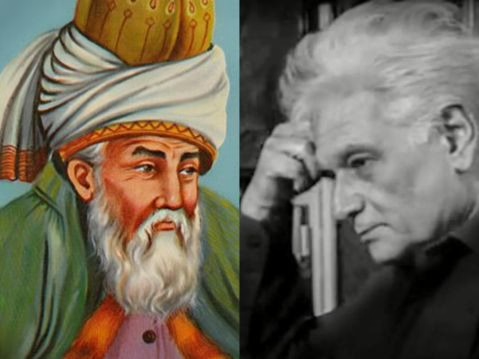


When modern philosophy traps meaning in language, Sufi mysticism points to the heart’s awakening
Throughout the history of philosophy, various ideas have emerged that challenge traditional concepts of meaning, truth, and reality. In the latter half of the 20th century, French philosopher Jacques Derrida introduced one such theory, known as Deconstruction. According to this philosophy, no text, statement, or piece of writing carries a fixed or absolute meaning. Instead, every reader interprets it according to their own understanding, background, and environment.
For Derrida, truth and reality have no permanent, absolute form. Whatever we call ‘truth’ exists only within the text and in its interpretation. His famous assertion, “There is nothing outside the text”, suggests that no ultimate meaning or truth lies beyond the written word. As a result, under the framework of Deconstruction, meaning is always shifting, and it is impossible to agree upon any final, definitive interpretation.
Within this perspective, even an author’s intention or objective becomes irrelevant. Derrida maintains that once a text is placed before a reader, its meaning is shaped by the reader’s understanding, not by what the writer originally meant to convey.
This concept stands in sharp contrast to the intellectual tradition of the East, especially to the teachings of Mawlana Jalal-ud-Din Rumi (RA) For Rumi, the source of meaning and truth is not human intellect or individual interpretation, but the awakening of the heart and spiritual enlightenment. He wrote:
Translation:
“Each person befriended me according to their own perception,
Yet no one sought the secrets of my heart.”
(Masnavi-ye Ma’navi, Book 1, Couplet 31)
For Rumi, the discovery of meaning does not depend on a reader’s surface comprehension but on the illumination of the heart, a spiritual journey, and inner wisdom. He believed that the true meaning behind words is not revealed to everyone ….. it is granted to those whose hearts are awakened.
While Deconstruction views truth as a relative, shifting play of language and signs, Rumi regards it as an absolute, unchanging reality. It is not something that appears through arbitrary interpretations but manifests in the mirror of one’s inner self. He reminds:
Translation:
“Not everyone can grasp the secret of Truth,
Only the heart of a lover awakened by Divine love can perceive it.”
Derrida also argued that language, by its nature, invites ambiguity and contradiction. Words can never fully capture a fixed, final meaning. Every sentence leads to another interpretation, causing meaning to endlessly defer. Rumi recognised this limitation long before modern philosophers, cautioning:
Translation:
“Many embellish their words with eloquence,
So that the true meaning drifts further away from Truth.”
(Masnavi-ye Ma’navi, Book 2, Couplet 2074)
One of the foundational ideas of Deconstruction is that meaning is never fully settled. Every meaning hints at another, creating an endless chain of deferrals — a process Derrida famously termed ‘Différance.’
In contrast, Rumi offers a way out of this intellectual entanglement. He declares:
Translation:
“If you understand the words but fail to grasp the meaning,
You are like a donkey circling a dome, never reaching its centre.”
And this is the essential difference. Deconstruction entangles thought in an endless play of words, drawing it further from truth. Rumi’s teachings, however, open the door to truth only when the eye of the heart awakens, allowing the seeker to perceive reality illuminated by divine insight.
For Rumi, not every interpretation is valid. The true meaning is revealed through spiritual awakening and inner clarity. He believed that the secret of truth cannot be unlocked by superficial reasoning alone, but is attained through mystical experience and a heart kindled with Divine love.
In essence, Deconstruction’s philosophy distances human consciousness from truth, trapping it in linguistic games. In contrast, Rumi’s message urges humanity to recognise ultimate reality through the inner light of the heart. In today’s world of intellectual crisis and civilizational confusion, this message has become even more relevant.
Rumi’s simple yet profound lesson remains:
Translation:
“When the heart is awake, one can
Glimpse the truth in every utterance.”
The writer is a teacher
Rather Nasir
nk*************@***il.com