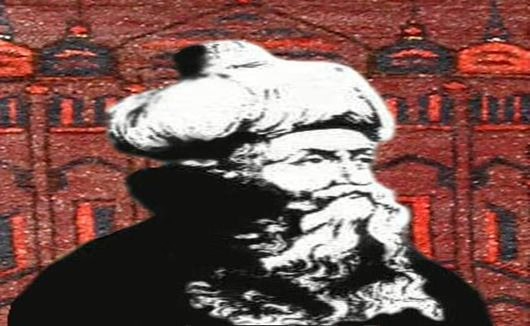


Exploring the profound influence and controversial legacy of Ibn Arabi, whose doctrine of ‘Wahdat al-Wujud’ continues to resonate and provoke debate across cultures and generations
Ibn Arabi is one of the most complex and influential figures in Islamic history, if not in human history at large. His profound ideas have cemented his reputation as one of the most important thinkers in the Islamic intellectual tradition.
To his admirers, he is revered as Shaykh al-Akbar (The Greatest Master), one of the greatest saints and spiritual authorities in Islamic history. To his detractors, however, he remains a deeply controversial figure, even a dangerous heretic. This division stems from his intricate and fascinating metaphysical and cosmological ideas, particularly his doctrine of Wahdat al-Wujud (Unity of Being). These ideas not only shaped his time but continue to inspire and provoke debate among scholars and mystics to this day.
Ibn Arabi was born in 1165 in the city of Murcia, located in present-day Spain. During his time, this region was part of Al-Andalus, a hub of intellectual, cultural, and mystical activity. The 12th century was a golden age for Islamic scholarship in Al-Andalus and North Africa, producing renowned philosophers, scientists, and mystics. Ibn Arabi’s upbringing was shaped by this vibrant intellectual and spiritual environment.
Born into an aristocratic family, he had access to quality education and some of the most influential thinkers of his time. Among them was the famous philosopher Ibn Rushd (Averroes), with whom Ibn Arabi reportedly had a notable and symbolic encounter. His era also boasted great minds such as Ibn Tufail, Ibn Bajjah, and the Jewish philosopher Maimonides, as well as mystics like Abu Madyan and Ibn Barrajān. These individuals profoundly influenced the young Ibn Arabi, shaping the unique intellectual and spiritual synthesis that characterized his later works.
Ibn Arabi’s teachings and writings quickly spread across the Islamic world after his death in 1240. His influence extended from North Africa to the Middle East and from the Balkans to Southeast Asia. His ideas were carried by Sufi orders and became deeply embedded in Islamic societies’ cultural and intellectual fabric.
His teachings also found a place in Persian, Turkish, and Urdu literary traditions. Many great poets, including Rumi and later South Asian mystics, were inspired by his ideas, incorporating his concepts into their poetry. This widespread influence ensured that Ibn Arabi’s name became synonymous with the heights of Islamic mystical thought, even as his ideas continued to spark debate and controversy.
At the heart of Ibn Arabi’s philosophy is the concept of Wahdat al-Wujud, or the Unity of Being. This doctrine asserts that all existence is fundamentally one, with God as the ultimate reality from which all things emanate and to which they ultimately return. For Ibn Arabi, God is not only the creator but the very essence of existence itself. Everything in the cosmos is a reflection or manifestation of the divine.
This idea was revolutionary and controversial. To Ibn Arabi’s followers, it represented a profound understanding of the relationship between the Creator and creation, emphasizing the unity underlying all diversity. To his critics, however, it bordered on pantheism, as it seemed to blur the distinction between God and the world.
Ibn Arabi expressed these ideas with remarkable depth and subtlety, often using poetic and symbolic language. His works explore the interplay between the divine and the human, the eternal and the temporal, and the seen and unseen realms.
Major Works of Ibn Arabi
Ibn Arabi was a prolific writer, and his literary output remains unparalleled in its scope and depth. Some of his most influential works include:
- Fusūs al-Hikam (The Bezels of Wisdom)
One of Ibn Arabi’s most famous and influential works, this book explores how 27 prophets, from Adam to Muhammad, embody specific divine attributes and wisdom. Drawing heavily on Quranic verses and Hadith, the Fusūs is a synthesis of theology, philosophy, and mysticism, offering profound insights into the nature of prophecy and divine wisdom.
- Al-Futūhāt al-Makkiyya (The Meccan Openings)
This monumental work is an encyclopedic treatise on metaphysics, theology, cosmology, and spirituality. It delves into topics such as the inner meanings of Islamic rituals, the spiritual journey to God, the hierarchy of the cosmos, and the esoteric significance of the Arabic alphabet. The Futūhāt is considered one of the most comprehensive works of Islamic mysticism ever written.
- Tarjumān al-Ashwāq (The Interpreter of Desires)
A collection of love poetry inspired by Ibn Arabi’s encounter with Nizam, a learned and gifted woman from Isfahan, during his pilgrimage to Mecca. These poems celebrate divine love and the beauty of creation, blending the personal and the universal. Ibn Arabi later provided a commentary on these poems to clarify their spiritual meanings.
For Ibn Arabi, the ultimate goal of the spiritual path is to realize one’s connection to the divine. This realization is rooted in love, which he sees as the essence of existence. Love, for Ibn Arabi, is both a divine attribute and a human experience, bridging the gap between God and creation.
He famously described love as “knowledge tasting,” emphasizing that it can only be truly understood through direct experience. Like Wahdat al-Wujud, love is indefinable yet universal, a reflection of the divine in the human heart.
Despite his immense influence, Ibn Arabi’s ideas have always been controversial. Some scholars and religious authorities accused him of heresy, arguing that his teachings blurred the line between the Creator and creation. Others criticized his symbolic language, which they believed could lead to misinterpretation.
His philosophy spread extensively through Sadr al-Din al-Qunawi and later reached India, where it interacted with Vedanta traditions, sparking inter-religious dialogue. In India, figures like Akbar and Dara Shikoh were deeply influenced by his concept of unity of being.
Ibn Arabi remains one of the most challenging yet monumental thinkers in mysticism, with his works continuing to inspire and intrigue scholars and spiritual seekers to this day. His insights into existence, love, and the divine continue to resonate across cultures and generations.
His teachings remind us of the unity underlying all diversity and the infinite potential of the human spirit to reflect the divine. Through his writings, Ibn Arabi invites us to witness the interconnectedness of all things and to recognize the divine presence in every aspect of existence.
The writer is a freelance journalist. He holds a degree in Mass Communication and Journalism from the Kashmir University.
Umar Hayat Hussain
uh*****@***il.com