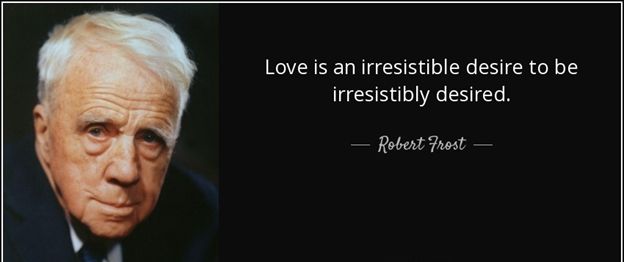


Love is an irresistible desire to be irresistibly desired: Robert Frost
Love, the most commonly used word, is unfortunately a limitedly understood concept. It is an emotion that is very central to human existence. It is a feeling with varied kinds of manifestations. It is healing and cathartic all at once. Different people experience and express it differently. In addition to this, it is one of the most romanticised emotions in popular culture, art, literature or any kind of creative enterprise. It is usually defined as a feeling shared by two adult persons for one another. This feeling shared by two opposite sexes is usually termed infatuation, lust or crush in the modern sense. In this context, it has acquired carnal connotations, implications and lustful purport. The love purporting lust and infatuation mostly proves lethal and ends in heartbreak.
Shakespeare in his most famous love tragedy ‘Romeo and Juliet’ says that ‘Love is a smoke made with the fume of sighs; being purged, a fire sparkling in lover’s eyes; being vexed, a sea nourished with lover’s tears; what is it else? A madness most discreet, a choking gall, and a preserving sweet. The love that we come across in literature books, dramas, and mythologies is usually of two opposite sexes who peak and pine for one another to actualize and fructify their vows, promises and mutual agreements. In most of the cases, lovers fail to reach the successful end. In this case, we have an ample number of prototype examples in the literature where lovers fail in their purpose. For example; Frahad fails to meet Shireen, Majnoo fails to get Laila, and Romeo-Juliet dies in heartbreak when they drink poison to say goodbye to their vicious families; the families that are engaged in long-drawn blood feud. This kind of love is usually shown through the lens of romance and excessive feelings. Besides this, lovers involved in such kind of love are all ‘star-crossed lovers’ for they never get what they intend and hope to get.
Love is not only what one person holds for another person. Our idea of love has always been limited by slotting it into romance and lusty sentimentalism. The commercialisation of love as the most sellable emotion has also made it performative to a very large extent. We fail to account for platonic relationships, friendship, loving oneself or parents. Love is a spectrum of emotions that run free and fluid, and we have as a society tried to shrink it into moulds that we feel are right.
But, love is beyond these carnal connotations, definitions, and romanticized versions as well. We have parental love for children and vice versa. We have a love that is shared by siblings for one another and we have love shared by neighbours for each other, and we have a ‘platonic concept of love’ advocated by the greatest philosopher Plato. In all these categories of love, there is no presence of carnality. Such kinds of love are based on the bedrock of mutualism, regard, respect, sympathy, empathy, and a sense of belonging, etc. Love is also a kind of strong passion to do something for perfection and self-sacrifice. Keeping these notions in mind, we must refrain ourselves from pigeonholing the term into the limited meanings of carnality and crush. Thereby hangs a tale!
Postscript: Love is not only something you feel; it is something you do. David Wilkerson
The writer has done PhD in English from AMU. Besides this, he has qualified UGC-NET and JKSET in English for Assistant Professorship. He can be reached at bi***********@***il.com