

An in-depth exploration of challenges, strategies and collaborative efforts in the fight against apple scab
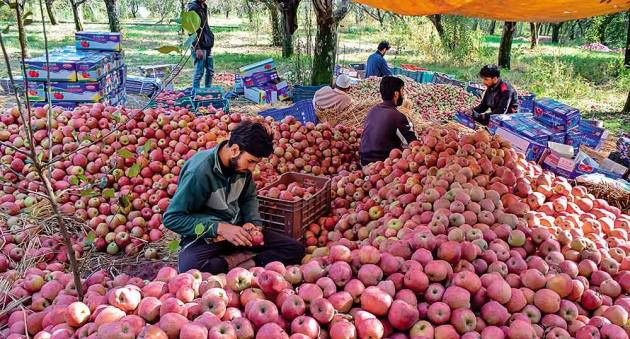
“Apple” one of the most important fruits of J&K holds significant cultural and economic value. Directly or indirectly half of the J&K population is involved in the cultivation or trade of apples. Kashmir’s apple industry is not just a source of income but a way of living for the residents. Providing a core means of earning to the growers and contributing significantly to the local economy, it would not be so exaggerated to say that the region’s prosperity is presently hanging in the balance. The orchardists are facing several challenges which in turn prevent the apple industry from realizing its full potential. Among these issues, disease epidemics particularly apple scab pose the most formidable obstacle.
Apple scab, caused by the fungus Venturia inaequalis, is one of the most important devastating diseases of cultivated apples worldwide including Kashmir. Apple scab causes a significant economic loss each year by degrading both fruit quality and yield. If the disease control measures are not sufficiently done, the loss in the economy can increase by up to 70% of the production value and will continue increasing if no adequate control measures are adopted. The disease is seen more severe in apple growing districts which have cool, wet weather in spring and high summer rainfall. Apple scab attacks foliage, blossoms and fruits; resulting in the defoliation of trees and making the fruits unmarketable. The most visible and severe symptoms of apple scab occur on leaves as dark green velvety spots, and on fruits as green to olive-brown lesions close to the blossom end.
The fungus overwinters predominantly as pseudothecia (sexual fruiting bodies) following a developmental stage on apple-dead fallen leaves of the previous year. The sexual spores (ascospores) start maturing in early spring at the green tip stage when temperature and moisture are suitable. Further, during the rainy season, these spores are released forcibly into the air and are carried by the wind (up to 200m) to newly emerging leaves and fruits of healthy trees. Free moisture on the leaf surface is absolutely necessary for spore germination and further development of the fungus depends on the temperature and the duration of leaf wetness. Once primary infection occurs, secondary spores (conidia) are formed, allowing a tree to continually reinfect it or neighbouring trees as long as environmental conditions are favourable.
Around the globe, wherever the apple is cultivated, the scab causes a huge loss to the apple industry. These unfavourable losses necessitate immediate attention to have an ideal system or plan that can help in reducing these losses and at the same time should be acceptable at the grower’s level. A well-Integrated Disease Management (IDM) approach is usually planned to achieve long-term effectiveness, with acceptable affordability, and minimal environmental disruption. IDM includes methods that are used in conjunction and are more likely to be effective at controlling disease than dependence on a single technique, such as calendar-based pesticide spraying. These methods also help in reducing the development of fungicide resistance, usually seen as the biggest drawback of spraying. The IDM approach could be utilized via the following discussed framework:
Cultural control methods
Standard cultural and sanitary practices are used to reduce scab infection such as leaf shredding, flail mowing, burning or burying leaves in the soil which help to discourage the development of associated fungus. The utilization of 5% urea application when apple leaves exhibit 15-20% yellowing or leaf fall serves the purpose of eliminating leaf litter and the scab pseudothecia they harbour and tends to effectively reduce scab risk by 50-66%. This agricultural practice promotes the growth of saprophytic microorganisms in the soil, thus enhancing litter decomposition.
Selecting sites that provide more than six hours of sunlight per day, spacing trees adequately, and following proper pruning practices for the proper sunlight penetration and air circulation in the canopy and between trees speeds up the drying of leaves and fruit for the prevention of scab development.
Host plant resistance
It is essential to grow varieties that are more resistant to apple scab diseases and other pests. Among the important apple varieties cultivated in Kashmir, Shireen Firdous and Akbar stand out for their excellent resistance to scab. Other scab-resistant cultivars such as Freedom, Jonafree, Liberty, Prima, Priscilla, Macfree, Florina, and Pioneer are important choices for apple growers in different regions.
Biological control methods
Several studies have identified different antagonistic agents to manage Venturia inaequalis such as Microsphaeropsis ochracea, which occurs naturally on dead and isolated leaves and acts as a good antagonist of Venturia inaequalis. In addition, the earthworms, Lumbricus terrestris are found as main natural biological agents which help in removing dead fallen leaves from orchard floors in winter and early spring. Some strains of Trichoderma longibrachiatum also found antagonistic towards Venturia inaequalis, decreasing ascospore production from naturally infected leaves.
Chemical control method
On susceptible apple cultivars, apple scab is primarily managed through the application of fungicides. Regular and well-timed fungicide sprays have proven to be the most practical means of controlling scab.
Following weather-based monitoring systems in spray schedule, can help in reducing the number of sprays and improve the accuracy of application timing. These approaches not only reduce the input costs but also enhance profit for growers.
A diverse range of fungicide chemistries are available for the management of apple scabs such as contact fungicides; forming an external barrier on the plant surfaces. However, they are typically not rainfast (they wash off readily with rain) and do not translocate through plant tissue. Systemic fungicides, in contrast, penetrate epidermal tissue and can translocate within plant tissue. These sprays are more rainfast than contact fungicides and usually have longer reapplication intervals. Both contact and systemic fungicides are commonly used sprays in Kashmir to control the scab and its impact.
Annually, the Horticulture department frames a spray schedule tailored specifically to the Kashmir valley, considering the region’s normal weather conditions. Fungicides are best applied prior to rainfall, and in case of a missed application, it is advisable to spray it within 3 to 4 days after rainfall. To improve the efficacy, adjuvants/stickers may be added to fungicides, especially during rainy days. In scab-prone areas, 12-14 days intervals should be maintained between the sprays up to the primary scab stage. A few important tips every grower should consider include: not using over or sub-lethal doses of pesticide, not spraying pesticides during the full bloom period, maintaining a gap of 3 to 4 days between insecticide and fungicide spray and avoiding mixing fungicides, insecticides and spray suspensions other than those recommended by SKUAST-K.
To sum up, the battle against apple scab remains a crucial concern for apple growers and enthusiasts alike. The use of well-timed fungicide applications, informed by weather monitoring systems plays a pivotal role in managing this persistent threat. Managing apple scabs involves obvious costs, but the investment in disease control pays off. Coming up with innovative sustainable practices via research collaborations, and government support is key to preserving the region’s apple heritage. Together, we can safeguard this cherished legacy for years to come.
Sayima Nargis is an M.Sc. student (Division of Plant Pathology) at SKUAST-K Shalimar, Srinagar. She can be reached at wa***********@***il.com