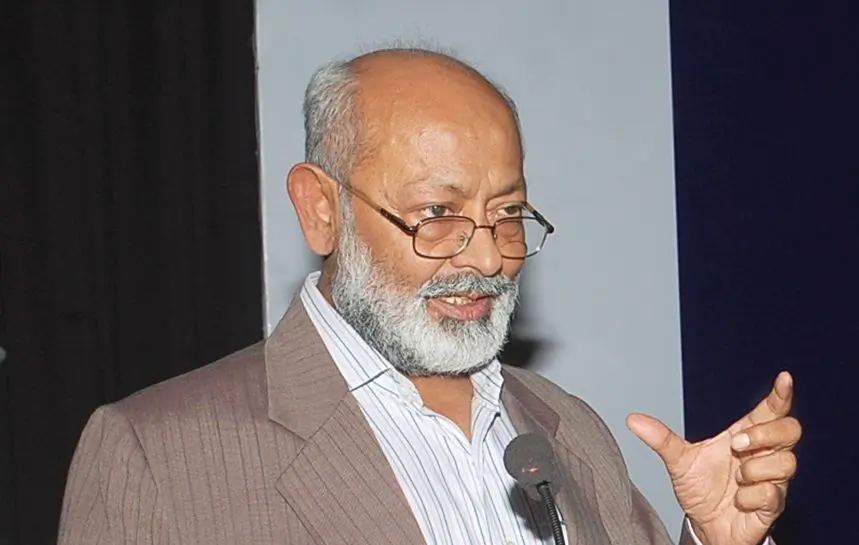
His 2004 letter to the US President George Bush combined scholarly insight with a moral plea for responsible global leadership
By Prof Hamid Naseem Rafiabadi
Dr Mohammad Manzoor Alam, a distinguished scholar and Chairman of the Institute of Objective Studies (IOS) in New Delhi, has been widely recognised for his insightful contributions to contemporary socio-political thought and Islamic scholarship. Among his numerous engagements, one notable instance that reflects his commitment to justice and global ethical responsibility is his letter addressed to President George W. Bush of the United States. This letter, sent on November 27, 2004, and delivered to the White House on November 30, 2004, highlights Dr Alam’s deep concern for the responsible use of American power, particularly in regions like Afghanistan and Iraq, and his advocacy for fairness in international relations. Despite the significance of his appeal, no response was received from the White House until February 3, 2005.
In his letter, Dr Alam first congratulated President Bush on his reelection, acknowledging the immense power and influence vested in the office of the US President. He emphasised that the President possesses the unique ability to shape the world either for the better or, regrettably, for the worse. Motivated by a sense of moral and civic responsibility, Dr Alam expressed his apprehensions regarding the exercise of American power and the broader implications of US foreign policy.
Dr Alam highlighted that, traditionally, the United States had not been perceived as a colonial power, especially in Asia, including the Indian subcontinent and West Asia. Unlike the European colonial powers, America was historically seen as a nation guided by principles of justice, fairness, and respect for sovereignty. However, Dr Alam expressed concern that recent developments had begun to alter this perception. The US military interventions in Afghanistan and Iraq, coupled with reports of excesses at Abu Ghraib, Najaf, and Fallujah, were seen as departures from the ideal of an America that respects the international rule of law and promotes a just global order. He drew historical parallels with tragic incidents such as My Lai in Vietnam and Wounded Knee in America’s formative years to underscore the gravity of these actions.
The central question posed by Dr Alam was whether the United States, a nation historically averse to colonialism, was now adopting policies reminiscent of colonial powers. He asked whether America intended to reassert itself as a colonial force at a time when the world had assumed such practices belonged to a bygone era. This question reflects Dr Alam’s careful observation of international affairs and his unwavering commitment to justice, grounded in ethical and moral reasoning.
Beyond critiquing American military interventions, Dr Alam also addressed concerns regarding the Israeli-Palestinian conflict. He acknowledged the US administration’s promise to establish an independent Palestinian state within four years. While welcoming this declaration, he raised critical questions about the substance and credibility of such promises. He pointed out that the prospective state might be demilitarised, lack contiguous territory, have borders controlled by Israel, and deny Palestinians the right of return to their homes. Dr Alam’s measured concern was whether this state would genuinely serve the interests of the Palestinian people or merely function as a symbolic gesture. He urged that any resolution to the Palestinian issue should be just and in line with the principles of fairness that the international community, including the United States, professes to uphold.
A notable dimension of Dr Alam’s appeal is his appeal to shared moral and religious values. He recognised President Bush as a religious-minded individual and invoked the broader Abrahamic tradition shared by Muslims, Christians, and Jews. He reminded the President of the Quranic guidance that calls for justice and dialogue among the “People of the Book”: “Say: ‘O People of the Book! Come to common terms as between us and you: That we worship none but God.'”
Dr Alam emphasised that justice is an essential component of power and that those blessed with influence bear a responsibility to uphold fairness in all their actions. He implored President Bush to ensure that the weak are not deprived of their rights, reinforcing the ethical foundation upon which international relations should be conducted.
Dr Alam’s letter reflects not only his global outlook but also his unwavering commitment to human rights, moral responsibility, and ethical governance. It demonstrates his understanding that scholarly insight must be accompanied by practical advocacy, particularly in matters that affect vulnerable populations and global peace. Through his careful articulation, Dr Alam sought to engage directly with one of the most powerful individuals on the planet, urging him to act with compassion, fairness, and foresight.
The significance of this letter lies in its blend of scholarly insight, ethical reasoning, and diplomatic tone. It was not merely a critique of U.S. foreign policy but an appeal to shared human values and moral responsibility. Dr Alam’s approach exemplifies a principled form of engagement, where intellectual discourse and moral persuasion converge. By addressing both immediate political concerns and broader ethical imperatives, he provided a model for constructive dialogue between civil society leaders and global policymakers.
Dr Mohammad Manzoor Alam’s broader contributions extend beyond this correspondence. As Chairman of the Institute of Objective Studies, he has consistently advocated for research, education, and social reform grounded in ethical principles. His work emphasises dialogue, intercultural understanding, and evidence-based scholarship. By hosting interactive sessions with scholars from around the world, including Americans, he has sought to foster mutual understanding, bridge cultural divides, and promote informed discussion on global issues. His leadership demonstrates the critical role that scholars and civil society leaders play in shaping international discourse and advocating for justice.
Furthermore, Dr Alam’s scholarship is marked by a careful balance between critique and constructive engagement. While he raises critical questions about power, policy, and justice, he also offers pathways for reconciliation, dialogue, and improvement. His engagement with President Bush exemplifies this approach: it is firm in its concerns but respectful in tone, emphasising shared values and ethical responsibility. This style of advocacy reflects the broader ethos of the Institute of Objective Studies, which aims to combine rigorous research with practical relevance and moral guidance.
Dr Alam’s letter also highlights the importance of accountability in global leadership. By addressing issues such as military excesses, human rights violations, and the fairness of political solutions, he underscores the principle that power must be exercised responsibly. This concern resonates not only within the context of U.S. foreign policy but also in the broader discourse on governance, justice, and international relations. It serves as a reminder that scholars and civil society leaders have a vital role in holding powerful actors accountable and advocating for policies that uphold human dignity and ethical standards.
In conclusion, Dr Mohammad Manzoor Alam’s correspondence with President George W. Bush, alongside his regional and global engagements, is a compelling example of principled scholarship applied to real-world challenges. Through his letters, interventions, and leadership, Dr Alam articulated concerns regarding the responsible use of power, the pursuit of justice, and the ethical obligations of leaders. He combined historical insight, ethical reasoning, and a commitment to human rights to produce actions and writings that are both intellectually rigorous and morally compelling. His appeal to shared Abrahamic values and his dedication to education, relief, and social justice further reinforce the universality of his message.
Dr Alam’s life and work continue to inspire scholars, policymakers, and civil society leaders alike. His dedication to justice, ethical governance, intercultural dialogue, and humanitarian intervention provides a model for responsible leadership in an interconnected world. By engaging thoughtfully with global power structures while advocating for fairness and compassion, Dr Mohammad Manzoor Alam has cemented his legacy as a scholar, advocate, and champion of justice whose insights remain deeply relevant to contemporary global and regional challenges.
—Dr Hamid Naseem Rafiabadi (also known as Dr Hamidullah Marazi) is a distinguished contemporary Islamic scholar whose work significantly contributes to the dialogue between Islamic philosophy and modern Western thought. He is the author of several books. Through a rigorous comparative methodology and an emphasis on epistemological integrity grounded in Tawhid (the oneness of God), Marazi critiques secular paradigms and advocates for an integrative intellectual tradition. His scholarship not only critiques Western thought but also calls for mutual enrichment between traditions, emphasising Islamic metaphysics, ethics, and educational reform as central to contemporary challenges.
ha**********@***il.com