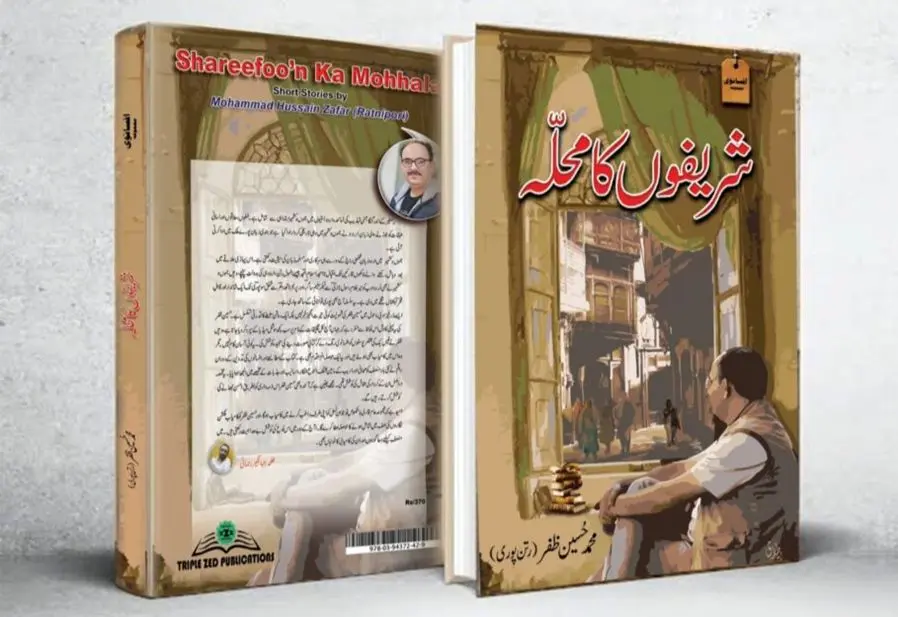


Through poignant stories and deep cultural insights, Zafar Sahib’s work underscores the importance of humility, moral character, and familial love, inspiring readers to honour their past while striving for a meaningful future
By Bashir Ahmad Dar
“Shareefoo’n Ka Mohhala” (The Clan of Decents) is not just a book; it is a masterpiece by Hussain Zafar. The author has poured all his energy and knowledge into creating this work. Every word is thoughtfully placed and carries a message of its own. The book touches upon nearly every aspect of life — economic, social, and, of course, political. In his Intesaab (Dedication), the author breaks stereotypes by dedicating the book, in the final line of the attribution, to all those whom he may have hurt, whether intentionally or unintentionally.
Likewise, in the Taaruf (Introduction) section, the author touches upon a common superstitious belief held by many, particularly in our part of the globe, that the number three is a heavy and ill omen. It is a harbinger of misfortune and ill will. Yet, the very first, rather casual, reading of the book gently shatters this long-held notion, as the author mentions that he was the third son of his parents and would always stand third in class. Had the number three truly been unlucky, he could not have achieved such academic success. This serves as the first positive resonance a reader may draw from the author’s work — the initial ripple of its uplifting influence on the reader’s mind.
Born and raised in Rantipora, Pulwama, and later having moved to Srinagar, first for studies and then for work, Mr Hussain Zafar, the author, is well-acquainted with both village and city life. Since it is not possible within the limited space of this write-up to discuss everything he has expressed in his book, I have chosen to reflect on one of its multi-layered, lesson-bearing chapters titled “Phavda” (translated as Shovel).
The Phavda in the story carries a figurative meaning. At the outset, this simple tool symbolises the primitive yet pure village life and highlights its significance in the daily existence of a village farmer. However, as the story progresses, its meaning deepens. By the end, the Phavda comes to represent Salman himself, who, despite rising to the rank of an IAS officer purely through merit, never forgets his roots and remains deeply connected to the soil.
In the story, a village boy named Salman from district Baramulla passes his matriculation examination and gains admission to a higher secondary school in the bustling town of Baramulla. However, his deeply religious and caring father, who had raised him in a purely spiritual environment, grows concerned about his son’s moral integrity. Fearing that Salman might lose himself in the tempting yet deceptive life of the town, and to prevent him from doing so, the father gives him a shovel and asks him to get it repaired at the ironsmith’s shop. This episode repeats for several days until, finally, the ironsmith, somewhat exasperated, tells Salman to ask his father to come himself and explain what exactly he wants to be done with the shovel.
The boy does take the shovel to the ironsmith multiple times, but deep down in his heart, he hates it. His mother and sister share the same feeling. But neither Salman nor his mother nor his sister can muster the courage to tell the father not to burden Salman with the shovel.
The story beautifully conveys multiple messages to those willing to listen, such as advising us to remember our roots, no matter how successful we become or how far we go in life. It reminds us to honour those who sacrificed their comfort and strength, who “spent themselves and consumed every inch of their being”, just to see us grow and rise. At the same time, the story serves as a gentle but powerful reminder to parents. It urges them to take utmost care while raising a child because a child of today is the leader of tomorrow. It teaches us that a child is the father of a man. Providing children with bread, butter, and shelter is not enough; rather, nurturing a strong moral character is the foremost duty of every parent.
The story frames parental guidance not as harsh control but as wisdom born from selfless love. In a “tough and showy world,” parents are portrayed as the unwavering anchors of genuine care, making their guidance worthy of trust and obedience.
The story strongly teaches children to stay humble and embrace humility. It urges them to remain obedient to their parents, for parents are the most selfless souls in this tough and showy world. It guides children to stay focused on their goals. Most importantly, it counsels them to build a strong moral character.
Moral character is the foundation. The story argues that achievements without character are hollow. Success is given meaning by the humility, obedience, and spiritual grounding that Salman maintains. The author delivers a powerful message when he paints a picture of Salman in the concluding part of the story, in which Salman, who, despite becoming an IAS officer, carries the shovel with all humility and teary eyes. It was no longer a burden for him but a symbol of the trust his father had shown. Salman remained humble, obedient, and spiritually grounded, so should every child be.
Elsewhere in the story, Salman looks at his mother and sister with hope, expecting them to persuade his father to desist from troubling him by making him carry the shovel to and from the ironsmith every day, lest he should fall victim to an inferiority complex. But both the mother and daughter lower their gaze in helplessness. Here, Hussain Zafar brutally exposes the patriarchal nature of our society, where men exercise power and authority, while women have little say, even in important family matters. This truth is as painful as it is real.
By having the mother and sister lower their gaze, Hussain Zafar isn’t portraying them as uncaring; instead, he illustrates their “helplessness” within a patriarchal structure. Their silence is not consent to the father’s method; it is a silent acknowledgement of their limited agency in challenging the male head of the household on a matter of his son’s upbringing.
It shows that even in loving families, dynamics of power and silence can exist, and valuable lessons are sometimes delivered through harsh, unequal structures.
The emotional climax of the story arrives when Dr Salman, now a triumphant IAS officer, still cherishes the humble shovel with grateful, teary eyes and a contented heart. The climax shows that true success isn’t about forgetting your roots. It is about honouring the struggles and the people who shaped you. With time, the humble shovel transforms from a tool of labour into a “symbol of trust.” It becomes a priceless heirloom of his father’s love and lessons. The climax teaches us that the ultimate achievement for a person like Salman is not to become a different person, but to become a version of himself that his father and his own past self would be proud of. The shovel is the bridge between the boy he was and the man he became. It is a powerful reminder that our roots are not chains holding us back, but the very foundation that gives us the strength to reach great heights.
Zafar Sahib’s book “Shareefoo’n Ka Mohhala” is indeed a treat to read. I give the author five stars for compiling this book, which is simple, easy, and to the point. I highly recommend this book to everyone willing to learn not only about our own culture but also to imbibe political insight.
The writer is a teacher da**************@***il.com