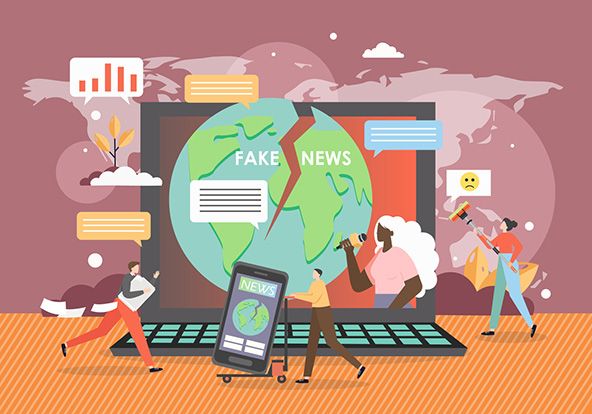


In a world flooded with misinformation and sensationalism, developing the skill to analyse, question, and evaluate is essential for personal growth, democratic health, and societal progress
By Dr Sabzar Ahmad Bhat
Today, we see a huge amount of information every day through social media, fast news, and viral posts. But how much of this information is true, complete, and fair? To understand what is real and what is not, we need one important skill: critical thinking.
What Is Critical Thinking?
Critical thinking, as defined by the Merriam-Webster Dictionary, is: “The act or practice of thinking critically (as by applying reason and questioning assumptions) to solve problems, evaluate information, discern biases, etc.”
At its core, critical thinking is not about passively accepting information. It involves actively engaging with ideas—asking questions, verifying facts, considering multiple perspectives, and reflecting before arriving at conclusions. It is a disciplined process of thought that demands clarity, accuracy, relevance, fairness, and depth.
The ancient Greek philosopher Socrates famously stated: “The unexamined life is not worth living.” Socrates championed the practice of questioning—challenging assumptions and probing deeply into concepts of justice, truth, and virtue. This legacy, known today as the Socratic method, remains a foundational approach for developing logical and reflective thinking.
Why Critical Thinking Is More Important Today
Modern media often prioritises sensational headlines to capture attention rather than delivering the nuanced truth. Consider a headline like: “Teen becomes millionaire overnight using secret app!” At first glance, it may seem impressive. Yet, upon closer examination, we might learn the teen received significant funding after years of effort. The headline, while technically correct, omits crucial context, which could potentially mislead the reader.
This is where critical thinking becomes vital. It enables us to ask:
- Is this the full story or just a fragment?
- Can the source be trusted?
- What information is missing or intentionally excluded?
Francis Bacon, the father of empiricism, warned against uncritical reading: “Read not to contradict and confute, nor to believe and take for granted… but to weigh and consider.”
In an age of misinformation, conspiracy theories, and echo chambers, critical thinking acts as a safeguard, empowering individuals to discern truth from distortion.
A Timely Warning From Ravish Kumar
In his powerful book The Free Voice, journalist Ravish Kumar writes: “Fake news first falsified news and journalism, and it is now turning the citizens fake. The robo-public is a fake public. A fake public makes a fake republic, a fake political consciousness, a fake democracy.”
He goes on to call social media-driven propaganda machines like WhatsApp University the “biggest laboratory for fake news,” where people are fed distorted narratives to manufacture consent and vilify dissenters. This underscores how critical thinking is not just a personal virtue—it is a defence against the manipulation of democracy itself.
Six Practical Steps To Develop Critical Thinking
To foster critical thinking as a daily habit, consider these six actionable strategies inspired by MDeOswald:
- Question Everything
Don’t accept statements at face value. Ask Why? and How? to uncover deeper meanings.
- Embrace Diverse Perspectives
Engage with people from varied backgrounds and viewpoints to challenge personal biases.
- Practice Reflective Thinking
Regularly review your decisions and thought processes. Learn from successes and mistakes.
- Prioritise Evidence Over Emotion
Base conclusions on facts and data. Avoid decisions rooted in impulse or prejudice.
- Stay Open-Minded
Be curious and ready to revise beliefs when new evidence appears.
- Encourage Respectful Debate
Promote disagreement without hostility. Constructive debate sharpens ideas.
How Critical Thinking Strengthens Society
Critical thinking does more than improve individual reasoning—it fortifies democracy and social cohesion. Philosopher John Stuart Mill insightfully remarked: “The worth of a state, in the long run, is the worth of the individuals composing it.”A society made up of informed, rational citizens is more likely to be just, peaceful, and resilient. Critical thinkers scrutinise policies, hold leaders accountable, and resist manipulation—cornerstones of a healthy democracy.
Tools And Resources to Cultivate Critical Thinking
- Kialo – Platform for structured debates and argument mapping.
- The School of Thought – Offers helpful guides and posters on logical fallacies and cognitive biases.
- Online Courses:
- Introduction to Logic (Coursera)
- Logical and Critical Thinking (FutureLearn)
- Rhetoric: The Art of Persuasive Writing and Public Speaking (edX – Harvard)
Conclusion
In an age overwhelmed by information noise, critical thinking acts as our compass—helping us focus on truth, fairness, and reason. As Socrates reminds us:
“Strong minds discuss ideas, average minds discuss events, weak minds discuss people.”
By committing to question wisely and reason clearly, we empower ourselves to become stronger thinkers, better decision-makers, and responsible citizens.
The writer, PhD from Central University of Gujarat, specialises in human rights, peace and conflict studies
su**********@***il.com