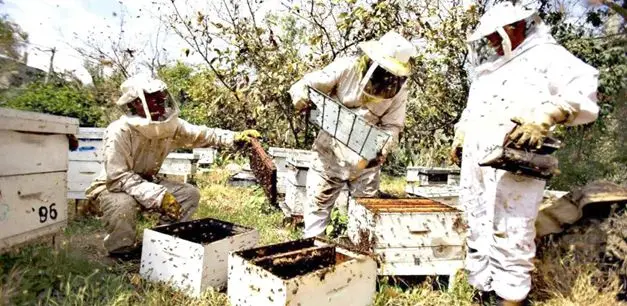


Exploring pathways for sustainable growth, employment, and environmental conservation through apiculture in the Himalayan region
By Osman Javid / Sumaya Jan / Dr Sajad H. Parey
The Himalayan state of Jammu and Kashmir (J&K) is renowned for its natural beauty, rich biodiversity, and fertile valleys that sustain a wide range of agricultural and horticultural activities. Among the lesser-discussed yet increasingly significant sectors is apiculture, the scientific management of honeybees for the production of honey and allied products. While traditionally regarded as a minor rural activity, beekeeping has evolved into a vital contributor to income generation, employment creation, ecological balance, and agricultural productivity in the region over the last decade.
In the current context of unemployment, climate change, and the search for sustainable livelihood options, the honeybee industry deserves renewed attention. This article examines the importance of the sector, highlights its role in the Jammu and Kashmir (J&K) economy, explores its potential for employment generation, and outlines policy recommendations that could unlock its full potential.
Ecological Importance of Honeybees in J&K
Honeybees are not merely producers of honey. Their most crucial role lies in pollination, which sustains ecosystems and enhances agricultural yields. The Kashmir Himalaya is marked by unique ecological conditions, diverse flora, distinct altitudinal gradients, and seasonal flowering cycles. Orchards of apple, almond, cherry, pear, and apricot dominate the valley, and their productivity depends significantly on pollination. Studies indicate that yields of cross-pollinated crops can rise by 20–25 per cent when supported by scientific beekeeping practices.
Beyond fruit cultivation, wild bee species, such as bumblebees, leafcutter bees, and mining bees, ensure the regeneration of wildflowers, forest species, and medicinal plants. This enhances biodiversity, strengthens soil stability, and aids water retention in sloped terrains. Declining bee populations due to habitat loss, pesticide use, and climatic changes would therefore not only reduce honey yields but also disrupt the ecological balance of the region. In short, the sustainability of the Kashmir ecosystem is directly tied to the health and survival of its bees.
Economic Potential and Growth of Honey Production
Over the past six years, honey production in J&K has grown at an impressive pace. According to official estimates, production has nearly doubled from around 13,000 quintals in 2019 to more than 27,000 quintals in 2024–25. The number of functional bee colonies has also expanded, rising from about 132,000 in 2019 to nearly 227,000 in 2025.
This growth has been facilitated by targeted government schemes such as the Holistic Agriculture Development Programme (HADP), the National Beekeeping and Honey Mission (NBHM), and subsidies under the Mission for Integrated Development of Horticulture (MIDH). These interventions have provided modern hives, processing units, training facilities, and marketing support.
The economic value of the sector is significant. Honey is the flagship product, but equally important are by-products such as beeswax, royal jelly, bee venom, and pollen. These command premium markets in pharmaceuticals, cosmetics, and nutraceuticals. Current estimates suggest that the apiculture sector contributes nearly Rs 500 crore annually to the economy of J&K, with potential for far greater expansion if market linkages and branding are improved.
Employment Creation and Livelihood Diversification
One of the most pressing challenges in Jammu and Kashmir is the high level of unemployment, particularly among rural youth and educated graduates. Beekeeping offers a practical and scalable solution. Unlike land-intensive farming, apiculture requires relatively little land and modest capital investment. Colonies can be managed by smallholders, landless farmers, and even urban households with access to flowering vegetation.
The government projects that the apiculture sector can generate nearly 50,000 direct and indirect jobs in the region. This includes opportunities for hive management, honey extraction, value addition, marketing, and entrepreneurship in allied products. Women and self-help groups, in particular, stand to benefit from its low entry barrier and compatibility with household responsibilities.
Success stories are already visible. In districts such as Pulwama, Anantnag, and Kulgam, youth entrepreneurs have established migratory beekeeping units, moving colonies seasonally to mustard fields, orchards, and forested zones. With proper training and market access, many of them have begun earning incomes running into several lakhs annually. These examples underline that beekeeping is not only an ecological service but also a practical tool for rural economic resilience.
Challenges Facing the Honeybee Industry
Despite encouraging growth, the sector faces multiple structural and environmental challenges that hinder its full development.
Habitat Loss and Pesticides: Deforestation, conversion of meadows, and declining floral resources have reduced the natural forage available to bees. Moreover, unregulated pesticide use in orchards affects bee health, reducing colony strength and pollination efficiency.
Climate Change: The shifting phenology of flowering plants, erratic winters, and changing rainfall patterns directly impact bee survival. Colonies often collapse during prolonged winters or drought periods, causing significant losses to farmers.
Infrastructure Gaps: Extraction, processing, testing, branding, and marketing remain underdeveloped. In many cases, honey is sold unprocessed at low prices, denying farmers the benefits of value addition.
Awareness and Training: A large proportion of beekeepers still rely on traditional techniques, lacking exposure to scientific practices such as disease control, queen rearing, or modern hive management. The absence of strong extension networks exacerbates these gaps.
Importance of Policy Support
Given its dual role in ecology and economy, the honeybee industry deserves strategic policy support from the J&K administration. Encouragingly, the government has already initiated several schemes. For instance, under the HADP, a three-year programme worth Rs 47 crore has been launched to promote beekeeping, expand colonies, and enhance processing infrastructure. Training programmes and awareness seminars are being conducted regularly to attract youth and women into the sector.
However, more needs to be done to institutionalise the sector as a pillar of J&K’s rural economy. Lessons can be drawn from other states such as Himachal Pradesh and Punjab, where beekeeping has been integrated into horticultural and agricultural extension services.
Policy Recommendations for Strengthening Beekeeping in J&K
Strengthening apiculture in Jammu and Kashmir requires a shift from viewing it as a supplementary activity to treating it as a strategic growth sector. Establishing specialised research centres in collaboration with SKUAST can drive innovation in disease management, queen breeding, and climate-resilient practices. Alongside this, the development of processing units, accredited testing labs, and branding hubs will create an integrated value chain that aligns J&K honey with national and global quality standards. Financial tools such as microcredit, targeted subsidies, and crop-insurance models can reduce risks and encourage wider participation. Tailored training programmes for women, youth, and self-help groups, covering entrepreneurship, marketing, and digital commerce, would further expand opportunities and transform beekeeping into a sustainable livelihood.
Equally important is the integration of beekeeping with the broader rural economy and environmental management. Linking apiculture with horticulture can improve fruit yields while diversifying farmer income, and forestry programmes can introduce nectar-rich species to support bee forage. Environmental safeguards, such as regulating pesticide use, adopting integrated pest management, and conserving wildflower corridors, are essential for long-term viability. Digital platforms, including GI tagging, QR-coded packaging, and cooperative-led e-commerce, can enhance traceability, build consumer trust, and open access to premium markets. With these measures, apiculture can emerge as a resilient pillar of J&K’s economy, generating employment, protecting ecosystems, and ensuring sustainable rural development.
Future Prospects and the Way Forward
The honeybee industry has the potential to become one of the fastest-growing rural enterprises in Jammu and Kashmir. With global demand for organic and natural products rising, J&K’s honey, marketed as Himalayan and organic, has the ability to command premium value. By aligning with sustainable development goals, the sector can simultaneously ensure ecological conservation, rural employment, and food security.
Looking ahead, a three-pronged approach is essential: scientific capacity building, policy support, and market development. If the current momentum is maintained and gaps are addressed, the apiculture sector could well become a symbol of both economic prosperity and ecological stewardship in Jammu and Kashmir.
Conclusion
Beekeeping in J&K is no longer a marginal activity. It is emerging as a vital sector that bridges environmental health, rural employment, and economic diversification. With honey production rising, livelihoods expanding, and government support strengthening, the industry stands at a promising threshold. Yet, its sustainability will depend on how effectively policies are implemented, how inclusively opportunities are shared, and how resilient the sector becomes to environmental stress.
In essence, the honeybee industry is not simply about producing honey. It is about nurturing ecosystems, empowering rural communities, and building a sustainable economic future for Jammu and Kashmir. If bees thrive, so too will the people and landscapes of this fragile Himalayan region.
Osman Javid is a Research Scholar in the Department of Zoology at BGSB University, Rajouri, India
Sumaya Jan is a Research Scholar in the Department of Economics at the Central University of Jammu, India
Dr Sajad H. Parey is a senior Assistant professor in the Department of Zoology at BGSB University, Rajouri, India
(su*********@***il.com), (os***********@***il.com)