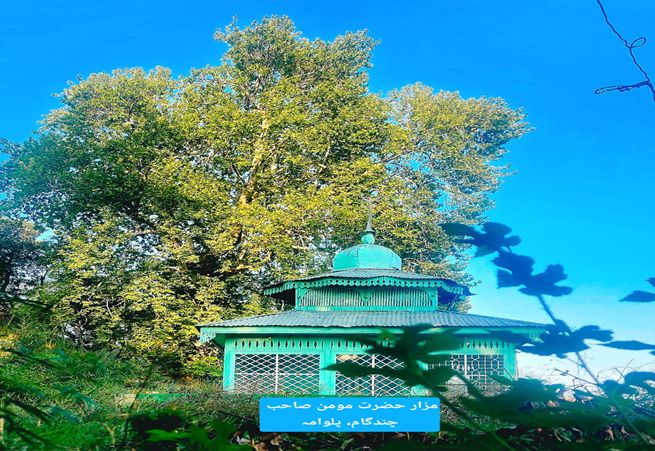


Momin Sahib is revered as a great Sufi saint and a figure of knowledge and is recognised as the Murshid of Sochh Kral, Mahmood Gaami and Karam Buland
Momin Shah, commonly referred to as Momin Sahib, was an 18th-century notable scholar (‘Alim), Sufi saint, and poet of Kashmir. He is regarded as a mentor for a generation of Sufi poets in Kashmir and is recognised as the second Sufi poet of the valley after Khawaja Habibullah Nowshehri (c. 1555-1617). Although limited information exists regarding his early life, it is said that Momin Sahib was born in the second half of the 18th century and passed away in the first quarter of the 19th century. Originally a native of Pampore area of district Pulwama, he subsequently settled in the village of Chandgam (Pulwama) to promote his mystical mission and teachings. It was also reported that Momin Sahib had several children, with Arif Shah Sahib being the only surviving son who carried forward his father’s mission.
Regarding his descendants, there exists no agreement among the village inhabitants, nor is there any documentation or historical evidence of his lineage. Nonetheless, a full Shah family resides near his tomb in Chandgam, an area referred to as “Peer Mohalla”.
Momin Sahib devoted his life to serving the poor, the marginalised, and the needy and destitute. He offered food, housing, and spiritual guidance to all in need—regardless of religion or background. His kindness and generosity have impacted the lives of all in the community. He used to offer not just food to the needy, but also time, love, and attention. His kindness provided solace, his deeds inspired, and his presence healed the broken hearts. Clearest evidence of his generosity is his clay pot, still available at his burial site (Tomb), which is displayed for the visitors who visit his tomb. He used to feed all the needy from this clay pot without any discrimination. The inhabitants of Chandgam and adjoining villages hold the belief that this pot possessed a vivid Baraka (blessings), and Momin Sahib reportedly fed hundreds of people miraculously from this small clay vessel, which is a clear indication that he was a true, perfect Wali and Sufi saint.
Momin Sahib possessed an immense Sufi insight and imprint that subsequently produced great Sufi personalities and poets. He is regarded as the Murshid (Mentor/ Guide) of notable Kashmiri Sufi poets such as Sochh Kral (1782-1854), Mahmood Gaami (1765-1855), Karam Buland, among others. The available sources (though limited) indicate that Momin Sahib was an influential Sufi saint and a figure of knowledge.
The entirety of Momin Sahib’s literary legacy of knowledge and wisdom is unavailable to us because it was not recorded properly: neither by his disciples nor by his descendants. However, whatever his literary legacy is currently available to us, it has (mostly) come through the oral history and classical performers. His Kalam (poetry) suggests that Momin Sahib was a great Sufi saint and a symbol of knowledge and mysticism during his time.
The major contribution and gift that Kashmiris owe him is his Masnavi called “Mantiq ul-Tayir” (The Conference of the Birds). Mantiq ul-Tayir is originally a symbolic Persian allegory composed by a famous Sufi saint, Farid ud-Din Attar (1145-1221 CE): a poet, hagiographer and theoretician of Sufism. Attar’s book is considered as the “Gospel of Sufism”, and the title is taken from the Qur’an (Surah al-Naml, 27: 16, which states: “And David was succeeded by Solomon, who said, “O people! We have been taught the language of birds [Mantiq-ul-Tair], and been given everything ˹we need˺”). Mantiq al-Tayr, consisting of approximately 4,500 lines, serves as an allegorical representation of the human quest for Divinity.
Momin sahib has selected only Masnawi from this book and presented it in a very simple, clear, and appealing way. The translation’s elegance is so profound that one might not realise that the original Masnawi is in Persian. He composed a major portion in the style of Vauchans (a Kashmiri literary genre). The total count of poetic verses in his Masnawi is 389.
His poetry (Kalam) is a rich spiritual and literary legacy, fusing Islamic mysticism with local cultural and linguistic elements. It emphasises the purification of soul, detachment from material desires, and the realisation of the true self. He penned it in the Kashmiri language, ensuring that their message was comprehensible to the general people. His poetic verses were frequently performed or recited at gatherings (Sufi Mehfil), enhancing their broad spread and communal importance. He expressed spiritual wisdom through emotional experiences.
The entire Masnavi serves as an extended allegory: a flock of birds, led by the hoopoe, journeying in search of their king. Each bird symbolises a human flaw or attachment (e.g., Nightingale = earthly love; Peacock = lost paradise), transforming the narrative into a reflection of the soul. Once each bird voices an excuse, the hoopoe answers with parables, Qur’anic references, and brief historical anecdotes. These inset narratives act as parables, distilling Sufi teachings into bright, memorable tales. Each bird symbolises a human weakness/ flaw (vanity, fear, greed, pride, etc.), rendering their narratives deeply introspective. The journey through the seven valleys symbolises the spiritual transformation required to meet divine truth. The birds are required to traverse seven valleys—Quest, Love, Insight, Detachment, Unity, Bewilderment, and Poverty/Annihilation—corresponding to the Sufi itinerary from Tariqah (Sufi Path) to Fanna (self-annihilation) and Baqa (eternal existence in God).
The richness and depth of his Kalam is found in its spiritual philosophy and poetic artistry and craft, offering multiple levels of meaning—personal, mystical, philosophical, and universal. His Kalam is a depiction of the soul’s journey towards God. The birds’ quest symbolises the Sufi path.
The impact of Qur’anic expressions in Moomin Sahib’s poetry is profound and multifaceted. His work shows a profound bond with the Islamic message and is shaped by the stylistic influence of Qur’anic language. Terms such as Iman (faith), Nur (light), Taqwa (piety), Ghayb (the Unseen), Anfus (selves), Momin (Believer), etc. are frequently used, echoing Qur’anic diction. It is deeply infused with Qur’anic imagery, concepts, and moral-philosophical ideas that reflect the spiritual and divine essence of the Qur’an.
Momin Sahib occasionally cites Qur’anic verses directly in his Kalam, and his language is infused with Qur’anic expressions and phrases, whether in paraphrased form or embedded within the reasoning of his allegories, or integrated into mystical stories from Islamic tradition (such as Isra and Miraj: Prophet’s Miraculous Night Journey). Below are a few verses/ couplets from his Sufi Kalam with their English translations:
v Thathe cha ashqin changi draunyey/ Rache rache mache maaz khyun ye lo// Cheer goi dedi peth heyo sakhrun ye/ Dar kin gache ne runye lo/ Ashqinis naras chuye gendunye (Bearing the blow of love is not a matter of fun/ It is like eating one’s own flesh in pieces. Now it’s too late; so, get ready from your abode! / Come out from the window to play the gambling of love)
v Madhos pan gasse mad walunye/ Adhe gasse had nerunye lo/ Lahadi pan gasse prez novenyey (One should bring down his mad elephant like ego/ Only then he should try to cross the limits/ And try to grasp the infinite reality!)
v Pan nuyi pan gache tresh kan chunyey/ Sui gache changi zalun ye lo/ Temke gashi gache pan prez nunyey (One has to drink his own blood instead of water/ One has to light the candle with his blood/ Then under this light, he has to identify himself)
v Momino’ yete no kansi rozunyey/ Yatte mo lag yuth hyun yey lo/ Tawan chu dunya yen te gachunyey (O Momin! No one stays here forever/ so do not be too arrogant here! / In fact, this is a place of affliction/ by coming and going, entering and exiting)
Considering his literary legacy, I believe that Momin Sahib was an educated intellectual figure of his era and had significantly influenced society, especially in south Kashmir. This is evident through his profound acquaintance, comprehension, and perception of Attar’s Mantiq ul-Tayir, which he translated into Kashmiri language in a strong poetic style. He was an impulsive poet in the Kashmiri language. Regrettably, his entire body of poetry was not collected or preserved by his disciples or descendants. Only a small portion of his works is presently available to us.
Momin Sahib had started many noble practices and admirable activities in the community, including educating people, comforting distressed souls, spiritual nourishment to the bewildered, and providing food to the needy. Currently, the main focus at his resting place (Tomb) during his Urs is solely on adhering to and celebrating certain traditional/ cultural customs—such as visiting his tomb, singing, and engaging in cultural performances, and other cultural practices—while his mission, message, Kalam (mystic poetry), and teachings have continually been overshadowed. Hence, it is crucial at this moment to revive and restore the rich cultural heritage of knowledge, love, and wisdom of Momin Sahib, and a meaningful commemoration can be set up at his memorial—that will be a genuine tribute and honour to him and will serve as an excellent way to preserve his intellectual and spiritual legacy.
The writer is an Assistant Professor, Arabic Literature, at GDC Beerwah, Budgam
Dr Muhammad Irshad Ul Haq
ir***********@***il.com