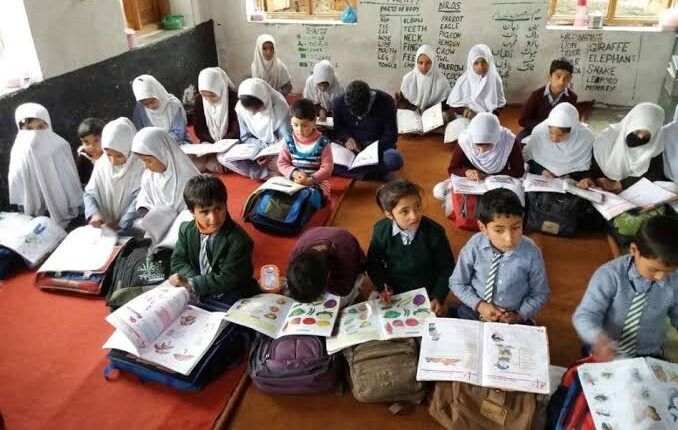


A primary school shows the way where four-year-olds solve Rubik’s cubes, count dice and shout ‘Yeshhh!’ in learning delight
It was 11 am when we, as the academic monitoring team, reached the village Shipora of Narbal Zone in District Budgam for monitoring. A beautiful primary school under the shade of walnut trees, where the teacher’s jubilation was awesome.
A beautiful classroom of the pre-primary class caught my eye. I went into the classroom with my colleagues. A beautiful bunch of kids aged below five, who were in their own world of fantasy without caring about our presence, had small rubber balls in their hands. They were throwing them to each other.
Some were busy with their activities. I asked one to stand up. He did. “What is your name?” I asked. “Abaan,” he replied. Then he spelt his name as “A… B… I… N Abaan.” Hahaha… laughter everywhere. The class was so beautifully set up. The students were so ecstatic that the atmosphere was filled with serenity. I hugged Aban and enquired about his class, to which he replied, “4th… na, na, na, KG.” Smiles everywhere, no fear at all. We were very ecstatic to see these children who had no fear at all.
Though they did not have a good playground to play in, the teachers had turned the big hall, where these kids under five years old read and play. The walls were so beautifully painted that they caught our sight. These kindergarten kids were busy without paying attention to us. One kid was using math manipulatives for math. He held Rubik’s cubes in his hands. I freed the cubes and asked him (aged four) to join and make the seven-rod—he did—then the ten-rod. In another corner of this hall, I observed a few using dice. I rolled one and asked Zehra (aged below four) to recognise and count the dots. She answered in a smattered way—“four”—“Correct,” I replied.
All of a sudden, in another corner of this beautiful kindergarten hall of this primary government school, I heard a girl (aged five) shout very loudly, “Yeshhhhhhh!” It was Rounaq Zehra holding a glass in her soft hands to put the glass on a green-coloured ball, the activity for colour recognition.
So many other activities were in full swing in this primary school, all aligned with NEP 2020. Aban, the hero of my heart, was playing with toys now. This reminded me of the uses of toys in early childhood. Every toy teaches children something new. For example, building blocks help with motor skills and problem-solving, while puzzles encourage thinking and creativity. Toys that kids can push, pull, or move around help them strengthen their coordination and build confidence.
Aban left the toys and ran towards the musical instruments. I followed him. Everything that is taught by NEP 2020 for early childhood education was on full display in this small school under the shade of walnut trees. Music helps in brain development. It is not just a source of joy for children who grow up hearing the sounds of nature like birds, rain, and even farm songs; it boosts their cognitive growth. I found some slates arranged perfectly with sketch pens. I held Aban’s soft hands and we walked towards these slates without asking him anything. Aban held a sketch pen in his hands and started drawing. In early childhood education, art and craft activities foster creativity and self-expression. They help children express their emotions, ideas, and feelings. They also develop their fine motor skills.
Aban and I started playing with the rings of different colours. He threw exactly the ring I asked for towards me. We, as a team of academic monitors, were really astonished to see how the teachers of this very small government primary school had turned this classroom into a powerful early education tool perfectly aligned with NEP 2020.
My friend asked me some questions, which left me thinking:
If this small government primary school can do this, why not all the government schools?
If this government primary school with four teachers can turn the classroom into a perfect kindergarten setting, why not others?
How much does it cost to buy these tools, viz. coloured rings, Rubik’s cubes, dice, math manipulatives? If they can buy them, why not all the government schools?
We did not hear a single word from these teachers about workload or staffing imbalance stories. All were enjoying their stay at the school. Why do others blame them 24/7? Why are the walls in this school beautifully painted and decorated, while in the majority of schools, they are not?
Dear education, it does not take much to care about early education in our government schools. It requires only a heart filled with sympathy and sincerity. We can be on par with private schools. It requires a little bit of patience and sincerity. NEP-aligned activities can make a lasting difference in a child’s development. If we engage children through math manipulatives, arts and crafts, toys, and games, we nurture their curiosity and love for learning.
Sometimes government education policies get marred in government schools but flourish in private schools. This is not due to a lack of funds or parental care, but due to the lack of a little bit of push from our side.
We left the school with yet another lesson learned. Aban kept on waving goodbye to us.
The writer is a teacher at Boys High School, Narabal
Muntashir Kifayat Hussain
mu**************@***il.com