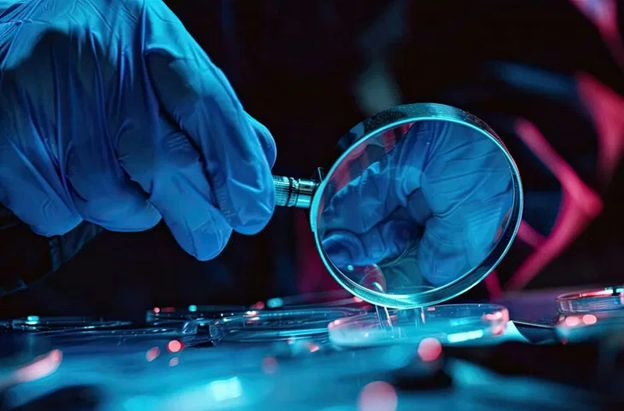


With DNA profiling, AI-driven analysis and digital forensics, science is becoming the ultimate witness in solving crimes and delivering truth. From blockchain tracking to rapid DNA tools, the tech revolution is transforming criminal investigations and judicial outcomes
In today’s world of digital revolutions, global mobility and socio-political complexities, crime has unimaginably evolved while transcending borders and manifesting in encrypted networks, biological data, financial systems and virtual spaces. In response, forensic science has emerged not merely as an investigative tool, but as a frontline pillar of justice by way of aiding in linking the crime with perpetrator(s). Forensic Science once confined to backroom analysis, now anchors the justice system by uniting biology, chemistry, physics, anthropology, digital forensics, behavioral science and AI to deliver corroborative truth with scientific precision. Rooted in ‘forensis’ (public forum) and ‘scientia’ (knowledge), forensic science fortifies legal processes and reinforces societal trust. It is no longer reactive or siloed, but proactive, predictive and interdisciplinary, capable of pre-empting crimes through data-driven insights and advanced diagnostics. From DNA profiling to cyber-forensics and geospatial analysis, forensic science adapts with criminal innovation, offering clarity where misinformation thrives.
More than a discipline, forensic science symbolises resilience against injustice. It bridges law enforcement, the judiciary and the public, anchoring courts in evidence-based reasoning and empowering governance with credibility. In an age of distorted truths, understanding forensic science is a civic necessity. Crime and forensics share a dynamic, symbiotic bond with each shaping the other and together defining the evolving landscape of justice.
Defining crime in the context of forensics: Crime in view of forensics is not just a legal breach but a disruption of societal order that demands scientific investigation and ethically validated resolution. It includes any human act, be it physical, digital, psychological, or environmental, that violates codified norms and requires forensic scrutiny. From a footprint or fingerprint at a crime scene to a digital trace in a cyber-heist, every offence leaves behind evidence. Forensic science’s duty remains to uncover it. It doesn’t merely observe facts but deciphers them. By identifying and individualising perpetrators with precision, it converts suspicion into evidence, doubt into data and chaos into clarity.
As the bridge between crime and conviction, it is vital in separating the innocence from the guilt. In a world marked by complexity, misinformation and manipulation, forensic science offers an objective, irrefutable voice in the pursuit of justice. While traditional crimes like homicide and burglary persist, today’s threats, ranging from cyberstalking, ransomware, data breaches, crypto fraud, biometric spoofing, environmental crime and bio-warfare, are complex, encrypted and transboundary. They defy conventional methods and demand a multidisciplinary forensic response. This evolution has elevated forensic science from a supporting role to a core force in justice delivery. Its relevance is now widely recognised by law enforcement, courts and the public.
From decoding digital footprints and authenticating identities to reconstructing criminal intent, forensic professionals are the chief scientific custodians of justice. In an age where technology both empowers and endangers, their role is not just reactive but transformative. They provide the evidentiary backbone of fair trials, public trust and the rule of law. Today, more than ever, credible, science-driven interventions are essential in confronting crime’s evolving face. Forensic science stands not only as a tool of detection but as a torchbearer of truth in the ongoing quest for justice.
The transformative power of forensic science in bridging law enforcement, judiciary and societal stability: Forensic science is the essential bridge between law enforcement, judiciary and societal order. More than a technical domain, it acts as a constitutional enabler, turning subjective narratives into objective, admissible and scientifically validated evidence. Upholding the principle “Let the guilty not escape and the innocent not suffer,” forensic professionals serve not as agents of punishment but as ultimate guardians of truth, transforming suspicion into substantiation and vice versa through empirical rigour.
India’s landmark criminal law reforms, namely Bharatiya Nyaya Sanhita (BNS), Bharatiya Nagarik Suraksha Sanhita (BNSS) and Bharatiya Sakshya Adhiniyam (BSA) 2023, underscore this shift by making forensic evidence mandatory in serious offences, steering justice away from conjecture toward scientific objectivity. These reforms recognise forensics not as a supplementary aid but as a foundational pillar of justice. Modern forensic science is powered by innovation. AI-driven facial recognition, privacy-conscious genomic tools and digital traceability are no longer futuristic but are being actively deployed in enhancing prosecutorial precision and reducing miscarriages of justice.
The relevance of forensic science is emphasised by four realities:
- Tech-enabled, transboundary crime ranging from deepfakes to encrypted currencies, all demand forensic intervention where conventional policing falters.
- Objectivity over perception is what makes forensics counter the fallibility of human memory and bias with replicable data.
- Judicial transparency is maintained by scientific evidence that bolsters fair reasoning and legal accountability.
- Faster justice delivery alone due to forensics in real-time through DNA profiling, mobile forensics and automated analytics, besides accelerating resolution in complex cases.
Core disciplines in unified Forensic Science: The multidisciplinary arsenal for contemporary justice
In the face of unprecedented shifts in crime patterns ranging from traditional violence to cyber-enabled, transnational and organised criminal operations, the role of the forensic science practitioner has evolved to become the ultimate transmitter of truth, tasked with delivering evidentiary proof that can withstand the highest thresholds of legal scrutiny. To meet this ever-expanding demand, forensic science has transformed into a deeply interdisciplinary and integrative domain, converging diverse scientific specialisations under a unified framework. This multidisciplinary nature not only amplifies its investigative precision but also ensures forensic applicability across criminal, civil, humanitarian and regulatory landscapes.
Below are the core disciplines that form the backbone of the unified forensic science ecosystem:
- Biological Forensics:
At the heart of human identification and crime scene reconstruction, biological forensics deals with biological materials such as blood, tissues, bones and other bodily fluids. Its scope includes:
– DNA Profiling and Genealogy: For individualisation, kinship analysis and familial searching.
– Forensic Anthropology: Skeletal examination for age, sex, trauma, ancestry and stature estimation.
– Disaster Victim Identification (DVI) & Mass Grave Investigations: Critical in both humanitarian and conflict contexts.
– Forensic Entomology: Estimating time since death (PMI) through insect colonisation patterns.
– Injury analysis and Age estimation: Useful in cases of assault, abuse and unidentified remains.
- Chemical Forensics:
This domain deciphers the chemical underpinnings of crime from toxicity to combustion. The scope comprises:
– Forensic Toxicology: Detection and quantification of drugs, poisons and alcohol in tissues and fluids. Importantly, it is crucial for NDPS Act enforcement.
– Arson and Explosives Analysis: Identification of accelerants, residue patterns and detonation mechanisms.
– Illicit Drug Characterisation: Tracing chemical signatures for dismantling trafficking networks.
– Forensic Chemistry: Detection of synthetic and natural compounds, environmental pollutants and chemical warfare agents.
- Physical Forensics:
Drawing from physics and materials science, this discipline focuses on tangible, trace and impression evidence. Physical examination consists of:
– Ballistics: Examination of firearms, bullet trajectories, gunshot residues and injury correlations.
– Trace Evidence Analysis: High-resolution comparisons of micro-debris such as fibres, paint, glass, and soil.
– Toolmarks & Fingerprints: Comparative analysis to link suspects with tools, weapons or crime scenes.
– Fracture & Pattern Analysis: Evaluating the mechanical behaviour of materials involved in accidents or assaults.
- Questioned Documents & Historical Document Examination:
Bridging forensic investigation with legal scrutiny and historical inquiry, this field focuses on document authenticity and tampering via:
– Handwriting and Signature Verification: Crucial in cases involving cheque frauds, wills, contracts and threats.
– Ink and Paper Analysis: Dating materials to detect forgeries or establish provenance.
– Radiocarbon Dating: Employed in historical document validation.
– Metadata Forensics: In the age of deep-fakes and AI-generated content, inconsistencies in formatting or digital trails reveal manipulation.
- Digital and Cyber Forensics:
As crimes migrate to the digital realm, this discipline has become indispensable in modern investigations:
– Cybercrime Forensics: Recovery of data from encrypted systems, cloud storage, dark web, IP tracing and email/social media analysis.
– Mobile Forensics: Retrieval of call logs, app data, geolocation and deleted files.
– Blockchain and Cryptocurrency Forensics: Tracking illicit financial transactions, token transfers and smart contract abuses.
– AI and IoT Forensics: Emerging areas focusing on smart devices, autonomous systems and algorithmic accountability.
- Environmental and Wildlife Forensics:
Addressing the interface between crime and ecology, this growing field safeguards biodiversity and environmental integrity:
– Wildlife Crime Investigation: Identification of poached species, illegal trade tracking and origin tracing.
– Environmental Forensics: Determination of pollution sources, industrial spills and environmental degradation through analysis of air, water and soil samples.
– Habitat Encroachment and Conservation Law Enforcement: Monitoring and verifying ecological violations, encroachments on protected lands with scientific precision.
Technological advancements in Forensic Science:
Forensic science today is not just evolving but is visibly being revolutionised. It is no longer a reactive tool, but is acting as a potential player to become a proactive, tech-driven engine of justice. Emerging technologies now shape investigations with speed, precision and credibility, transforming how crimes are detected, analysed and prosecuted. Key technologies that forensics incorporates are:
– AI and ML: These are regarded as the brain of modern forensics and it is enabling predictive policing, suspect profiling, biometric analysis and forensic linguistics via LLMs like ChatGPT, etc.
– Immersive Tech: Aspects such as 3D scanning and VR have successfully recreated crime scenes for courts and investigators and are thereby enhancing clarity and understanding of crimes.
– Next-Gen DNA: Rapid DNA tools, privacy-preserving genomics, and epigenetic profiling offer fast, deep and ethical insights.
– Blockchain: This aspect ensures tamper-proof evidence trails and smart procedural compliance.
– Geo-Analytics: Satellites and GPS data enhance surveillance, track movements and reveal hidden crimes.
– Automation and Robotics: Virtopsy and AI-driven tools boost accuracy in autopsies and document forensics.
Thus, it is apparent that technology is not just supporting the cause of justice through forensic science but is rather defining its future. Expectedly, in the near future, justice will be served in faster, smarter and fairer manners through data-driven forensic efforts.
Ethical and legal considerations in technologized forensics:
As cutting-edge tools like AI, genomics and digital surveillance redefine forensic capabilities, they simultaneously trigger critical ethical, legal and human rights concerns. Forensic science must evolve not just in precision, but also in integrity that has to be anchored in transparency, individual rights and judicial admissibility. Some of the concerns are:
– Scientific admissibility and legal reforms: Robust forensic evidence must meet legal standards of reliability and reproducibility. Frameworks like the Daubert and Frye standards ensure methodological rigor, while India’s BNSS (2023) enhances forensic accountability through certified labs, digital documentation and chain-of-custody enforcement.
– DNA, biometrics and privacy: While DNA profiling and facial recognition have revolutionised investigations, they raise alarms about consent, privacy and data misuse. The proposed DNA database laws face criticism over weak safeguards. Global models like GDPR and the UK’s Biometrics Commissioner highlight the need for purpose-limited, consent-based frameworks.
– Standardisation and accreditation: Inconsistent protocols risk miscarriages of justice. International standards like ISO/IEC and oversight by bodies like NABL are essential to ensure procedural uniformity and scientific validity across forensic disciplines.
– AI bias and algorithmic opacity: Predictive policing and facial recognition tools, if left unchecked, can encode systemic biases. Black-box AI must be auditable, explainable and transparent. High-profile errors, such as misidentifications as observed by UK police systems, underscore the need for human oversight and bias mitigation.
– Secondary use of bio-samples: Repurposing DNA or tissue without informed consent breaches autonomy and ethics. Despite ICMR’s guidelines in India, gaps in enforcement risk exploitation, especially among vulnerable populations. Clear communication, ethical reviews and legal checks are vital.
– Forensic neutrality and public trust: The credibility of forensic science hinges on expert impartiality, scientific humility and accurate courtroom communication. Misrepresentation or media sensationalism can distort justice. Ongoing training, ethical conduct and a science-literate judiciary are essential to safeguard truth and fairness.
Future directions in forensic science towards just, tech-integrated and inclusive justice:
As crime becomes increasingly complex and technology-driven, the need for transparency and fairness in justice delivery has never been greater. In this landscape, forensic science must transform from a reactive tool into a proactive pillar of justice. Its future lies not only in technological advancement but in a paradigm shift, anchored in interdisciplinary collaboration, innovation, public engagement and equitable infrastructure. It must serve as both a scientific discipline and a governance enabler, linking law enforcement, judiciary, policy and society.
Interdisciplinary collaboration is vital. Contemporary crimes ranging from cyber threats and behavioural offences to socio-economic and biodiversity crimes require insights from criminology, psychology, artificial intelligence, law and public policy. AI facilitates predictive analytics, while behavioural sciences help understand motives, enhancing forensic applications. Global examples like the Forensic Technology Centre of Excellence (USA) and ENFSI (Europe) illustrate the power of standardised, collaborative forensic systems. India, particularly Jammu & Kashmir (J&K), must develop similar region-specific models adapted to its socio-legal realities.
Robust research and development are equally essential. Although India has academic capacity, it lacks indigenous forensic innovation. National science missions such as DST, DBT and ICMR must prioritise AI-enabled forensic tools, portable diagnostics and trace evidence automation. Public-private partnerships can further accelerate this progress, as seen in Germany’s facial morphing technologies or Japan’s rapid drug test kits. In India, these innovations are not a luxury but are critical for timely and fair justice.
Enhancing forensic literacy is another game-changer. Forensic science must be made accessible through school curricula, public outreach and professional training. Judges, prosecutors and law enforcement need systematic education in modern forensic practices such as DNA profiling, digital evidence handling, odontology and toxicology. Legal reforms like BNSS 2023 acknowledge this need; structured training must now be institutionalised.
Access to forensic services remains uneven, particularly in rural and conflict-affected areas. Mobile forensic units equipped with DNA, toxicology and cybercrime tools can bridge these gaps. India is working toward deploying region-specific mobile labs, drawing inspiration from models like the FBI’s Rapid DNA Units and Kenya’s mobile wildlife forensics. However, while India is upgrading its forensic infrastructure, J&K still lacks dedicated forensic education and training institutions. Despite national expansion of labs and DNA centres, policy inaction has left the region behind. This must change. Forensic science is not a niche; it is a foundation of democratic justice. Its holistic integration can ensure accountability, restore public trust and serve as a catalyst for truth in India’s, particularly J&K’s evolving justice system.
About the author
Dr Sami Ullah is a Forensic practitioner and Anthropologist with an MSc and PhD in Forensic Science and an MA in Anthropology. As Co-Founder & Chairman of the RADISAT Foundation, he advocates for Forensic science education, justice reforms and scientific and research advancements in crime investigation and scientific reporting. His expertise spans DNA forensics, Investigative Forensics, Forensic Anthropology, Forensic Toxicology including Substance Abuse and Addiction and Interventional Forensics. Passionate about bridging the forensic science gap in Jammu & Kashmir, he works to integrate forensic science into academia, industry, private sector, law enforcement and governance.
Sami Ullah
sa********@***il.com