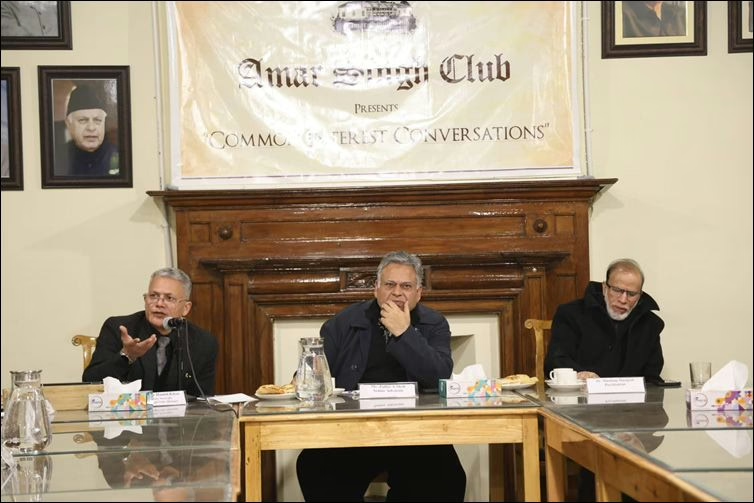


SRINAGAR: The Managing Committee of Amar Singh Club, Srinagar held the third interaction of its program ‘Common Interest Conversations’ on the topic of Digital Addiction: An Invisible Pandemic on the 8th of February, 2025. The interaction was presided over by Learned Senior Advocate Mr Zaffar Shahand chaired by eminent psychiatrist Dr Mustaq A Margoob. The panel included Dr Shazia Kouser – Developmental Psychiatrist, Directorate of Health Services, Kashmir, Mr Mohammed Rafi – Former Director Education, Mr Peerzada Ashiq, Bureau Chief (The Hindu), Professor Mahmood Khan – Kashmir University, Dr Musharaf Masudi, Mr G N War – Education, Mr Sardar Nasir Ali Khan, Mr Sameer Wazeer (IUST), Mr Tahir Peerzada and Managing Committee Members Mr Rauf Ahmed Punjabi, Mr Parvez Fazili, Mr Abid Shamas and other members of the Club.
The agenda of the interaction was an in-depth examination of the educational system and the impact of digital technology on it. Nasir Hamid Khan, Club Secretary welcomed the participants and thankedLearned Senior Advocate Zaffar A Shah for presiding over and renowned PsychiatristDr Mustaq A Margoob, for chairing the interaction.
Zaffar Shah said that in light of previous interactions, it was clear that overconsumption of technology had negative effects on the minds and body of younger generation and perhaps it was time to introduce the proper use of technology as a subject in the curriculum as a part of their education. It would enable them from the very beginning of their learning process to differentiate between the good and bad of technology. He stressed upon the thought for education to be functional and focus on the needs and interests of the student without the stress of grades and merit percentages. Students needed to be taught the skills they need to interact with technology. He said that efforts needed to be made for enhancing the natural learning processes of the individual which develop the life and quality of mind rather than goal-oriented education which appeared to put students under stress. He said that our intention is to converge on certain issues which we think are the issues that are prevalent in our society today and how the right-thinking people of the society should respond to these issues. Do we become indifferent and leave the issue as it is, or should be play the blame game as in parents shifting the blame to schools and vice versa. He said that God has not been discriminatory and provided, more or less, equal intelligence to all but it depends on how we use that intelligence that makes all the difference. He said the biologically it has been seen that brain loves comfort and laziness and an effort is required to get out of our comfort zones. Children have the same tendencies and it is a matter of concern that when we expose children to this technology what is its impact on them as children. As adults, we have the luxury of choice which is based on our mental capacities and we make those choices hundreds of times in a day. For a child whose brains are yet to develop fully, there is no choice, he is impressed by visuals. Today, we can rely on the expert opinion of Dr Sushil Razdan who said that it damages the brains of children and affects creativity. We cannot ignore this fundamental thing. It affects the fundamentals of his existence, of his personality ultimately, of everything he does in life. This then becomes a matter of concern which requires a multi-dimensional response from us. This requires us to ask hard questions to ourselves as a society and try to find hard answers.
Dr Mustaq A Margoob stated that mental health experts in Kashmir were concerned at the rising number of cases of parents approaching them regarding their wards indulging in hyper-active behaviour, abnormal anger and violence issues and reduced physical growth. In his own extensive clinical practice and that of other mental care experts, there was a sharp rise in such cases where further probes reveal that the same children appear to be visibly pacified and calm when given a mobile device – clear signs of the pandemic of digital addiction including virtual Autism – a preventable and reversible affliction. He said the first six years of life are an extremely critical period where foundations of personality are laid by the mind by processing and understanding the world around it. He said that nature has designed stress coming from peer pressure, competition, sports, as a positive trigger for children to face challenges, achieve goals, adapt to their environment and gain confidence which is essential for learning, growth and personality development. He said that digital devices had added debilitating levels of stress on children and impaired their emotional intelligence processes due to which they find it hard to connect with their families and the community. He said that it had been seen that the use of digital devices was akin to driving a 4×4 vehicle through your brain circuits and it takes 2-4 hours of screen free time for the mental network to restore baseline levels. He stated that use of digital devices 2 hours before bedtime interfered with the natural sleep patterns resulting in loss of focus and physical and mental fatigue.The rise in anxiety and depression disorder cases in Kashmir were directly attributable to the use of smartphones.
He said that today, globally medical authorities are stressing upon the importance of preventive measures in addition to curative measures for treating various conditions. He said that metal health experts are also moving towards positive psychology and it is the need of the day that psychiatric treatment -both preventive and curative – reaches out to the community. Narrating his own experience, he said that in the 1990s, we used to be 2 to 3 psychiatrist who treated patients from all over Kashmir in the Mental Hospital. Today, our Institute of Mental Health- having a substantial manpower of around a 50 to 60 mental care professionals as well as at least 1 to 2 psychiatrist available in each District Hospital catering to only 6 to 10 percent of patients of psychiatric disorders of Kashmir leaving an estimated 90 percent of themuntreatedor fend for their needs from other sources. He said that our traditional coping mechanisms of mental health have become weak due to cultural and economic changes in the past few decades. Kashmir in earlier times used to have extended families which provided much insulation and nurturing to children and acted as a psychological buffer.The other mechanism was the influence of teachers in shaping the lives of children. Citing from the contents of a interview with Dr G Q Allaqaband, who faced all imaginable hardships and impoverishments as a child but rose to be an icon in Kashmir, Dr Margoob stated that teachers had left an everlasting influence of his life and played a key role in developing his personality. Today, the digital age has greatly reduced this important coping mechanism where teachers themselves seem to be grappling with technology as a rival.
Dr Shazia Kouser stated that the patients we see in hospitals are not typical community samples as hospitals basically treat cases where the disorders are in advanced stages and because of the social taboo of being a mental patient, they usually exhaust all other options of treatment before they arrive at our hospital. Because of this reason you could say that we only see the tip of the iceberg, mostly related to online gambling, pornography and online gaming disorders. The consequences of these addictions are that they result in crippling financial losses, serious mental and physical dysfunctions and other problems which the patient and their families are forced to address. But the increased volumes do indicate that it is an alarming situation. Sharing her experiences, she said that we see patients from all walks of life. Patients from very affluent or very disadvantaged backgrounds with educated parents or orphans come after incurring losses on account of academic, economic and social fronts. Children today suffer from anxiety, depression and avoid social contact because they live in their own bubble of virtual reality with lots of online friends and followers, and for them this defines their world. She said that while the use of technology for providing education of children who do not have access to schools and teachers, like in far flung areas, is welcome, it’s regulation and rationalisation here is urgently required for providing space in their young minds for creative thoughts to form.
She said that modern education had recognised the need for making mental wellness counsellors available in schools and some private schools here do provide them. But today every child needs professional guidance and counselling to be nurtured towards healthy use of technology and this needsplanning at individual levels.
Prof Mahmood Khan stated that in order to bring out the creative side of students it was important to incentivise debating, writing, art, sculpting and other activities which require focus and attention. They needed to be exposed to outdoor activities related with horticulture, agricultureHe stated that the analogue method of learning/teaching process should be encouraged by educational institutions as it had been proven to be better for the mind and it’s creativity mechanisms.
Mr G N Var while quoting from various research and studies undertaken, stated that the effect of technology in the teaching process was not in the interests of students. He said that experts had suggested that it was time to take technology out of the classrooms before it was too late. He said that if we saw statistics with regard to Kashmir, literacy rates had gone down by 10 to 12 percent. The Performance Rating Index of Ministry of Education, GOI had rated J&K at par with Meghalaya and Jharkhand. Another study on learning outcomes had also rated J&K quite low. He said the results of all surveys indicate that the digital programmes are not proving beneficial for not only the minds but also the bodies of children. He said that there are perceptible behavioural changes in today’s children. He said that due to the interventions initiated by Dr Mustaq A Margoob, private schools do not charge fee from orphans or children from destitute families. He stated that unfortunately private schools are engaged in unnecessary controversies over fee and books which shifts the focus from real concerns of quality education and developmental issues. He said that it is a matter of concern that critical thinking and collaborative learning skills of students was constantly dipping. There is a stark problem of non-availability of human resources in the education sector. He said that Zaffar Shah and the management of Amar Singh Club deserved to be congratulated for taking up a urgent conversation, which was a first for him, with regard to children, the future generation and education in a structured manner
Mohammed Rafi stated that being the biggest influencers, parents needed to act as role models at home so that the children are not drawn towards the magical allure of digital devices. He pointed out that the minds of children may be puzzled by the contradictions in being taught through digital technology at school and then being told that it is something harmful. He stressed upon the need torevisit, rationalise and wherever possible reduce the digital burden on students in the education system.
Sardar Nasir Ali Khan drew the attention of the participants towards the impact of situational turbulence in Kashmir in the past few decades which has left an impact on the behaviour of today’s parents who grew up in the 1990’s. He said that parents are hesitant in sending their wards to play outdoors with other children because they have no knowledge about the other children. There is a social disconnect where even next-door neighbours hardly know each other. This has resulted in parents not being enthusiastic about sending the kids out, which the kids also prefer as they spend that time in a magical digital world. He also pointed out the growing culture of prep schools in Kashmir and questioned whether digital technology was being used to keep the children pacified, which would render them brain damaged for the rest of their lives.
Sharing his experience of running a radio station with the objective of shifting the focus of children towards creative pursuits and performance building activities. He said that during his interactions with children, he observed that children could not communicate their personality traits and talents effectively.
Dr Musharaf Masudi shared her experience of being a mother and now a grandmother. She said that her 10 year old grandchild is presently off school for three months due to the winter vacations. She questioned that what is this child going to do at home for three months. Both his parents are working professionals and have duties to attend to and they are left with no choice but to leave him with the maid. She provides him with a mobile device to play games and busies herself with other household chores. We are trying to inculcate the daily habit of reading by making him read storybooks at bedtime. But he is distracted by his father using a mobile phone. Underlining the difficulty of weaning children away from screens, she questioned what activities do we offer them?
Peerzada Ashiq congratulated the management of Amar Singh Club and said that there has been a definite impact of the previous two sessions in the society. Giving an example, he said that a day before he had a very interesting conversation with his mother when she forwarded a video clip of Dr Sushil Razdan and Dr Kaiser Ahmed informing the public about the harmful effects of Digital Addiction on children from the previous session. He said that his mother was concerned that as a father he was not taking care of his children with regard to protecting them from digital devices. He said that there is still very little awareness amongst parents about how much screen time and what type of content is healthy for their children for which a proper awareness message is to be formulated.
Nasir Hamid Khan presenting the vote of thanks said that our earlier conversations, besides being a learning experience for us, have been well received in the society. We have successfully triggered public debates on various platforms. I was following some of these debates and I couldn’t help but sense an element of fatalism – which is the belief that nothing can be done to reduce the harm; that it is something pre-determined and beyond our control. But as our learned Senior Advocate friend Zaffar Shah so eloquently put it, it is a man-made problem and nothing divine, that it cannot be managed or controlled.
As opposed to fatalism, I continue to be guided by my faith and am a passionate believer in the doctrine of free will. The belief that we possess the capacity to make choices and decisions, the ability to stand up and look challenges in the eye. All actions committed by man’s free will are to be counted on the Day of Judgement because they are our own and not God’s and we shall be judged as per our knowledge. All religions lay stress on acquiring knowledge and demand accountability. Iqra – the first word revealed to my beloved Prophet Muhamad (PBUH) – means to read and we have been repeatedly commanded to seek knowledge, to share knowledge and to use that knowledge for the larger good of humanity. In Hinduism, seeking knowledge is the core principle of ‘Dharma’ which is essential for attaining ‘Moksha’. In Sikhism, the concept is known as ‘Gian’ and is fundamental for attaining ‘Mukti’ through selfless service called Seva.
From our previous sessions on this subject, we have come to understand that use of digital technology is a risky affair. Our children are crumbling under a mountain of mental and physical problems due to overconsumption of digital stimuli. They feel awkward in social situations and no longer enjoy sports and physical activities. Creativity, meaning and purpose are visibly missing. They suffer from anxiety and confusion, and there are indications of possible structural alterations not only to their brains but also to their moral beliefs and value systems. We are looking at a sad, angry and isolated generation. Na Shoakh e Kamala Raha Na Khoaf e Zavaal.
While studying Australia’s proposed social media ban, I came across a response from Prime Minister Anthony Albanese that caught my attention. When asked about the reasons for the legislation, he simply replied “we want our kids to have a childhood’. Though I am not a supporter of banning social media because I believe, to their young minds – curious and naughty creatures that children are – a ban would only heighten its allure, – but the agony and distress of the Australians is palpable. It identifies with the helplessness being felt by us, the senior generation – called ‘Digital Immigrants’ – at watching our loved ones being wasted by digital stimuli. Childhood is what the young generation is being deprived of today.
We all have our opinions about the purpose of education. If I had to sum it up in one line, I would say it is to develop the best possible version of an individual to reach his full potential. Our objective then, should be to prepare them to face the challenges of life, in whatever form they may come, not only with fearless confidence but with dazzling brilliance. Ladies and Gentlemen, life is beautiful but at the same time it can be extremely brutal and any life worth living is usually a constant problem-solving and decision-making struggle. Exceptional powers of critical thinking and reasoning skills are required to overcome this challenge. We need to provide an enabling environment for firing their imagination. We need to accept the fact that young people, as well as us, will be spending the rest of our lives entangled in a complex digital world. The task of education, therefore, should primarily be to act as a productive space in which students can critically reflect upon, and form judgments about that world.
Talking about the importance of resting our mental networks and the subsequent boredom, she says that getting bored forces us to come face-to-face with bigger questions of meaning and purpose and it is also an opportunity for discovery and invention. It creates the space necessary for a new thought to form, without which we are endlessly reacting to stimuli around us, rather than allowing ourselves to be within our lived experience”.
As we continue our search for answers and solutions, there has to be awareness about the costs and consequences. As discussed earlier, dopamine is a vital brain neuro transmitter that helps control movement, mood and feelings of pleasure. In an experiment, it was found that genetically engineered mice unable to make dopamine will not seek out food, and will starve to death even when food is placed inches from their mouth. Yet if food is put directly into their mouth, they will chew and eat the food, and seem to enjoy it. Like the mice, dopamine deficiency caused by digital overconsumption blocks the desire of young minds to engage in meaningful activities.
Our second concern is the mind-altering impact of digital technology. Dr Anna states that in California, a 6 year old boy watching cartoons on his iPad stumbled upon Japanese cartoon pornography. Curious to try out the behavior he had seen and which to his mind seemed normal, he sodomised his 4 year old brother. Internet suggests behaviors which may otherwise never occur to us. When we see others behaving in a certain way online, those behaviors seem normal.
I think these two examples pretty much sum up the scary costs and consequences of digital addiction.