

A reflective journey through lessons, friendships and transformative experiences
I still remember the morning I arrived at the University of Kashmir. The soft morning light reflected off Dal Lake as I made my way to the campus, my heart racing with excitement and nerves. The weight of my admission letter felt heavier than usual in my bag, symbolizing not just an academic opportunity but a new chapter in my life.
Walking through the Sir Syed gate, for the first time, I realized this was where I would challenge my ideas, grow intellectually, and perhaps discover a new version of myself. The first semester didn’t disappoint—it was a whirlwind of new experiences, profound lessons, and unforgettable moments.
Academic Experience
Diving Into Political Philosophy with Dr. Javid Ahmad Dar
Dr. Javid Ahmad Dar was the torchbearer of our intellectual journey into political philosophy. His lectures were more than just academic—they were profound explorations of human thought. When he spoke of Plato’s Republic, he didn’t just describe the ideal state; he made us envision it. “Plato teaches us to dream big, but Aristotle teaches us how to bring those dreams to life,” he often remarked, seamlessly transitioning between the two great thinkers.
Discussing Hobbes, he painted a vivid picture of the chaos that necessitated the Leviathan. “Hobbes doesn’t just offer a theory; he gives us a mirror to understand the price of order,” he explained. His insights into Machiavelli’s The Prince were equally gripping, urging us to see beyond the stereotypes and appreciate the complexity of power. “Machiavelli isn’t evil; he’s pragmatic,” he reminded us, challenging our preconceived notions.
Dr. Javid Sir’s passion for Political Philosophy wasn’t just about imparting knowledge; it was about igniting curiosity and inspiring a deeper understanding of the texts that shaped political thought.
International Politics with Dr. Shahnawaz Sir
Dr. Shahnawaz Sir’s classes on International Politics were like journeys through history and current events, all tied together with theoretical rigor. His ability to link ancient diplomatic strategies with contemporary geopolitics left us in awe. “Power is the ultimate currency in international relations, and his Famous Line “Antology of realism is the Antology of war “ he would say, before delving into examples from the Cold War or modern conflicts.
His teaching didn’t just stay confined to the classroom. He often encouraged us to follow global events and connect them with our readings. “A student of international politics must have one eye on theory and the other on the world map,” he told us, instilling in us the habit of critical observation.
Public Policy with Dr. Aijaz Sir
Dr. Aijaz Sir had a unique way of making public policy relatable. “Policy isn’t just about government decisions; it’s about shaping lives,” he would emphasize, making every lecture feel personal. His stories about real-world policy failures and successes kept us engaged, while his detailed analysis of policy frameworks honed our critical thinking skills.
His approach was patient and encouraging, especially when we struggled with complex concepts. “A good policy analyst asks ‘why’ before asking ‘how,’” he reminded us, teaching us the importance of identifying root causes before proposing solutions.
Human Rights with Dr. Anjum Madam
Dr. Anjum Madam’s passion for human rights was palpable in every word she spoke. “Human rights are not privileges; they’re the essence of humanity,” she often said, setting the tone for her classes. She brought global and local perspectives to the table, using examples from Kashmir to drive home the importance of safeguarding these rights.
Her ability to connect theoretical frameworks with real-world struggles made her lectures both enlightening and emotional. “Every time we speak for the voiceless, we reclaim the essence of humanity,” she said, leaving us inspired and introspective.
Indian Political System with Dr. Sadiya Madam
Dr. Sadiya Madam’s classes were a masterclass in unraveling the complexities of Indian democracy. “India is not just a democracy; it’s an experiment in diversity,” she would say, highlighting the unique challenges and strengths of our political system. Her ability to relate constitutional provisions to everyday political debates made her lectures incredibly engaging.
She encouraged us to think critically about the strengths and weaknesses of India’s federal structure, elections, and governance. “A strong democracy is one where citizens question, not just obey,” she said, empowering us to engage with our political system meaningfully.
Dr. Sadiya Madam not only taught us the intricacies of the Indian political system but also imparted invaluable skills that went beyond textbook knowledge. One of the most impactful lessons she gave us was on how to approach assignments. Before I joined her class, the process of crafting an academic paper was intimidating—especially when it came to proper referencing and structure. I often found myself unsure of how to effectively present my arguments or cite sources.
Dr. Sadiya Madam, with her meticulous attention to detail, showed us that assignments aren’t just tasks to complete—they are opportunities to showcase critical thinking, precision, and academic integrity. She guided us through the nuances of organizing our ideas logically, structuring our arguments clearly, and presenting them with evidence that supported our thesis.
But perhaps the most important skill she taught us was how to cite our sources properly. She emphasized the importance of academic honesty and the need to give credit where it is due. “Every idea that isn’t yours should be acknowledged,” she would say. Her insistence on proper referencing in our assignments not only saved us from plagiarism but also improved the quality of our work.
Before learning from Dr. Sadiya Madam, referencing seemed like an afterthought, something done hastily at the end. But under her guidance, I began to see it as an essential part of academic writing, a way to engage with existing literature and contribute to the scholarly community. Her lessons on assignment writing have left a lasting impact on my academic journey, making me a more careful and conscientious student.
Political Ideologies with Dr. Sakeena Madam
Dr. Sakeena Madam was a beacon of clarity when it came to the study of Political Ideologies. Her class was a deep dive into the philosophical foundations that shaped the political systems we see today. She didn’t just teach ideologies; she made us live them.
Her approach was both rigorous and accessible. She believed in pushing us to engage critically with every ideology—from liberalism to socialism, from conservatism to anarchism. “Political ideologies are not just abstract concepts,” she would say. “They are the blueprints that shape the world we live in.” Her classes were often peppered with debates, discussions, and real-world examples that made the ideologies come alive.
What made Dr. Sakeena Madam stand out was her ability to make complex ideas seem simple, breaking them down into their core elements while never losing sight of their broader implications. Her passion for the subject was infectious, and her teaching was not just about memorizing theories, but about understanding their practical relevance in today’s world.
Friendships and Memories
Beyond academics, the semester gave me friendships that added warmth and joy to my days. My best friend Idreas Mir was, as always, a constant companion, and we navigated this new chapter together. But this time, new faces joined the journey. Friends like Showkat, Aarif, Mushtaq, and Irshad became integral parts of my everyday life.
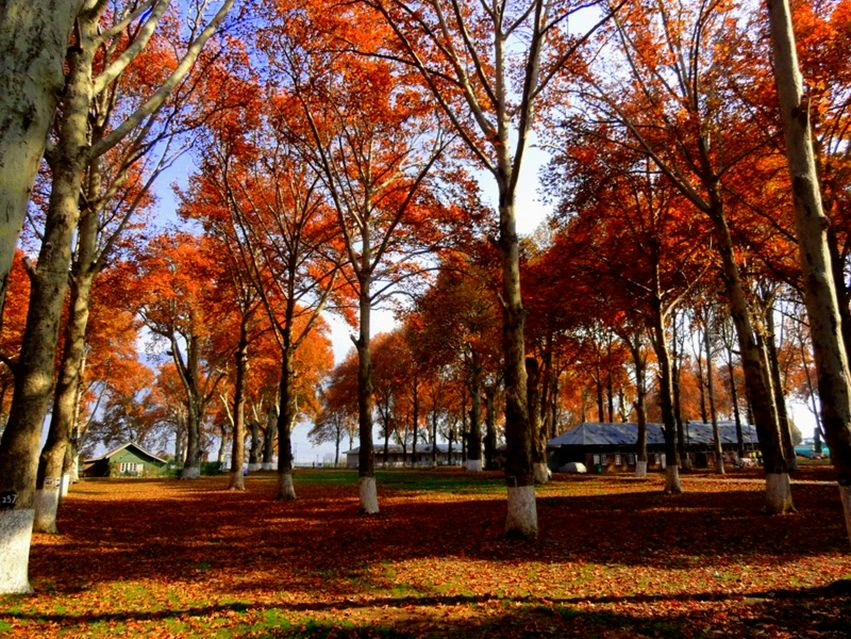
Evenings at Naseem Bagh campus were magical. The serene surroundings of Chinar trees created a peaceful retreat where we often sat after classes. Our favorite spot was Mir Sob’s shop, where cups of steaming tea accompanied our lively discussions. Whether we debated philosophical concepts, laughed over jokes, or planned our next assignments, those moments became a treasure trove of memories.
Memorable Moments
The first semester gifted me many unforgettable moments, but perhaps the most profound were my first few presentations. Standing in front of my peers and professors, I felt a mix of nervousness and exhilaration—a feeling that marked the beginning of my journey as a serious student of Political Science.
My first presentation in Indian Political System under the guidance of Dr. Sadiya Madam on the theme “How Politics Affects Sports”. As I spoke about how political ideologies and decisions influence the world of sports, I was initially overwhelmed. But her encouraging nods and constructive feedback boosted my confidence and made the experience unforgettable.
In Political Ideologies, under the guidance of Dr. Sakeena Madam, I presented “The Role of Ideology in Shaping Knowledge Systems”, The topic pushed me to think critically about how ideologies shape our understanding of the world. Her feedback reminded me that “knowledge is power, but ideology determines its direction.”
Another memorable moment was my presentation on “Challenges Faced by Women” in the Human Rights class with Dr. Anjum Madam. Speaking about societal and political hurdles women face was both intellectually stimulating and emotionally impactful. Her compassionate approach and motivational words added depth to the experience.
The Turning Point: A Serendipitous Encounter
Amidst the whirlwind of classes, assignments, and the sheer enormity of postgraduate studies, I found myself overwhelmed during the early days at the University of Kashmir. Adjusting to the rigorous academic environment and meeting the expectations of a new chapter in life had left me a bit anxious and uncertain.
One day, while leaving the Allama Iqbal Library, I unexpectedly met Dr. Mohd Younis Dar, who teaches at the Department of Urdu at the University of Kashmir..Dr. Younis Dar is not just a teacher but a beacon of guidance, a mentor who has always been there to inspire and uplift me. His warmth, wisdom, and genuine care for students make him stand out as an extraordinary individual. He has taught me the value of humility, the power of knowledge, and the importance of resilience in the face of challenges.
When he hugged me that day, it felt as though all my worries melted away. His kind words reminded me that I was not alone in this journey, and his encouragement became a source of renewed strength. Moments like these are rare, and they remain etched in my memory as symbols of support, friendship, and unwavering belief in one’s potential.
“You look like you’ve been carrying the weight of the world on your shoulders, Aamir,” he said with a kind smile. His words struck a chord, and before I knew it, I found myself sharing my worries with him—the pressure of new subjects, the fear of falling short, and the overwhelming nature of university life.
Dr. Younis Sir listened intently, his calm demeanor radiating reassurance. “Aamir, challenges are what shape us. Remember, you’ve already achieved so much. This phase is just another stepping stone, and I have no doubt you’ll conquer it with the same determination you’ve always shown,” he said, his words like a soothing balm for my anxious heart.
That brief encounter changed everything. His hug, his words, and his unwavering belief in me reignited the confidence I had momentarily lost. It was a reminder that I wasn’t alone in this journey and that I had a network of mentors who genuinely cared about my growth, both academic and personal.
From that day onward, I carried his words with me, allowing them to guide me through the challenges of the semester. It wasn’t just a moment of kindness—it was a turning point that gave me the strength to face my fears and embrace the journey ahead.
Tensions and Support
As enriching as the semester was, it came with its fair share of challenges. There was often a sense of tension about studies, with assignments piling up and presentations around every corner. However, the faculty ensured we never felt overwhelmed. Their consistent support and approachable nature eased our anxieties.
Whether it was Dr. Javid Sir staying back after class to clarify a complex idea or Dr. Shahnawaz encouraging us to take one step at a time, their guidance made all the difference. “You’re not alone in this journey,” they would say, reminding us that every challenge was an opportunity for growth.
Final Reflection
As I look back on my first semester at the University of Kashmir, I can’t help but feel an overwhelming sense of gratitude. This journey has been filled with challenges, moments of self-doubt, and countless hours of hard work, but it has also been a time of immense growth and learning. The support I received from my professors, the camaraderie I shared with my friends, and the sense of belonging I felt at the university have all played a crucial role in shaping this transformative experience.
Dr. Javid Ahmad Dar Sir, Dr. Shahnawaz Sir, Dr. Aijaz Sir, Dr. Anjum Madam, Dr. Sadiya Madam, and Dr. Sakeena Madam each brought something unique to the table, and their collective wisdom will continue to guide me throughout my academic journey. They didn’t just teach us the content; they taught us how to think critically, how to question the world around us, and how to approach knowledge with humility and respect.
Followed by Dr. Farooq Sir, who introduced us to the complexities of Comparative Politics, and Dr. Showkat Sir, whose insights into Public Administration deepened our understanding of the practical aspects of governance. Dr. Farooq Sir’s meticulous approach to comparative studies helped us grasp the nuances of political systems around the world, while Dr. Showkat Sir’s engaging lectures on public administration bridged the gap between theory and real-world application, offering us a clearer view of how politics and administration function together. Their guidance in the later part of the semester played a pivotal role in enriching our learning experience and broadening our perspectives. The bond I share ”with my friends, like Showkat, Aarif, Mushtaq, Irshad, and many others, has also been a cornerstone of my experience. The evenings spent at Mir Sobs Shop in Naseem Bagh, sipping tea and sharing our thoughts, will remain one of the most cherished memories of this phase of my life.
Despite the moments of tension and uncertainty, I always knew I had the support of my teachers and friends. Their encouragement helped me overcome my worries and kept me grounded, even when the road ahead seemed uncertain.
I am filled with gratitude and pride for being part of the Department of Political Science, a space that fosters intellectual growth, critical thinking, and academic excellence. The department is not just a hub of knowledge but also a nurturing ground where students are encouraged to explore, question, and evolve.
Under the guidance of exceptional faculty members, the department stands as a pillar of academic rigor and personal mentorship. It is a place where ideas flourish, discussions thrive, and every student feels valued. The support, encouragement, and camaraderie I have experienced here have left an indelible mark on my journey.
This first semester has been nothing short of transformative, and I owe much of it to the department that has become a second home. The friendships formed, the lessons learned, and the memories created will always remain close to my heart as I continue this enriching journey.
The writer is pursuing a Masters in Political Science at the University of Kashmir
Aamir Afzal Dar
aa*************@***il.com