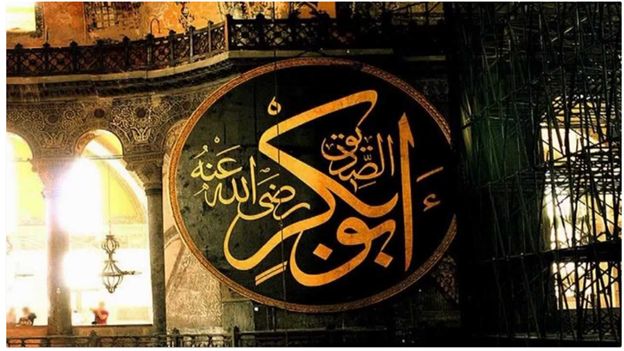
Hazrat Abu Bakr Siddiq (RA), the first pious caliph of the nascent state of Madina, was the lifelong associate, closest disciple and the most trustworthy companion of the holy Prophet Muhammad (PBUH). When ordained for Hijrat, the holy Prophet took Hazrat Abu Bakr in confidence and asked him to make necessary preparations for the journey to Yathrib (re-named Madina) and also to accompany him. Hence he earned the honorific title of ‘Companion of the Cave’.
Personally, Hazrat Abu Bakr (RA) was a man of unalloyed purity, remarkable simplicity and peerless affability. He was born and brought up in Mecca. He flourished as an honest businessman. In the pre-Islamic administrative set-up of Mecca, he as the chief magistrate was a man of consequence and by virtue of this post, he wielded much authority and enjoyed great respect in society. He was also a genealogist par excellence. He happened to be the neighbour of the holy Prophet (PBUH).
When the holy Prophet (PBUH) launched the preaching of Islam, Hazrat Abu Bakr (RA) was the first free male adult to have embraced the new faith without the least hesitation and became one of the first four who accepted Islam. Since then, he followed the holy Prophet resolutely and steadily throughout his life.
In spreading Islam, the disgruntled three pagans of Mecca inflicted all sorts of tyranny and oppression on the newly converted Muslims. He being an elite was not victimised so severely, but so many others were relentlessly persecuted.
As a consequence of the safe arrival of the holy Prophet (PBUH) in Madina, a series of wars ensued. He participated in all the battles. In the battle of Ohad he himself was wounded, even then he was one of those devotees who shielded the holy Prophet. At the time of preparations for an expedition to Tabuk, when it was a hard time for the people of Madina, the devoted Muslims contributed towards sinews of war whatsoever they could but he set a unique instance by volunteering whatever he possessed. When Haj was made obligatory, he was sent as Amir-i-Haj.
On this occasion, it was proclaimed that no pagan henceforth would enter the Kaba. This proclamation vetoed all nefarious activities committed in the sacred house and purified it of all sorts of abominations.
After the demise of the holy Prophet (PBUH), there naturally arose the question of who to succeed him to continue his mission and administer the state affairs. He, by virtue of his very close association with the holy Prophet (PBUH), was unanimously elected through the general consciousness of the people and installed as Caliph.
Receiving the oath of allegiance he in unequivocal words declared the policy of his governance: ‘O people! I have been made your Amir but I am not the best among you. If I do right, help me, if I err, correct me’. Further ‘that truthfulness is a sort of trust and falsehood is defalcation.’ he emphasised that ‘the weak among you will be strong before me, I will get his right restored and the strong in my eyes is weak and I will get from him the others’ dues and restore to the weak’. At the end of his address, he emphatically uttered, ‘Obey me till I obey Allah and His Prophet and if I disobey Allah and His Prophet I shall have no right to claim your obedience.’ This was his manifesto.
After consolidating the state internally he focused towards external enemies to deter the imminent threats of aggressions from the then two big powers, the Persians and the Byzantines. The wars fought against these formidable enemies in Iraq and Syria, which ultimately expanded the Islamic State, were launched during his caliphate.
He led a very simple life and earned his livelihood through business but when he had to devote full time to running the state affairs, he for a certain period took a sort of stipend from the Bait-ul-Maal for his subsistence for which he willed to get it replenished. During his caliphate spread over only two years and three months, he strictly followed the path set by the holy Prophet (PBUH). He discharged his responsibilities with honesty, integrity and sagacity till he breathed his last on the 22nd of Jamadi-us-Sani.
The writer is a student of Islamic Studies at the Central University of Kashmir and can be reached at ir***********@***il.com
Hazrat Abu Bakr Siddiq (RA): An Exemplary Companion of Prophet (PBUH)