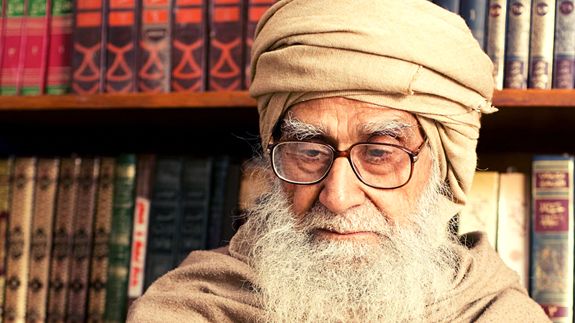


The revolutionary feature of Mawlana’s religious thought is that he understood Islam vis-a-vis the modern age where scientific developments, cultural trends and philosophical issues are prevalent
Ijtihād, ordinarily means extreme struggle to achieve something. According to the Islamic religious point of view, Ijtihād aims to solve different arising issues in the light of the Qur’an and Sunnah vis-a-vis human needs. Both Qur’an and Sunnah encourage exercising human intellect to comprehend things. Islamic teachings keep a vast scope for Ijtihād since its early inception. Muslim history witnessed multiple personalities who attempted to open the door of Ijtihād in order to make Islamic teachings relevant for all times. Mawlana Wahiduddin Khan was among them who strongly focussed on the need of Ijtihād. He was a keen observer of his times and he raised the issue of Ijtihād highly in his speeches and writings. He was born in 1925 in Azamgarh UP India. He studied Islam in depth, and concurrently he made an assessment of the socio-political situation of the Muslim world in order to present an acceptable image of Islam. Mawlana comprehended Islam in a moderate and peaceful way. He characterises Islam as a phenomenon of a perennial, firm, and pious relationship between Allah and individuals.
Islam, in its unadulterated and original form, is a manifestation which binds human beings with Allah, says Mawlana. The movement of Islam, according to him, aims to induce, persuade and convince the people to apprehend their relationship with Allah. Moreover, Islam fundamentally aims to achieve the targets of maintaining a human existence in individuals, to create a sense of accountability in human beings, and enriching their morality. Islam seeks a pious life and selfless love of Allah from human beings. This bond between Allah and humanity in Qur’ān has been summed up in a single and comprehensive word called ‘Ibādt. He says that Islam seeks two types of demands from its adherents: one is factual or real demand and another one is additional demand. Mawlana says that real demand concerns the inner and outer life of an individual, while additional demands are related to the peripheral life of the individual. These additional demands are contingent on the situation and fluctuate according to the capacity of the individuals.
Ijtihād constitutes a main ingredient of Mawlana’s religious thought. He presents the meaning, nature, and importance of Ijtihād in the light of modern days and the needs of Islam. He says that the very first task of Muslims is to reconstruct the teachings of Islam in the light of contemporary times. Ijtihād in Islam aims to comprehend the revealed teachings in-depth and made them applicable in modern days. He says that to maintain Islam in modern dynamic circumstances, Ijtihād is imperative. Furthermore, to present a positive picture of Islam, ijtihād plays a vital role in contemporary times. According to Mawlana, Ijtihād means to attempt the utmost to deduce new commandments and solutions for the prevailing issues from the basic sources of Islam directly. He says that Ijtihād is the only religious mechanism through which we can present a pristine picture of Islam, and can maintain its validity and legitimacy for all times. Depending upon the sources of Ijtihād, he says that it is of two types: Ijtihād-i-Mutlaq and Ijtihād-i-Muqaid. The former is to utilize the basic sources of Islam i.e., Qur’ān and Sunnah to deduct new issues, while the latter means when we base the efforts of our predecessors to solve any issue or to extract a new commandment. However, Mawlana says that what the Muslims of modern times need is to exercise Ijtihād to solve the issues.
Depending upon the situational role of Ijtihād, Mawlana divides Ijtihād into two types: Ijtihād-i- ‘āmm (common Ijtihād) and Ijtihād-i-khās (proper Ijtihād). Common Ijtihād, according to Mawlana, is the efforts to solve the apparent issues of Islam, like issues related to ablution, prayers, etc. While proper Ijtihād aims to solve those issues which are related to the inner dimension. He says that in contemporary times, the need of the hour is to exercise proper Ijtihād at large. Scientific developments, political changes, the emergence of new economic avenues, and various developments at the societal level have brought novel issues. To tackle these issues and to prove the cogency of Islamic teachings, proper Ijtihād is of utmost necessity. Discussing the basic qualification and conditions for exercising Ijtihād, he lays down six conditions:
rich knowledge of Qur’ān
proper awareness about Sunnah
hold on to sayings of predecessors(aslāf)
fully accessible in the Arabic language
art of inferencing issues from the basic sources, and
complete knowledge about the prevailing circumstances.
Islamic teachings lead human beings in two aspects: on one hand it guides human beings about the realization of the creator, and on the other hand, it provides explicit principles about the correlation between human beings, social issues, economic issues, etc. Since human society is dynamic in nature. It varies from time to time and from place to place. Therefore, to meet the needs of this dynamic nature of society, it is pertinent to comprehend the Islamic teachings in light of demands of the society. For that very purpose, Ijtihād is a must. Islam has always paved the way for the Ijtihād. In this sense, Ijtihād aims to make Islamic teachings compatible with the changing circumstances, says Mawlana.
The revolutionary feature of Mawlana’s religious thought is that he understood Islam vis-a-vis the modern age where scientific developments, cultural trends and philosophical issues are prevalent. According to Mawlana, the modern age should not consider to be anti-Islam. He says that all that is needed for an acceptable face of Islam is to comprehend and interpret it in the light of modern challenges and needs, and to make Islamic teachings relevant in modern times.
Mawlana, an erstwhile Jam ‘āt-i-Islāmī member, decided to disassociate himself from the movement and engrossed in the dissemination of Islamic teachings among the people of all sects. He disagreed with the political and armed activities for the revival of Islam. Mawlana gave a high place to Daw ‘ah practice in his teachings. He presented his religious thought considering the prevailing circumstances and the demands of time. Peace occupies a central position in the religious thought of Mawlana Wahiduddin Khan. He saw Islam as an invitational program which asks individuals to surrender before the truth. He highlighted the cosmopolitan facet of Islam. Daw ‘ah, Ijtihād, and interfaith discourse constitute some main aspects of his religious interpretation. He says that Islam stipulates a conflictless and peaceful struggle for inviting people towards Allah. It never consents to anything which causes insidious consequences. Mawlana says that since its early inception, Islam has paved the way for the invitation, so it keeps no room for any violent act. He further says that the need of the hour is to reconstruct our relationship with Islam and try to preach it to others too.
Mawlana says that the only effective, profound, and peaceful mechanism to reconstruct Islam is to spread Islamic teachings among non-Muslims. He says that Muslims should prefer Islamic Daw ‘ah in any situation, and should get benefit from modern resources. It is the only feasible means through which a congenial atmosphere can be created. According to Mawlana, during the nineteenth century, Islamic revivalism became the pivotal theme of Muslim scholarship, and in this regard, various attempts were made, however, unfortunately, these attempts were based on political vision, and hence, Daw ‘ah received meagre attention. In the context of the contemporary social structure of Muslim societies, the need of the hour is to recognise the dynamism and importance of Islamic Daw ‘ah. Mawlana says that the primary duty of every responsible and faithful Muslim is to preach Islamic teachings among non-Muslims. He believes that Islamic Daw ‘ah is the only operative means to pull out Muslims from religious crises.
The author is a research scholar at IUST Awantipora’s Department of Islamic Studies, and can be reached at ni*********@***il.com