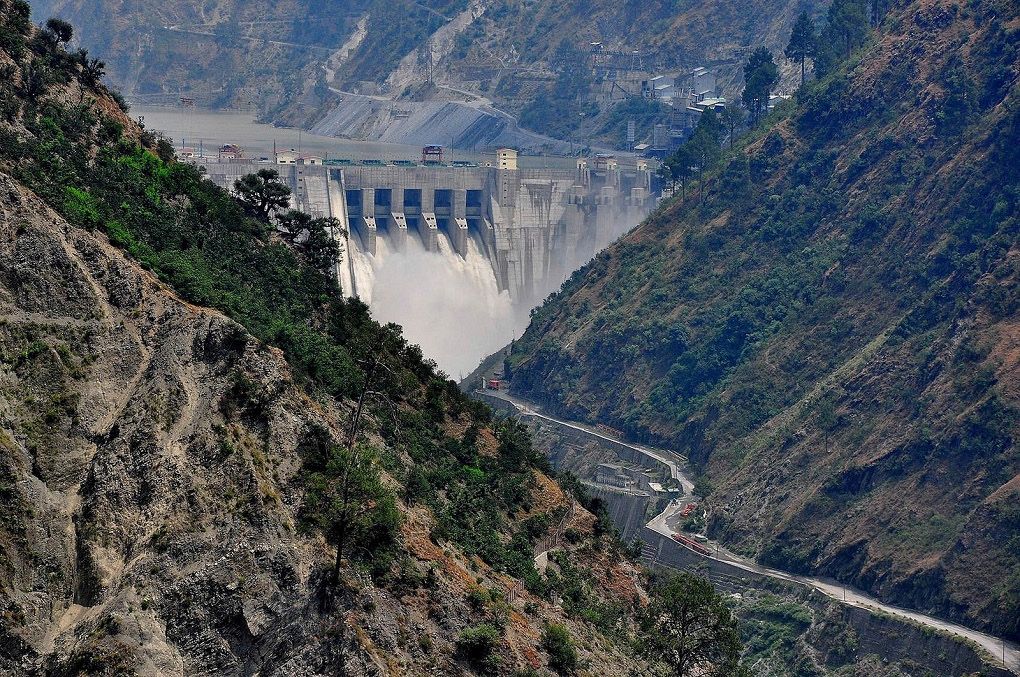


Jammu and Kashmir has enormous potential for producing hydel power, though it is not known for energy resources like coal, gas, or petroleum. The hydel power lies untapped in its numerous turbulent streams that burst down precipitous mountains. Both the topography of the land and the flow of the water are ideal for hydroelectric power production. The state’s projected hydel power generation capacity is 2000 MW, but some more recent studies dispute this number by putting the capacity at 3500 MW. Only 10% of this enormous potential has been harnessed thus far, leaving the remaining 90% unrealised. Even a significant portion of the overall tapped potential goes into the kitty of National Hydro Electric Power Corporation (NHPC), leaving just a little portion or peanuts to the UT of J&K.
Power projects owned by NHPC:
Salal hydroelectric power project: This is situated at stream Chenab in the Reasi district of Jammu division, with an initial capacity of 690 MW. Work on this undertaking was begun in 1970 and its first unit was charged in 1987. First unit of Stage II was charged in 1993, second in 1994 and third in 1995. The project since its inception is running under NHPC and the power produced goes to the northern grid.
Dulhasti hydroelectric power project: The project has come up over two waterways of the Chenab in Kishtwar district. Dul and Hasti are two distinct areas joined by the dam and the force of the streams is to be reckoned with separately. The development work began in 1985 and the unit became functional in 2007. The venture has an all-out introduced limit of 390 MW. This project is likewise worked and maintained by the NHPC and its output is moved toward the northern grid.
Uri hydroelectric power project: This undertaking has come up on a waterway of the Jhelum close to Uri in Kashmir division. The project has an introduced limit of 480 MW (phase I). The Northern Grid receives a significant portion of the power that is supplied by this project, which is likewise operated and maintained by NHPC.
Baglihar Power Project: It is being built across the Chenab River close to Batote. The project’s 900MW installed capacity is its whole capacity. The first phase of the project, which began in 1999 and had a first-phase operational completion date of 2008 with a 450 MW installed capacity, was completed in November 2015. Despite fierce opposition from the general public and PDC personnel, the project, which was completely owned by the erstwhile state of J&K, was handed over to NHPC after a successful run of about three months.
Power projects owned by Jammu Kashmir Power Development Department (JKPDD):
Mohra hydroelectric power project: It was built and put into service in 1907, during the reign of the former Maharaja. It is the oldest power project in the state. Its entire installed capacity is 9MW, and it is situated on the Jhelum River in Mohra in Baramulla district. Being the second hydroelectric power project on the Indian subcontinent, it has the distinction of being the first in India.
Lower Sindh Hydroelectric Power Project: This was established in 1956 and is situated on Nallah Sindh in Ganderbal. A man-made canal, commonly referred to as the power canal and bringing waters from Nallah Sindh, feeds the power plant. 15MW is the project’s total installed capacity.
Lower Jhelum Hydroelectric Power Project: This project uses the Jhelum River to generate electricity, with the power plant being in Warikhwal.
Upper Sindh (Sumbal) hydroelectric power project: This project harnesses the running waters of Nallah sindh with power house at Sumbal. The project was commissioned in the year 1973 and has an installed capacity of 22.60MW.
Upper Sindh (Kangan) hydroelectric power project: Its power house has come up utilizing the waters of Sindh nallah. The project has a total capacity of 105MW.
More than 3500 megawatts of electricity are generated in Jammu and Kashmir each year by 24 hydroelectric projects located throughout the union territory’s several districts. The Kashmir region generates about 2500 megawatts of electricity, which is enough to supply the valley with electricity every day of the year. But in the winters, Kashmir Valley is starved of electricity and large parts continue to be in complete darkness for long hours. The government has announced a schedule for power outages that includes a daily 4.5-hour outage in metered regions and an eight-hour outage in non-metered areas, but this is observed more in the breach.
Winter is significantly harsher and more difficult to survive when there are power outages and temperatures below zero. Consumers of electricity in Kashmir are getting increased power bills as a result of the Joint Electricity Regulatory Commission (JERC) approving an 8% to 22% increase in residential, commercial, industrial, and agricultural power tariffs throughout the union territory. This has incensed the people of Kashmir but the UT government has only turned a deaf ear to the complaints.
In Ganderbal and Doda, the district administration has placed limitations on the sale of electric appliances and urged store owners to refrain from selling heating equipment to people. Restrictions have been placed on the sale of heaters, geysers, electric blankets and other electric appliances. Without such essentials as heaters and warm water for bathing in the bitter winter, how could a human possibly survive in the minus temperature zone? We are only obliged to pay our electricity bills on time just as we regularly have to recharge our mobile phones.
The writer is a student of MSc in Zoology. He tweets @peermohdamir and can be mailed at eh**********@***il.com