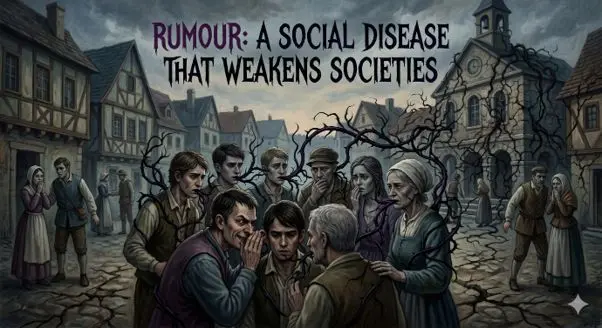


Rumours are a social disease that silently weakens societies. They cannot be effectively countered through laws and regulations alone; they require knowledge, awareness, moral responsibility, and adherence to ethical and religious values. As long as we continue to favour speculation and sensationalism over verification, the rumour mill will remain active. However, if every individual embraces responsibility and commits to truthfulness, the light of truth can indeed overcome the darkness of falsehood.
Syed Mustafa Ahmad
It would not be an exaggeration or a foolish statement to say that ever since human beings set foot on this earth, rumours have accompanied them in one form or another. Times have changed, communication technologies have advanced, and the world has become a global village, yet the circulation of rumours has not stopped; rather, it has become faster than ever before. Today, rumours seem to greet us in every street, lane, and highway. At times, they spread so rapidly that even the truth struggles to catch up with them.
A rumour is essentially a piece of news, information, or a story whose authenticity is uncertain or surrounded by doubt. Wisdom demands that such information be treated with caution and that no suspicious claim be accepted without verification. Unfortunately, the opposite is often observed in our society, where unverified information quickly passes from one person to another.
Rumours exist in countless forms and categories, but my purpose is not to classify them. Rather, I wish to examine the factors that enable rumours to travel from one place to another in the blink of an eye and to understand their impact on individuals, society, and collective consciousness.
As I have mentioned in my previous writings, I am neither a renowned author nor an experienced columnist. Driven by a love for reading and a desire to express my thoughts through writing, I occasionally attempt to put my ideas into words. This article is another effort in that ongoing journey.
The subject of rumours is vast, complex, and socially significant. It is impossible to cover all its dimensions in a brief article, but some important aspects can certainly be highlighted.
In my humble opinion, the first and most fundamental reason behind the spread of rumours is a distancing from religious values. Islam strictly discourages the transmission of information without verification. The Holy Qur’an teaches us to investigate any news we receive so that no individual or group suffers injustice due to ignorance or haste. Sadly, many of us are more eager to forward information than to verify its authenticity. This haste serves as fertile ground for rumours.
Another major reason is the lack of knowledge and awareness. While there is no shortage of highly educated individuals in our society, genuine intellectual maturity, critical thinking, and a spirit of inquiry are not always present. Some people hear half a story and construct the rest themselves. Others narrate hearsay as though they personally witnessed the events. As a result, truth is left behind while falsehood and exaggeration find a place in people’s minds.
Prejudice and preconceived notions also play an important role in the spread of rumours. We often form opinions about individuals, groups, or ideologies beforehand. When an unverified report about them reaches us, we tend to accept it without investigation and pass it on to others. Similarly, if we already hold a negative impression of someone, every allegation against them appears believable, while the mistakes of those we favour are often overlooked or justified. Such attitudes push truth into the background and allow rumours to flourish.
Another reason rumours spread is our inability to distinguish between truth and speculation. Many people form opinions based on emotions, hearsay, or personal preferences. The habit of questioning, investigating, and tracing information back to its original source is gradually weakening. Yet understanding the authenticity of information requires examining not only the claim itself but also its source and context. When blind trust replaces critical inquiry, rumours gain strength.
In many cases, unverified beliefs and stories are passed down from one generation to the next. Parents pass them on to their children, who then pass them on further, often without any effort to verify them. When the habit of questioning and seeking truth declines, the path for rumours becomes increasingly smooth.
The careless use of social media has become another significant factor. Today, a single mobile phone and an internet connection can spread information to thousands, even millions, of people within moments. Unfortunately, many users share messages, images, and videos without checking their authenticity. Consequently, baseless claims often acquire the appearance of truth.
In the age of social media, another worrying trend is the tendency to form instant opinions. We often see a message, image, or video and immediately pass judgment, only to discover later that the information was false or presented out of context. Such haste not only creates misunderstandings but can also damage the reputation of individuals, institutions, and entire communities.
Furthermore, sensationalism and the desire for recognition contribute significantly to the spread of rumours. Some people circulate unverified information simply to attract attention or appear well-informed. Others deliberately create rumours for political, social, or personal gain, seeking to influence public opinion or harm particular individuals, institutions, or groups.
Rumours also spread rapidly because many people feel the need to have something to discuss. Once a rumour emerges, individuals add their own interpretations, assumptions, and commentary. As a result, a minor claim can quickly evolve into an elaborate story.
Blind imitation further worsens the problem. We often repeat what others say without considering whether it is true. Such behaviour promotes a herd mentality rather than a commitment to truth and gives rumours additional momentum.
The consequences of rumours are often severe and far-reaching. First and foremost, they create distrust within society. People become suspicious of one another, and social relationships begin to weaken. In many cases, rumours cause conflicts between families and distance friends from one another. At times, they even contribute to sectarian tensions, social unrest, and public anxiety.
Another major harm is their impact on mental well-being. Rumours generate fear, uncertainty, and anxiety. When it becomes difficult to distinguish between truth and falsehood, collective reasoning weakens, and people lose their ability to make sound decisions. For this reason, rumours are not merely harmless words; they can pose a serious threat to social peace and stability.
The effects of rumours extend beyond personal relationships and influence the collective psychology of entire communities. The constant circulation of unverified information fosters fear, mistrust, uncertainty, and confusion. Over time, the social environment becomes increasingly toxic, and public confidence begins to erode.
Regrettably, we often fail to learn from past experiences. Time and again, we witness the damage caused by rumours, yet we continue to repeat the same mistakes. If rumours have brought us nothing beneficial in the past, there is little reason to expect them to bring any good in the future.
The need of the hour is to develop the habit of examining every piece of information through the lens of verification. If the authenticity of a report is doubtful, it is better to stop it there rather than pass it on. Parents, teachers, religious leaders, and the media all share the responsibility of promoting critical thinking, research, and responsible behaviour. The struggle against rumours must begin with each individual, for only a responsible person can contribute to a responsible society. At the collective level, an environment that encourages fact-checking and mutual verification is equally essential.
In short, rumours are a social disease that silently weakens societies. They cannot be effectively countered through laws and regulations alone; rather, they require knowledge, awareness, moral responsibility, and adherence to ethical and religious values. As long as we continue to favour speculation and sensationalism over verification, the rumour mill will remain active. However, if every individual embraces responsibility and commits to truthfulness, the light of truth can indeed overcome the darkness of falsehood.
Let us all take serious and practical steps in this direction so that we may navigate our collective vessel away from the storm of rumours and towards the safe shores of peace, trust, and truth. The journey may be demanding, but its rewards are lasting, meaningful, and beneficial.
sy**********@***il.com