

NEW DELHI: A powerful El Nio event appears to be taking shape in the tropical Pacific Ocean, and early forecasts are raising concerns that the phenomenon may not only strengthen significantly over the coming months but could also persist well into 2027, potentially reshaping weather patterns across the globe.
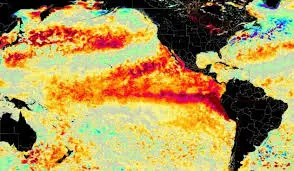
The latest North American Multi-Model Ensemble (NMME) sea surface temperature forecast for the November-December-January 2027 period paints a striking picture.
Large swathes of the central and eastern equatorial Pacific are projected to record sea surface temperatures more than 2 degrees Celsius above normal, with some model outputs indicating anomalies exceeding 5 degrees Celsius.
If realised, such warming would place the event among the strongest El Nio episodes ever observed.
Climate scientists classify a “Strong” El Nio when sea surface temperatures in the Nio 3.4 region of the equatorial Pacific rise between 1.5°C and 1.9°C above average. A “Very Strong” or “Super” El Nio is declared when anomalies exceed 2°C.
The latest projections suggest that the threshold could be crossed comfortably by the end of 2026.
Experts caution that forecasts this far ahead carry substantial uncertainty and should not be interpreted as a certainty. However, the consistency of the warming signal across multiple climate models is attracting attention within the meteorological community.
Climate analysts have said that this is not a forecast that can be dismissed lightly, noting that the projected ocean temperatures indicate the potential for an exceptionally powerful climate event.
El Nio occurs when unusually warm waters spread across the equatorial Pacific Ocean, altering atmospheric circulation patterns around the world. The phenomenon can trigger droughts in some regions, floods in others, marine heatwaves, coral bleaching and record-breaking global temperatures.
The timing is particularly significant as the planet is already experiencing unprecedented warmth driven by long-term climate change. A major El Nio event developing on top of elevated global temperatures could push weather extremes to new levels.
For India, El Nio has historically been associated with weaker monsoons, below-normal rainfall and heightened risks to agriculture and water resources. While the relationship is not absolute, strong El Nio events have often coincided with drought years and heatwaves across South Asia.
Globally, forecasters will be watching for impacts ranging from wildfire risks in parts of Australia and Southeast Asia to flooding across western South America and disruptions to marine ecosystems in the Pacific.
While it remains too early to predict the exact strength of the event, one message from the latest forecasts is becoming increasingly clear: the Pacific Ocean is warming rapidly, and the world’s climate systems may be entering a period of heightened volatility that could extend through 2027.
Agencies