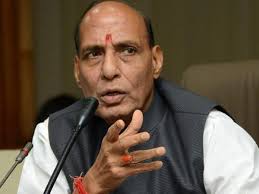


NEW DELHI: Defence Minister Rajnath Singh on Monday said that instability in neighbouring countries often spills into the maritime domain and urged the Indian Coast Guard (ICG) to respond swiftly to external developments.
Addressing the inaugural session of the 42nd Indian Coast Guard (ICG) Commanders’ Conference in ICG Headquarters here, the Defence Minister cited frequent developments in Myanmar, Bangladesh, Nepal, and other regional nations that impact coastal security, especially in the Bay of Bengal, through refugee influx, illegal migration, and irregular maritime activities.
Urging the ICG to maintain not just routine surveillance but also geopolitical awareness and readiness to act swiftly to external events, Singh underlined the force’s critical role in safeguarding India’s 7,500-km-long coastline and island territories.
Stating that maritime threats are becoming increasingly technology-driven and multi-dimensional, he said, “What were once predictable patterns of smuggling or piracy have now evolved into sophisticated operations using GPS spoofing, remote-controlled boats, encrypted communications, drones, satellite phones, and even networks operating on the dark web.”
He also warned that terrorist organisations exploit modern tools such as digital mapping and real-time intelligence to plan their activities.
“Traditional methods are no longer sufficient, we must be ahead of criminals and adversaries by integrating Artificial Intelligence, Machine Learning-based surveillance, drones, cyber defence systems, and automated response mechanisms into our maritime security framework,” he highlighted further.
The defence minister further cautioned that cyber and electronic warfare are no longer hypothetical threats but present-day realities. “A nation may attempt to paralyse our systems not with missiles, but through hacking, cyber-attacks, and electronic jamming. ICG must continuously adapt, upgrading its training and equipment to guard against such threats. Automated surveillance networks and AI-enabled systems are essential to reduce response time to seconds and ensure readiness at all times,” he said.
Linking maritime security directly with India’s economic well-being, Singh underscored that ports, shipping lanes, and energy infrastructure are lifelines of the nation’s economy. “A disruption in maritime trade whether physical or cyber can have cascading effects on security and economy alike. We must treat national security and economic security as one and the same,” he stressed.
“By patrolling the Exclusive Economic Zone (EEZ), the ICG not only deters external threats but also addresses illegal fishing, drug and arms trafficking, smuggling, human trafficking, marine pollution, and irregular maritime activities,” he added.
Singh further contrasted land and maritime borders, noting that while land boundaries are permanent, clearly marked and relatively predictable, maritime borders are fluid and constantly shifting due to tides, waves and weather. “A smuggling vessel may look like a fishing boat, a terrorist group may exploit the openness of the sea, and threats may emerge invisibly. Maritime security is far more complex and unpredictable than land borders and demands constant vigilance.”
Agencies