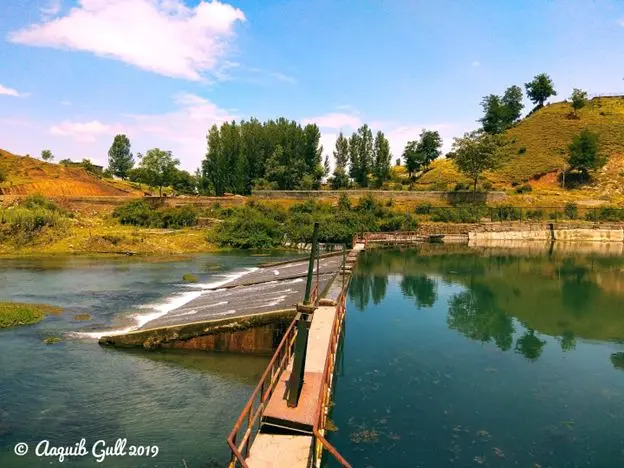


A sacred water source near Qazigund, rich in history and spiritual significance, remains neglected in development efforts. There is an urgent need to preserve its cultural and ecological legacy.
Barely two kilometres from Qazigund, in the southern lap of Kashmir’s Anantnag district, lies Panzath Nag—a serene yet significant site that remains largely overlooked in state planning and tourism development. Rich in history, hydrology, and heritage, Panzath is not merely a village; it is a living ecosystem and a cultural landmark.
The name Panzath is itself a poem, born from the Kashmiri words paanch (five) and haath (hundred), evoking the legendary five hundred springs that once laced its soil like veins of silver. Though time and circumstance have reduced their visible count, the pulse of abundance has not faded. These ancient waters have wandered through orchards, fields, and hearts, nourishing more than two dozen villages, stitching people, land, and legend together.
Yet, to those whose roots run as deep as the waters—whose childhoods echo with the song of brooks and myth—Panzath is more than hydrology or heritage. It is the very source of belonging. I write not as a mere witness, but as a son of the soil— who has guzzled from its springs, witnessed its quiet dignity and I write as a soul entwined with its banks—a keeper of its secrets, and a bearer of its longing.
Echoes from antiquity
Panzath Nag rises from the mist of ancient chronicles. In Kalhana’s Rajatarangini and the venerable Nilamata Purana, its springs are not only mapped but revered—sacred mirrors where the physical and spiritual meet. Here, Central to Panzath Nag’s living mythos is the spirit known as Nag Mouj—the “Mother of the springs”. The name itself is layered with meaning: Nag in Kashmiri means both spring and serpent, and thus, Nag Mouj can signify both “Mother of the Waters” and “Serpent Mother”. This duality is no accident. Kashmir’s most ancient religious impulse—predating written records—is Nāga worship, the veneration of serpentine water deities that held dominion over rivers, lakes, and subterranean springs. Panzath, with its teeming veins of water, would have been a natural seat for such devotion.
Being a student of history, we can link its sanctity to major pan-Indian deities, but there is no historical reference specifically. Instead, what echoes through time is this older devotion—earthy, mysterious, and deeply local. The spring is not simply a natural resource here; it is a divine presence, a feminine spirit, and a maternal protector. The Nag Mouj is not a tale—it is a living idea, revered quietly by generations who witnessed her constancy in nurturing the land and its people.
As time unfolded and Kashmir’s religious landscape evolved, so too did the village’s role in spiritual life. During the medieval period, Sheikh Aftab (RA), a revered Sufi saint, is believed to have lived near these very springs. His presence stitched a new sanctity onto the land—one that reflected the inward journey, the quiet surrender, and the Sufi way of merging with the divine through nature and solitude. His legacy left a lasting imprint: a shrine now stands near the spring, not as a monument but as a marker of peace, silence, and sanctity.
It is no coincidence that a saint found solace next to these waters. Whether through ancient Nāga rites or later Sufi reverence, Panzath Nag has always been more than a geographic location—it has been a portal, a space between the seen and unseen, where water becomes a teacher and time stands still.
So it is sanctifying through every rill and ripple. To tread these banks, even now, is to step into a living temple of water and memory, where prayers move like currents and stories take shape in reflection.
Festival of the sacred and the sustainable
Panzath has never relied solely on the past for its meaning. Every May, as spring renews the land, the village beats with collective purpose during the annual Gaade Maar festival. In an act both festive and solemn, men, women, and children join hands in the pristine pools – with simple wicker baskets, they catch not just fish, but duty: cleaning, weeding, and restoring the springs.
In this sacred labour, tradition becomes environmental foresight—a dance of celebration and stewardship taught by ancestors and sustained by love. With this act, ecology becomes ritual. It is an annual homage, not only to sustainability, but to those ancient beliefs that once saw every spring as a spirit, every ripple as a whisper of divinity
The forgotten promise
Despite these deeply rooted practices, Panzath Nag remains largely forgotten in developmental narratives. It is heartbreaking, however, that Panzath Nag remains off the map—invisible to tourism initiatives, absent from cultural narratives, and barely considered in ecological planning. Despite its undeniable relevance—as a rare blend of biodiversity, heritage, and hydrology—there are no signposts, no eco-trails, no educational outreach, and no support to help the village share its immense cultural capital with the world.
Though a government-run fish farm exists here and the Jal Shakti Department maintains basic infrastructure, so much more could be done. Eco-tourism, nature education camps, folk heritage walks, and homestays can be imagined here, not for profit alone, but to gently share a tradition still alive while protecting its integrity.
Let the waters speak
Panzath Nag is not a ruined temple or buried tale. It breathes through the springs, speaks through the stories, and waits—with the patience of still water—for someone to listen.
Perhaps, in a world rushing toward change, its greatest gift is the reminder to pause. To respect what is slow, sacred, and sustainable.
Let us not wait for a monument to be declared or a tragedy to be mourned before recognising a legacy already in motion. The village, the springs, the shrine, and the spirit(Nag Mouj)—they are already preserving themselves.
This is an earnest appeal to policy-makers, cultural bodies, tourism officials, and civil society to recognise and revive Panzath Nag. Let this sacred spring not be reduced to footnotes in old texts or anecdotes in fading memories. Let it be restored, protected, and celebrated as a symbol of Kashmir’s timeless relationship with water, nature, and heritage.
For the sake of our springs and our stories,
Now, it is our turn to preserve them.
So let us not wait for its waters to dry before we remember their worth.
Let this spring of promise not be forgotten.
Let Nag Mouj not fade into myth.
The writer is a lecturer, on “academic arrangement”, at PG Department History, Government Degree College (GDC) Bemina, Srinagar
Dr Masrat Ahmad Mir
ma*********@***il.com