

The story of the ozone layer is a powerful reminder of both the damage humanity can cause and the positive change we can achieve through global cooperation
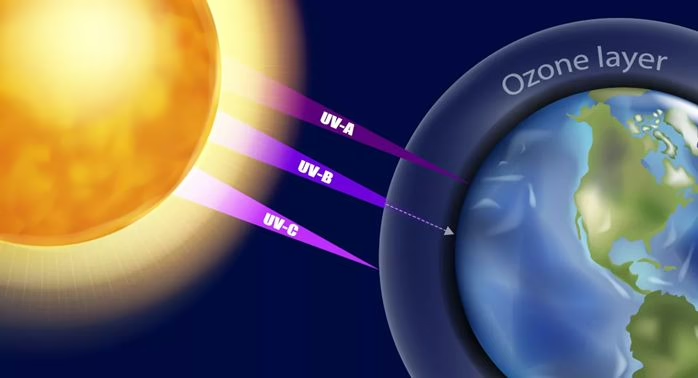
In the invisible armour that protects Earth from the harshness of space, the ozone layer plays a critical role. This thin but powerful layer of gas in the stratosphere, located roughly 10 to 50 kilometres above the Earth’s surface, acts as a natural shield by absorbing the majority of the sun’s harmful ultraviolet (UV) radiation. Without it, life as we know it would be in grave danger. Yet, decades of human activity have weakened this vital defence, with severe consequences for both human and animal health.
Understanding the Ozone Layer
Ozone (O₃) is a molecule composed of three oxygen atoms. While ozone at ground level is a pollutant and contributes to smog, stratospheric ozone is essential for life. It filters out UV-B radiation, the most biologically damaging component of sunlight. In the 1980s, scientists discovered a worrying thinning of the ozone layer, particularly over Antarctica—a phenomenon that came to be known as the “ozone hole.”
Human-made chemicals known as chlorofluorocarbons (CFCs), once commonly used in refrigerators, air conditioners, and aerosol sprays. These compounds rise into the stratosphere, where they break down ozone molecules, drastically reducing the layer’s ability to absorb UV radiation.
Impact on Human Health
With less ozone to shield us, more ultraviolet rays reach the Earth’s surface, posing serious health risks. One of the most direct and dangerous effects is the increase in skin cancer, particularly malignant melanoma and non-melanoma skin cancers such as basal cell carcinoma and squamous cell carcinoma.
According to the World Health Organization (WHO), a 10% reduction in ozone levels can result in an additional 300,000 cases of non-melanoma skin cancer and 4,500 cases of melanoma worldwide each year. These are not just statistics—they represent a silent, growing threat to global public health.
Beyond skin cancer, UV radiation also causes cataracts, a clouding of the eye’s lens that can lead to blindness if untreated. It can also suppress the immune system, making the body more vulnerable to infections and diseases. Children, outdoor workers, and people with lighter skin tones are particularly at risk.
Effects on Animal Health
The animal kingdom has not been spared either. Just like humans, animals are susceptible to the harmful effects of increased UV radiation. Domestic animals, especially those with thin fur or light pigmentation, can develop skin cancers and eye diseases, including cataracts.
Marine life is especially vulnerable. Phytoplankton, the microscopic organisms that form the foundation of oceanic food chains, are highly sensitive to UV light. A decline in their population due to ozone depletion can ripple up the food chain, affecting fish, marine mammals, and even human communities that rely on seafood for sustenance.
Amphibians, already facing global decline from habitat loss and pollution, are doubly threatened. Their permeable skin and life cycles that span both land and water make them particularly sensitive to UV radiation, leading to developmental issues and higher mortality rates in eggs and larvae.
The Cancer Connection
The link between ozone layer depletion and cancer, especially skin cancer, is now scientifically undeniable. As the Earth’s natural UV filter weakens, the risk of radiation-induced DNA damage increases. This DNA damage is a primary trigger for mutations that lead to cancer.
In countries with high UV exposure, like Australia and New Zealand, skin cancer is the most common form of cancer. Public health campaigns in these nations have aggressively promoted sun safety awareness, urging citizens to “Slip on a shirt, Slop on sunscreen, and Slap on a hat.” These efforts underscore the urgency of protecting ourselves in a world where the ozone layer is no longer as strong as it once was.
International Action and Signs of Hope
In response to the ozone crisis, the global community acted with rare unity. The Montreal Protocol, signed in 1987 and ratified by almost every country, successfully phased out the production and use of ozone-depleting substances like CFCs. This landmark agreement has been hailed as one of the most successful environmental treaties in history.
Recent satellite data show that the ozone layer is gradually healing. If current policies remain in place, scientists estimate that it could return to pre-1980 levels by the middle of the 21st century. However, the repair is slow and ongoing. Any backsliding, such as illegal production of banned substances, could reverse progress and reignite the crisis.
Conclusion
The story of the ozone layer is a powerful reminder of both the damage humanity can cause and the positive change we can achieve through global cooperation. While progress has been made, the threat is not over. Continued vigilance is essential to protect this fragile shield.
For individuals, the battle is also personal. Protecting oneself with sunscreen, wearing protective clothing, and avoiding excessive sun exposure are now routine parts of life in many countries. But these are only stopgaps.
Ultimately, the health of our planet—and all its inhabitants—depends on our ability to respect and protect natural systems like the ozone layer. The rise in cancer rates and environmental disruptions linked to ozone depletion should serve as a wake-up call. Our shield is healing, but our responsibility remains.
The writer is an environmental researcher and columnist
Sahil Jahangir Mir
sa***************@***il.con