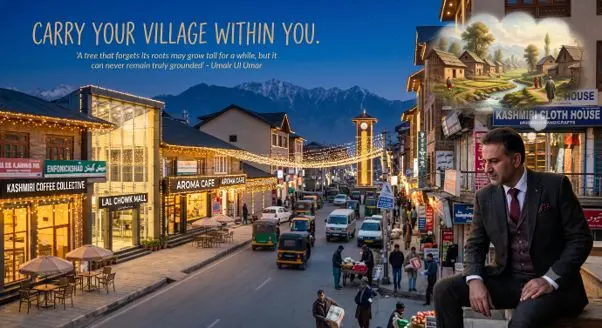


‘A tree that forgets its roots may grow tall for a while, but it can never remain truly grounded’
Umair Ul Umar
Many professors, doctors, engineers and civil servants residing in Srinagar today were born and raised in villages. Those villages nurtured them, educated them, protected them through hardship and shaped the character that eventually led them to success. Every milestone they celebrate today has its earliest foundation in the dusty lanes, modest schools and resilient communities of their native villages. There is absolutely nothing wrong with moving to a city. Cities offer opportunities, exposure and professional growth.
The problem begins when mobility turns into amnesia and progress becomes synonymous with abandoning one’s identity. It is remarkable how quickly some people begin to redefine themselves after settling in Srinagar. They introduce themselves as natives of the city while hesitating to acknowledge that they belong to a village. The village that invested in their dreams is remembered only when an ancestral funeral takes place. Beyond that, the emotional and cultural connection gradually disappears. The transformation often extends far beyond one’s address. Language changes. Dialect changes. Clothing changes. Food habits change. Tastes and preferences change. None of these changes is problematic in itself.
Growth naturally brings change. The concern arises when these changes are driven not by choice but by embarrassment toward one’s own origins. Rajma suddenly becomes “beans”. Sott, once a source of nourishment and pride, is dismissed as something that causes acidity, while foods once considered luxuries become symbols of sophistication. There is nothing wrong with enjoying Lawasa or embracing modern lifestyles. The tragedy lies in treating traditional foods as inferior simply because they remind us of our rural identity. Some people consciously attempt to modify their dialect to sound more urban. Yet language has a memory of its own. The accent often continues to whisper the story of the village from which they came. Rather than hiding it, one should wear it with dignity because every dialect carries the history of a people.
Education should broaden our worldview without narrowing our gratitude. As Dr Israr Ahmad has observed, when some families experience rapid economic mobility, one of the earliest visible changes is often in outward appearance and lifestyle. Whether one fully agrees with this observation or not, it raises an important philosophical question. Why should prosperity demand the abandonment of simplicity, modesty or cultural values?
Wealth should refine character, not replace it. Another paradox deserves reflection. Some individuals spend their lives in cities and have little connection with their ancestral villages. Yet when competitive examinations or government benefits linked to rural backward status become available, they readily claim that identity. Rights without responsibility create an ethical imbalance. If one continues to benefit from a village’s status, one should also remain connected to its welfare, development and future.
Only yesterday, many believed that this world was temporary and that simplicity was a virtue. Today, conversations revolve around fashion labels, designer clothing and social status, as though permanence has suddenly become guaranteed. Success should transform our circumstances, not our principles.
A village is not merely a geographical location. It is the place that first taught us to walk, speak, dream and persevere. It gave us values before it gave us opportunities. To deny that heritage is to disconnect oneself from the very source of one’s strength. Residing in a city does not require abandoning the village. Urban success and rural identity can coexist with pride and dignity. The most accomplished individual is not the one who forgets where they came from. It is the one who rises high enough to illuminate the path for those who remain behind.
Be proud to say, “I come from a village”. Your address may change, but your roots should never become a source of shame. The truest measure of success is not how far you travel from your village. It is how faithfully you carry your village within you.
The writer is an educator at GGHSS, Yaripora, Kulgam
um***********@***il.com