

A revolutionary technology, ORCA, converts organic food waste into earth-friendly water, reducing greenhouse gas emissions and landfill waste in the city
We are told that the world is waking up to a very large and very real problem that needs to be addressed sooner rather than later: managing food waste. According to the United Nations Environment Programme (UNEP), India wastes 68.7-74 million tonnes of food annually, which is about 55 kg per person. This puts India second only to China in terms of food waste.
According to the Master Plan of Srinagar Metropolitan Area 2000-2021, for a population of 12 lakhs in 2000 AD and an estimated 23.50 lakhs in 2021 AD, solid waste, including fruit and vegetable waste, amounts to 538 tons and 1356 tons per day, respectively. Out of 538 tons of solid waste in 2000 AD, 300 tons were handled by the municipality, while the remaining 236 tons of waste were partly dumped in water bodies, partly in ditches, and partly salvaged as Kabadi materials at domestic levels.
The first-ever DPR on SWM (Solid Waste Management) of Greater Srinagar City, prepared in the eighties by UEED for SMC, envisaged the installation of a Mechanical Compost Plant at Noor Bagh while using the Achan Landfill site for five years only. Unfortunately, the proposed mechanical compost plant never materialized, which would have yielded compost from the solid waste to enrich the agricultural lands and eliminated the obnoxious stench engulfing the city atmosphere, including the neighboring SKIMS. During the eighties, laboratory tests revealed that most of the vegetable, fruit, and food waste found in the solid wastes was compostable.
According to SMC, “Srinagar is the first metropolis and fastest-growing city in the Western Himalayas, and managing municipal solid waste is a significant challenge for local authorities. More than 13,000 metric tons of solid waste are produced in Srinagar city every month, which may become one of the main challenges for the successful implementation of the Smart City project in the summer capital. For many years, the government has failed to address the menace of solid waste, as nearly 450 metric tons of solid waste are produced in the city every day and dumped in the heart of Srinagar, at Achan, without being treated. With a population of 12.36 lakhs spread over an area of 294 sq. km on both sides of the Jhelum River, no residential area or commercial establishment in Srinagar has a facility for segregation of waste; much of the waste is dumped into water bodies like the Dal Lake and Jhelum River.”
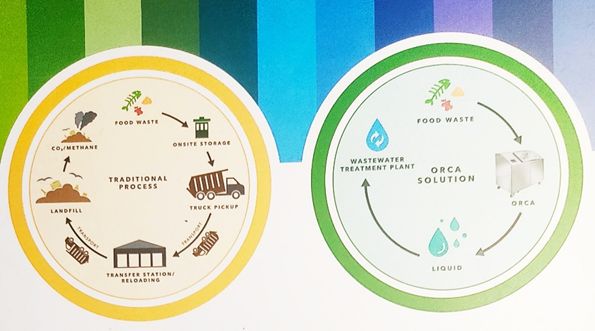
During my participation in the World Future Energy Summit held in Abu Dhabi in 2018, I came across an “Eco-friendly alternative solution to food waste disposal” by an international organization in partnership with SOZO Consultants, detailed as follows:
The organic food waste produces methane, a potent greenhouse gas with 21 times the global warming potential of carbon dioxide. Even worse, landfills are a major source of human-related methane in the USA, accounting for more than 20 percent of all methane emissions. “It was unsustainable waste management practices and staggering numbers like these that made the concerned wonder how they could divert this regular flow of food waste at the source, allowing organizations to reduce their environmental impact while making their daily operations more sustainable. It was from these notions that the ‘Organic Refuse Conversion Alternative’ came to be. Or, as it is called: the ORCA. The ORCA is a machine that ‘digests’ up to 2,400 pounds (over 1 ton) of food waste per day. Within 24 hours, this technology turns food waste into environmentally safe water that flows straight into the municipal sewage system.”
The sustainable technology is housed in a stainless-steel container, with a door on the top which employees open to throw food waste inside. Within the container, the ORCA’s proprietary, natural microorganism solution works with water and recycled plastic biochips to quickly break down the waste. Through a process called “aerobic digestion,” the ORCA technology constantly churns all this material, adding oxygen that accelerates the time it takes to transform the food waste into earth-friendly water.
Designed to eliminate organic food waste at its source by turning it into earth-friendly water, the ORCA is the perfect solution to our food waste problem. When you turn your food waste into water with the ORCA, you help reduce the number of CO2-producing garbage trucks on the road, decrease the amount of organic food waste being brought to landfills, and curb the potential methane-producing waste in our landfills. Simply put, the ORCA can help our organization become an environmentally conscious corporate citizen. To learn how the ORCA can help our organization (SMC) achieve its current and future sustainability goals, one can contact 1.855.355.ORCA (6722) or (contact email). SOZO Consultants, P.O. Box 4490, Abu Dhabi, UAE, T: +971 2 665 8511, www.sozo.ae.
The ORCA comes in four sizes:
Type Size-Weight Can process Can divert from landfill
0G15 810x580x1080 mm – 160 kg 7 kgs/hour 61 tonnes/year
0G25 1270x889x1244 mm – 363 kg 15 kgs/hour 95 tonnes/year
0G50 1740x889x1244.6 mm – 544 kg 25 kgs/hour 189 tonnes/year
0G100 2921x889x1244.6 mm – 680 kg 50 kgs/hour 378 tonnes/year
Once the machines are installed in homes, offices, commercial establishments, hotels, etc., the problem of collection, disposal, and treatment of solid waste by the municipalities shall be considerably solved, besides helping to improve the environment.
The writer is a former Chief Engineer