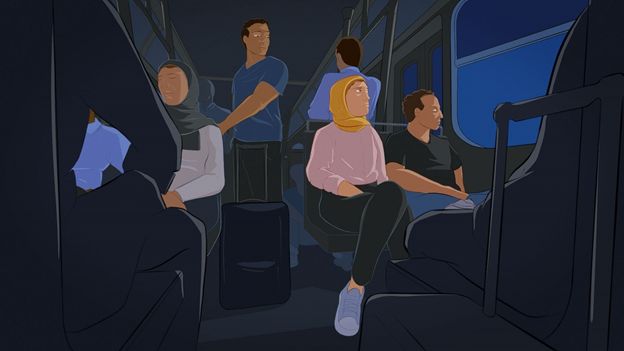


Examining the unseen battle faced by women in Kashmir’s public transport
Human civilization has witnessed innumerable changes since its inception. From hunting-gathering to modern industrial societies, everything undergoes change. From institutions to individuals, change is ubiquitous, its dynamic character redefines society and reshapes norms and values. As change manifests, institutions adapt, economies fluctuate, cultures acculturate and policies of the country shift shaping the complex web of our social life. Underneath this transformative character of change lies the stark, disconcerting truth about some spaces, where change is salient but its applicability remains silent. In these overlooked spaces of our society, the silent applicability of change perpetuates inequality, leaving certain individuals marginalized and unheard, these dynamics of change seem to bypass the urgent need for progress in addressing sexual harassment of women in public spaces. As these spaces recognized as symbols of collective existence remain battlegrounds for countless women who navigate them with apprehension and fear.
Sexual harassment and other forms of sexual offences in public spaces constitute a prevalent social phenomenon experienced by women and girls across the globe. The apprehension of experiencing sexual harassment has the potential to limit women’s opportunities to actively partake in public life, obstructing their prospects for fulfilling and unrestricted engagement in various activities of social life. This holds particularly accurate in countries where a significant proportion of the populace relies on public transportation for commuting.
In India, a significant section of the population, especially students pursuing higher education in colleges and universities make use of public transport for their travel needs. Unfortunately, as they journey, they experience victimization from their co-travellers. Such undesirable conduct impacts not just their physical health but also has consequences for their socio-psychological well-being.
As manifested by myriad global studies, the apprehensions and safety concerns of women have demonstrated an adverse effect on their choices regarding travel. They opt to avoid specific transit routes or bus stops and may refrain from using public transportation altogether due to the fear of harassment or victimization. This offensive conduct serves as an obstacle to the realization of their complete potential in a society founded on the principle of gender equality. Such acts of violence on the part of women constitute a violation of human rights and may, in the long run, retard their mental development and ultimately affect their life chances.
In Kashmir, public transport has become a concerning social space for women, especially college and university-going students who from time to time have complained about sexual harassment. With every passing day, it is becoming inconvenient for women, particularly college and university-going female students to travel by public transport as the fear of someone trying to do an inappropriate act always looms. The overcrowded public transport had become a hotspot for predators to harass the female students by taking undue advantage of the situation by deliberately pushing and shoving against female students. Toucherism, frotteurism and gazing have become the order of the day, a norm, resulting in an incredibly disconcerting social milieu for female students.
In this distressing scenario, the indifference exhibited by co-passengers when the victim raises her voice against the menace amplifies the issue. The silence and callousness displayed by the co-passengers is not only disheartening but also allows the cycle of harassment to persist. This insidious form of violence, unchecked and unchallenged has become a pervasive force that systematically devastates the lives of thousands of female students.
Although the introduction of ladies’ special bus service was seen plying on the roads of Srinagar, it hardly addressed the problem. It was soon closed down as it debarred the idea of inclusivity. Sexual harassment is a cause of concern, a human rights violation, that cannot be addressed just by approaching the problem with pink colour buses but by legal and mental reformation. We need to accept that women are not just objects of enticement, but rather guardians of life on earth, and the architects of the future. They deserve respect and not violence which is against the very idea of humanity. So, in our pursuit of a just and free society, it is crucial that reflexivity becomes the norm for every individual and the current paradigm of violence against women must shift towards valuing the inherent dignity of every individual.
The writer is a research scholar at the Department of History, Lovely Professional University. He can be reached at wa************@***il.com