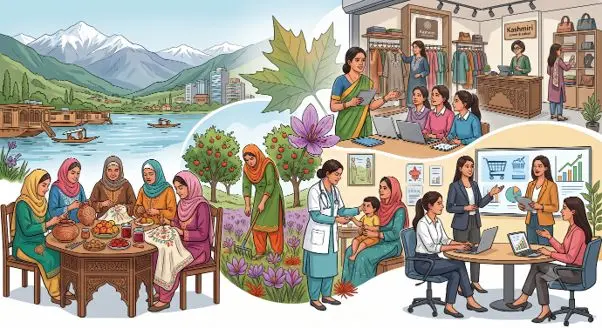


From classrooms to startups, farms to digital marketplaces, women across Jammu and Kashmir are reshaping the region’s economic and social fabric. Education, entrepreneurship, traditional crafts, and rural healthcare are being transformed by women. As India moves towards Viksit Bharat 2047, the lesson is clear: development thrives through inclusivity — and increasingly, its authors are women.
Rakshanda Gul
Women-led development and development through women’s participation are not separate ideas. They are closely interconnected and strengthen one another. No society can achieve inclusive growth while leaving behind nearly half of its population, and no meaningful progress for women can take place without broader social and economic development.
This relationship is particularly visible in Jammu and Kashmir. The educational opportunities, entrepreneurial ventures and professional achievements visible today have become possible in an environment where peace and stability have increasingly allowed people to think beyond immediate concerns and focus on the future. Families today speak more about careers, higher education and long-term aspirations than they did a generation ago.
Young people from the Union Territory are preparing for competitive examinations, pursuing professional education and exploring opportunities both within and outside Jammu and Kashmir, as well as in other parts of India and abroad. Young women are increasingly becoming part of this journey, entering universities, research institutions and workplaces that earlier generations often viewed as beyond their reach.
Women constitute nearly 48 per cent of India’s population and close to 47 per cent of the population of Jammu and Kashmir. Their participation is therefore not simply desirable but essential to the region’s future.
Whether in government offices or private enterprises, hospitals or educational institutions, businesses or farms, women contribute in countless ways. Their role within homes and families remains equally important, providing the care, support and stability that sustain communities and shape future generations.
From offices to orchards, classrooms to laboratories and markets to homes, women are helping shape the future of Jammu and Kashmir. The story of development in the Union Territory is therefore inseparable from the story of its women.
Changing Aspirations, Changing Homes
Perhaps the most important change has taken place quietly within homes and families.
A generation ago, higher education for daughters was often viewed as desirable but not always essential in many households. Today, that thinking is changing across Jammu and Kashmir. Families increasingly view education as an investment rather than an expense. Conversations about engineering, medicine, civil services, research and professional careers now include daughters with the same confidence and expectation as sons.
The results are becoming visible in classrooms, colleges and training institutions where young women pursue their ambitions with determination and confidence.
From Self-Help Groups To Startups
A walk-through of the local market today reveals another change. Businesses managed by women are becoming increasingly common. Some operate from dedicated shops, others from homes, while many exist partly in the digital world where a smartphone serves as an office, storefront and marketing platform at the same time.
In villages across Jammu and Kashmir, Self-Help Groups have become important sources of income and confidence. Women who once worked individually now collaborate to produce, package and market local products ranging from saffron and honey to embroidery, handloom products and traditional crafts.
Many of these ventures begin modestly with a sewing machine, a spare room and a handful of customers. Over time, some grow into enterprises that support entire families and create employment for neighbours and relatives.
Preserving Heritage, Creating Businesses
Some of the most inspiring stories are emerging from the intersection of tradition and innovation.
Around Dal Lake, Master’s student Tanzeela has worked to revive Wagu mats, a centuries-old Kashmiri craft threatened by machine-made alternatives. In Baramulla, Sheikh Jameela used support under Mission YUVA to establish a textile and handicrafts unit that now creates livelihoods for rural women while taking authentic Kashmiri shawls to wider markets.
In Srinagar, Anam Siraj’s fashion label, Closet Cloud, demonstrates how modern entrepreneurship can flourish alongside traditional craftsmanship. In Kupwara, Razia Sultana transformed skills learned at a crewel embroidery centre into an independent production unit that now trains young girls and supports local families.
Kashmir’s embroidery, shawl weaving, crewel work and papier-mâché traditions have survived changing times because artisans refused to let these skills disappear. Increasingly, women are becoming custodians of that heritage.
Breaking Barriers
Women are also entering sectors that previous generations rarely associated with them: Rifat Masoodi challenged long-standing stereotypes by successfully managing a cricket bat manufacturing unit, becoming one of the few women leading a business in Kashmir’s sports goods industry. Similar changes are visible in logistics, tourism, information technology, digital media and manufacturing, where women are steadily expanding their presence.
Farms, Food And New Opportunities, The Story Extends Far Beyond Handicrafts
Salaria Foods and Spices in Udhampur was set up by Abhilasha Salaria to improve the connection between farmers and the market, and she bought ingredients straight from the farmers themselves. Pooja Devi turned a small pickle business into the region’s first millet restaurant in Kathua with the help of the Holistic Agriculture Development Program.
In Rajbagh, Anam Zahari built a business around healthy and sugar-free chocolates, while in Kupwara, Haseena Begum moved from running a small rented hotel to leading a cooperative of women farmers engaged in sustainable organic farming.
Agriculture itself is changing. Women are increasingly experimenting with high-value crops, food processing and value addition. Mushroom cultivation, particularly button and oyster mushrooms, has emerged as a promising source of income because it requires little land and can be grown in simple indoor spaces.
Women farmers like Mugli Begum, a 70-year-old farmer from Sopore, are a great inspiration regarding the contribution of women in agricultural activities, earning their livelihood and enhancing the rural economy of Jammu and Kashmir.
Tahira has gone a step further by packaging dried mushrooms, training other women and creating local employment opportunities in the process.
Tourism With A Local Touch
Tourism has opened another avenue for women-led enterprise: In the upper parts of Doodhpathri, women run tea stalls providing tourists with some traditional delicacies such as Makai Chot and Noon Chai. It is a woman-centric enterprise that provides an extra source of income as well as encourages sustainable tourism. To a visitor, a cup of tea may mean nothing more than that, but for a whole household, it means freedom and economic empowerment.
A Smartphone As A Marketplace
For many entrepreneurs, the most valuable business asset today is not a shop in a busy market but a smartphone connected to the internet.
Traditional goods which relied a lot on local traders and tourists during specific seasons can now reach consumers all over India, and even abroad, through social media. Digital transactions, social media platforms, and e-commerce have eliminated some of the geographical constraints that existed before. This has been especially significant for women who juggle both work and home life.
Government programmes supporting entrepreneurship, financial inclusion and skill development have also contributed to this progress. Initiatives such as Mission YUVA, the Holistic Agriculture Development Programme, the Jammu and Kashmir Rural Livelihoods Mission and programmes implemented through the Jammu and Kashmir Entrepreneurship Development Institute have expanded access to training, finance and markets.
The Quiet Backbone Of Rural Healthcare
Women-led development is equally visible in sectors that rarely attract public attention. More than 13,500 Accredited Social Health Activist workers form the backbone of healthcare delivery in remote and snowbound areas of Jammu and Kashmir. They support maternal healthcare, child immunisation and emergency response services while improving health awareness in some of the region’s most difficult terrains.
Their contribution extends far beyond healthcare statistics. In many villages, they are among the most trusted and respected community leaders.
More Than Participation, A Leadership Role
Across the Union Territory, examples of women building enterprises, entering professions, preserving cultural traditions and contributing to public life are becoming increasingly common. Stories that once appeared exceptional are gradually becoming part of everyday life.
More work needs to be done. The inclusion of the labour force, better digital literacy in distant regions, and leadership representation would continue to require continuous effort and collaboration.
However, there is hope that the direction of change is promising.
As India embarks on its mission for Viksit Bharat 2047, there is a significant lesson learned from the state of Jammu and Kashmir: development thrives through inclusivity and everyone getting an equal chance to participate.
Across Jammu and Kashmir, that story is already being written in classrooms, workshops, offices, farms, markets and homes. Increasingly, its authors are women.
ra*************@***il.com