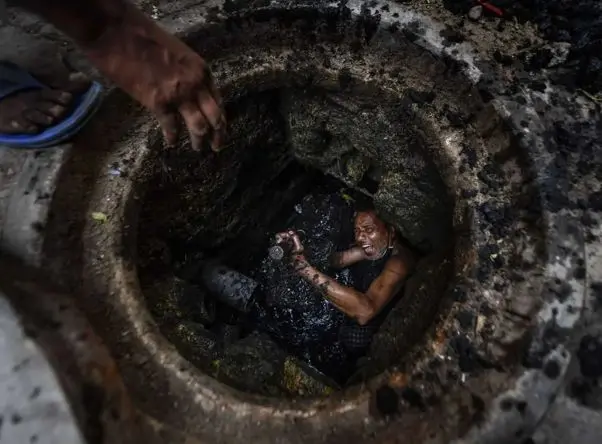


The death in Delhi should not be remembered as just another news headline. It should serve as a wake-up call. What remains lacking is the collective will to ensure that legal protections are translated into reality. Until that basic assurance is guaranteed, every septic tank death will stand as a reminder that our legal promises remain unfulfilled.
Zainab Jahan Ara
The death of a 55-year-old labourer while cleaning a septic tank in East Delhi this week is heartbreaking, but it is also deeply disturbing for another reason: it should never have happened in the first place. For the worker’s family, the loss is immeasurable. Yet for society, this tragedy is a reminder that despite laws, court directions, and repeated assurances from authorities, sanitation workers continue to risk—and lose—their lives while performing work that no human being should be forced to undertake under unsafe conditions.
Most of us rarely think about who cleans our sewers and septic tanks. These workers remain largely invisible until a tragedy makes headlines. However, behind every such incident is a family that loses a father, husband, brother, or son. What makes these deaths particularly painful is that they are not unavoidable accidents; they are preventable failures of governance, accountability, and implementation.
The Constitution of India places immense value on human dignity. Article 21 guarantees the right to life and personal liberty, a provision that has been interpreted by the Supreme Court to include the right to live with dignity. A worker entering a septic tank filled with poisonous gases without adequate safety measures is not merely facing an occupational hazard; his constitutional right to life is being placed at risk.
Recognising the inhuman nature of such practices, Parliament enacted the Prohibition of Employment as Manual Scavengers and their Rehabilitation Act, 2013. The law prohibits the employment of manual scavengers and specifically forbids hazardous cleaning of sewers and septic tanks without prescribed safety equipment and procedures. The legislation was intended not only to eliminate a degrading practice but also to protect workers from exactly the kind of tragedy witnessed in Delhi.
The judiciary has also spoken unequivocally on the issue. In Safai Karamchari Andolan v. Union of India (2014), the Supreme Court described manual scavenging as a violation of human dignity and directed governments to take concrete measures to eradicate the practice. The Court further ordered compensation for the families of those who die while cleaning sewers and septic tanks. The message was clear: no worker should lose their life performing such work, and when such deaths occur, accountability must follow.
Yet, despite these legal safeguards, the reality remains grim. Government data placed before Parliament has revealed that hundreds of workers have lost their lives while cleaning sewers and septic tanks over the past few years. These numbers are more than statistics; they represent lives cut short and families left behind.
The fundamental problem is not the absence of law but the failure of enforcement. In many instances, sanitation work is outsourced to contractors who neglect safety norms to reduce costs. Workers are sent into confined spaces without gas detectors, oxygen support, protective suits, or emergency rescue arrangements. When accidents occur, responsibility is often shifted from one authority to another, while the victims and their families bear the consequences.
Equally concerning is the slow pace of mechanisation. In an era where technology can perform complex tasks with remarkable efficiency, it is difficult to justify the continued reliance on human beings to enter toxic septic tanks. Machines capable of cleaning sewers and septic systems are available, yet their deployment remains inconsistent. The persistence of manual entry reflects not a technological limitation but a failure of administrative commitment.
Addressing this issue requires more than expressions of sympathy after each tragedy. Authorities must ensure the complete mechanisation of sewer and septic tank cleaning wherever possible. Contractors and officials who violate safety regulations should face strict legal consequences. Safety equipment, gas monitoring devices, and emergency rescue mechanisms must be mandatory and rigorously enforced. Compensation for victims’ families should be prompt, but compensation alone can never substitute for prevention.
Ultimately, the true measure of a society is reflected in how it treats those who perform its most essential yet least appreciated work. Sanitation workers play a vital role in maintaining public health and hygiene. They deserve not only our respect but also the full protection of the law.
The death in Delhi should not be remembered as just another news headline. It should serve as a wake-up call. Laws have already been enacted, constitutional principles have already been affirmed, and judicial directions have already been issued. What remains lacking is the collective will to ensure that these protections are translated into reality.
A worker leaving home to earn a livelihood should never have to wonder whether he will return alive. Until that basic assurance is guaranteed, every septic tank death will stand as a reminder that our legal promises remain unfulfilled.
The writer is a law student
za**************@***il.com