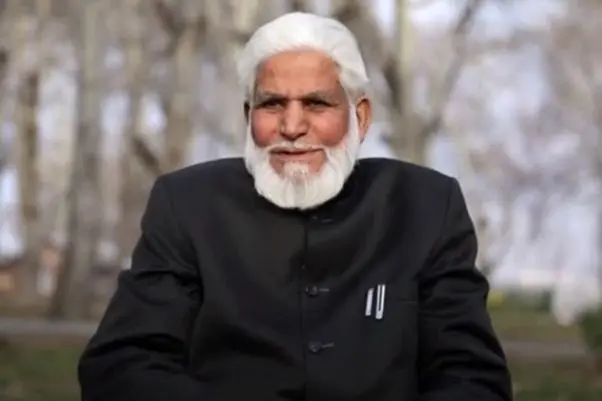


Kashmir will remember him not merely as a poet or scholar but as a cultural ambassador, a bridge connecting generations through language, faith, and moral insight. His life reminds us that intellectual labour, guided by sincerity and faith, is itself an act of devotion.
by Prof Hamid Naseem Rafiabadi
On 14th October 2025, I attended a gathering at Tagore Hall in memory of the late Professor Marghoob Banihali. I had long wished to speak about this remarkable teacher, mentor, and benefactor with whom I had the privilege of working for over two decades at the University of Kashmir. During that time, I witnessed firsthand his vast scholarship and noble character.
However, the atmosphere of the gathering differed from my expectations. Most speakers, except for one or two, dwelled less on Professor Marghoob Sahib and more on unrelated matters, leaving the truly instructive aspects of his life largely unexplored. Professor Mushtaq Siddiqi, Manshur Banhali and Zarif Ahmad Zarif made commendable efforts to address his contributions meaningfully, somewhat mitigating this shortcoming.
Such gatherings must focus on the intellectual and personal legacy of the individual being honoured. Those deeply familiar with the person’s life and work should be given priority to speak, while casual remarks, however well-meaning, often dilute the event’s scholarly value. Despite this, the felicitation of Professor Abdul Ahad with the Marghoob Award was a notable highlight. A serious scholar and historian, Prof Abdul Ahad is humble, devoted to scholarship, and entirely unconcerned with public recognition — a fitting recipient.
Born in the humble village of Bankoot, Banihal, Professor Ghulam Mohammed Giri, known by his pen name Marghoob Banihali, epitomised the cultural and intellectual spirit of Kashmir. Orphaned at a young age, he pursued education with fortitude despite financial hardship, even undertaking a 70-kilometre journey across snow-clad mountains in 1954 to appear for his matriculation examination. Guided by early mentors such as Haji Ghulam Ahmad Shah, Hakim Muhammad Hafizullah, and Molvi Ghulam Muhiuddin Kirmani — who advised him to adopt the pen name “Marghoob” — he laid the foundations for a lifelong dedication to scholarship.
Marghoob’s academic career included service as a teacher, headmaster, Tehsil Education Officer, and, eventually, lecturer at the University of Kashmir in 1969. Over the next three decades, he contributed across the Departments of Kashmiri, Central Asian Studies, and the Iqbal Institute, retiring in 1997 as Head of the Kashmiri Department.
A prolific writer and poet, Marghoob authored over fifty works in Kashmiri, Urdu, Persian, and English. His writings emphasised Islamic spirituality, human values, and communal harmony. His celebrated poetry collection Partavistan earned him the Sahitya Akademi Award in 1979. Subsequent honours included the prestigious Ghalib Award in 2008. His notable works span critical scholarship, translation, and linguistic reform — including Marghoob Theory (1982), Kashir Bal-e-Apare (1989), Qadeem Kashur (2001), and translations of Kalilah wa Dimnah and Noor Namah. His engagement with Iqbal’s philosophy and Islamic ethics was reflected in Kalam-e-Iqbal kay Ruhani, Fikri wa Fanni Sarchashmay (2006) and Ikhlaqiyat-e-Marghoob (2005).
Deeply rooted in love for the Prophet Muhammad (SAW), his ghazals, na’ts, rubaiyat, and manqabats revealed devotion, humility, and intellectual depth. Scholars such as Yusuf Taing lauded him as embodying a “versified biography of the Prophet (SAW).” Alongside luminaries like Mir Ghulam Rasool Nazki, Akhtar Mohiuddin, and Prof Abdul Haq, he stood out for his sincerity, erudition, and humility. His scholarship on Iqbal, influenced by Aali Ahmad Saroor and supported by colleagues such as Prof Ghulam Rasul Malik and Prof Muhammad Abdullah Shaida, enriched Persian literary studies and guided new generations of research scholars.
Prof Waheed-ud-Din Malik, former Vice-Chancellor of the University of Kashmir, described him as “a brilliant scholar of oriental languages and a sincere Kashmiri who dedicated his life to preserving the cultural and linguistic heritage of his homeland.” Literary contemporaries recognised him as “a movement, a history, and a trendsetter.” Linguists, including Prof Syed Maqbool and Prof Nazir Ahmad Malik, praised his Marghoob Theory as a culturally grounded and scientifically viable reform of the Kashmiri script. Mohan Lal Aash aptly described him as “a diamond carved from the high rocks of Pir Panjal — a creative writer with mastery over expression and deep understanding of global literary trends.”
Marghoob Banihali’s intellectual engagement transcended regional boundaries, drawing on the humanistic perspectives of figures like Sarojini Naidu and Qazi Nazrul Islam, while remaining rooted in the Rishi philosophy of Sheikh-ul-Alam. Known for his humility, spiritual depth, and reflective temperament, his life mirrored the qualities of the Sufi poets he so admired. Prof Abdul Haq noted, “He is truthful, sincere, and honest in thinking, practical in dealings, and multidimensional in personality.”
Today, Professor Marghoob Banihali’s legacy endures through his writings, students, and family — particularly his son, Prof Mushtaq Marghoob, who continues his father’s work in education and culture. Kashmir will remember him not merely as a poet or scholar but as a cultural ambassador, a bridge connecting generations through language, faith, and moral insight. His life reminds us that intellectual labour, guided by sincerity and faith, is itself an act of devotion.
May his soul rest in peace, Aameen!
—Dr Hamid Naseem Rafiabadi (also known as Dr Hamidullah Marazi) is a distinguished contemporary Islamic scholar whose work significantly contributes to the dialogue between Islamic philosophy and modern Western thought. He is the author of several books. Through a rigorous comparative methodology and an emphasis on epistemological integrity grounded in Tawhid (the oneness of God), Marazi critiques secular paradigms and advocates for an integrative intellectual tradition. His scholarship not only critiques Western thought but also calls for mutual enrichment between traditions, emphasising Islamic metaphysics, ethics, and educational reform as central to contemporary challenges.
ha*********@***il.com