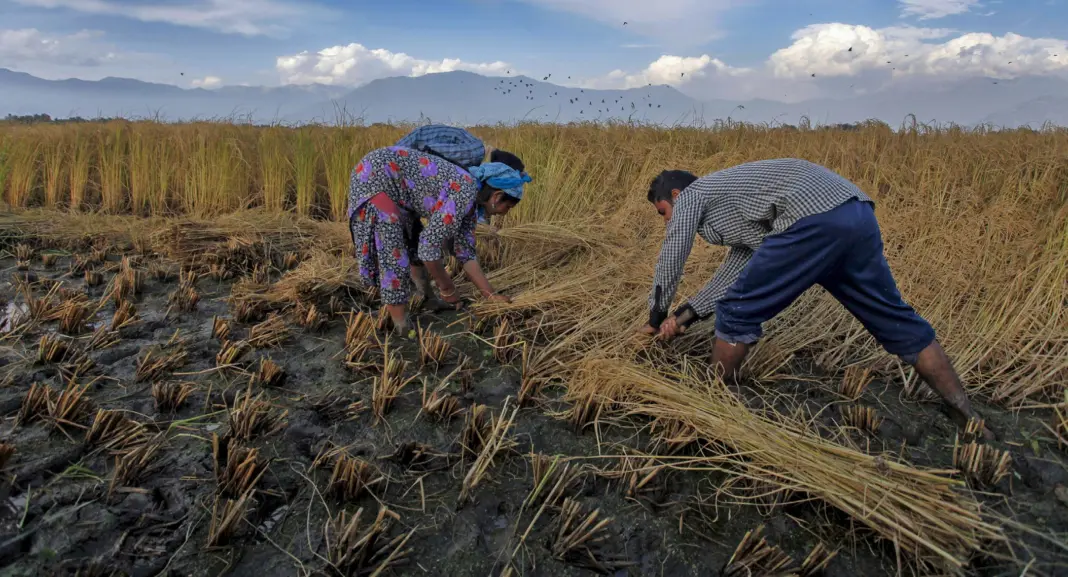


Data shows rural women’s participation in paddy cultivation has declined 40 per cent since the 2000s
June in Kashmir once carried the earthy scent of freshly tilled paddy fields, the rhythmic splashing of women’s feet in flooded plots, and the chorus of song and laughter as women like Hajra sowed rice with a skill passed down through generations. Hajra, now in her late 50s, stands by the edge of her ancestral field in a village in south Kashmir, watching a group of Bihari men planting saplings with machine-like speed and coordination. Her hands—once her pride, toughened by decades of work—now stay folded behind her back.
She used to lead the transplanting season. Her feet could sense whether the soil was ready, her hands knew exactly how deep to press the saplings. “We used to start at sunrise and work till late afternoon,” she says, her voice steady but distant. “It was exhausting, yes. But it was ours. We laughed, we argued, we lived in those fields.”
Hajra was not unique. She was representative. For decades, Kashmiri rural women formed the backbone of agriculture. Sowing, transplanting, weeding, and harvesting—every stage of paddy cultivation depended on them. These women were not paid in wages, but they held power in tradition. Their work defined the rhythms of rural life and the identity of Kashmiri agriculture.
In the 1990s, the land began to change. Political unrest altered rural rhythms. Young men increasingly sought employment outside the village—in cities, in government jobs, and in private sector roles. Simultaneously, the socio-political atmosphere of the Valley pushed families into survival mode, making long-term cultivation less appealing.
But someone still had to do the back-breaking work. And increasingly, that someone came from outside.
Bihari labourers, with their reputation for discipline and speed, began arriving in greater numbers. Initially, they were employed for occasional harvests or large-scale work. But by the early 2000s, many families hired them for everything—from sowing to harvesting. It was efficient. It was affordable. And for many, it felt inevitable.
“I couldn’t manage alone,” says Bashir Ahmad, a landowner in Kulgam. “My daughters are studying, my wife has health issues, and I’m too old. The Biharis come early, they don’t take tea breaks, and they finish in half the time. What choice do we have?”
What got lost in this efficiency was not just labour—it was legacy.
In today’s Kashmir, especially in villages from Pulwama to Bandipora, it’s common to see groups of male migrant workers dominating the fields. Women are largely absent. A few may supervise, a rare few may participate—but the image of rows of women transplanting paddy in rhythm is becoming rare.
According to data from the Directorate of Agriculture, the participation of women in field-level operations in Kashmir’s agriculture has dropped by over 40% in the past two decades. What was once unpaid, familial, and continuous labour is now being substituted by market-driven, external, and male-dominated alternatives.
Several factors have contributed to this shift
Education of Girls: With more rural families investing in their daughters’ education, fewer girls are available for day-long manual labour in the fields. While this is a welcome development, it inadvertently severs the generational link of knowledge transmission in agriculture.
Health Issues: Continuous exposure to waterlogged fields, poor posture, and lack of medical support have taken a toll on the older generation of women. With no safety nets, many withdrew once health issues became chronic.
Social Shifts: Changing ideas of dignity and women’s roles have made agricultural labour seem outdated or inappropriate for young women. In some villages, there is even subtle shame attached to women working in the fields, particularly for educated families.
Mechanisation and Labour Outsourcing: The availability of migrant labourers and tools like paddy transplanters, though not widespread, has begun reducing dependence on local human labour—especially female labour.
This transition has not come without cost.
Agriculturally, there is concern about the quality of work. “The women knew the land better,” says Ghulam Nabi, a retired employee from Anantnag. “They could tell which patch needed more water, which area had fungal issues. The Bihari workers do the job quickly, but not always with care.”
There is also a cultural cost. The folk songs sung during transplantation, the communal cooking during breaks, and the tradition of elders blessing the harvest are all fading. “Our fields were our festivals,” Hajra says. “Now they are just work sites.”
And there is an emotional displacement. Many older women feel sidelined in spaces they once ruled. “I never thought I would see the day when I am asked to stand aside in my own land,” says Fatima, a 63-year-old woman from Doru “They say I’m too slow. Maybe I am. But at least I knew what I was doing.”
All is not lost. In some villages, efforts are underway to bring women back into agricultural conversations, not necessarily with the same roles, but with evolved ones.
In Kulgam, a women’s self-help group has started cultivating organic vegetables on small plots, combining traditional knowledge with new markets. In Anantnag, a few young women trained in agricultural extension services are helping older women adapt to changing methods, including vertical farming and high-density cropping.
The government, too, has launched schemes aimed at promoting women-led agriculture. However, many of these schemes are either poorly implemented or fail to address the cultural dimensions of displacement. Training a woman to rear livestock or manage vermicompost pits does not address the symbolic vacuum created by her absence from the rice field.
What is needed is not just economic incentive but cultural recognition—honouring the role rural women have played, and can continue to play, in shaping Kashmir’s agricultural future.
Mohd Amin Mir
mi********@***il.com