

Addressing water pollution and promoting sustainable sanitation practices in the valley
The Kashmir Valley once boasted of the purest water bodies, but with the rapid growth of population and urbanisation, most of the water bodies became polluted due to the prevailing insanitary conditions.
Until the recent past, all houses in the city, towns, and villages had dry pit latrines. Early in the morning, vegetable farmers or scavengers in the city would collect the night soil from the latrines of the houses in long conical baskets called yatchis hanging on their backs, allowing this night soil to decompose in their farmyards, covering it with ashes. Additionally, the scavengers of the SMC would collect the night soil from the houses and dump it in open pits at Noorbagh to allow it to decompose. In rural areas, the night soil from the open pit latrines was used in their respective vegetable gardens as compost.
Hence, until this arrangement prevailed, there was minimal pollution of the water bodies. However, with the introduction of municipal water taps in households and the construction of pucca lanes and drains in the city and towns, people found it easy to allow raw night soil to flow into the open drains, which ultimately discharged into the water bodies, thus polluting them. In Srinagar city, Dal Lake and other water channels like Nalla Mar and its tributaries, besides the River Jhelum, fell victim to this pollution, resulting in waterborne diseases. Similarly, in rural areas, the water channels used for drinking and washing also became polluted.
With the rapid urbanisation and expansion of city limits, some people moved to the outskirts and built houses with compounds where they could afford to construct modern latrines with septic tanks and soakage pits. However, a significant section of the population continued to reside in the old city and maintain the existing arrangement.
In view of this alarming situation, during the eighties, the Urban Environmental Engineering Department (UEED), headed by Er G.R. Mir, Chief Engineer, and I, as the Xen of the S&D Division, collaborated with UNICEF to launch a Low-Cost Sanitation Scheme in Srinagar city. The UNICEF teams filmed documentaries of the existing system of disposing of raw sewage through open drains into water bodies, adversely affecting the health of people and children. Mr Dan O’Dell, the advisor from UNICEF, made frequent visits, and a few demonstration units of low-cost twin-pit latrines were constructed in several households in Srinagar with UNICEF assistance. Additionally, Dr. Bindeshwar Pathak, the founder of Sulabh International from Bihar, was invited to share his experience, as he had succeeded in establishing this program in Patna, Bihar, and other states of the country, besides becoming an advisor to 21 countries under UNDP.
The UEED launched a campaign by publishing pamphlets in Urdu and English for common distribution, as well as posters explaining the adverse results of pollution from open defecation, etc. The pamphlets were distributed free of cost among the public, including the employees of the Secretariat and the S&D division in Jammu. Boards in Urdu were fixed at focal points like Karan Nagar Chowk and the B.Ed. College premises. A two-day workshop was also held by UNICEF at Pahalgam, chaired by Dr. Cousins, an advisor from UNICEF South Asia, in which I also participated.
The areas selected for low-cost sanitation in Srinagar city were the left bank of the River Jhelum and the western bank of Nigeen Lake. The project was later handed over to the SMC for implementation. The Rural Development Department also found this program adaptable for rural areas. A survey of the existing situation in various towns was also conducted, along with a UNDP team filling out the necessary pro forma.
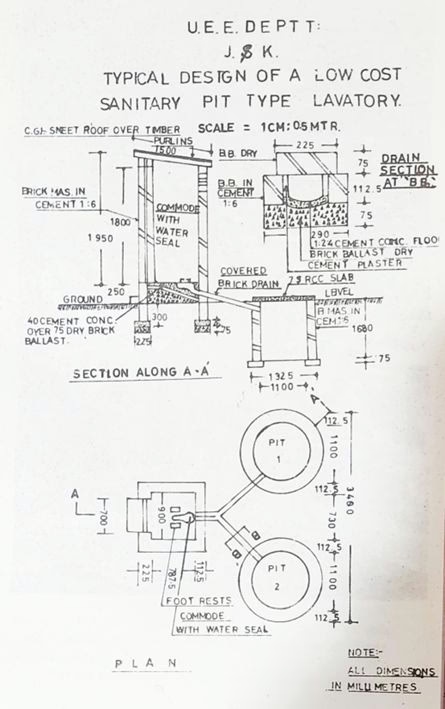
The pour-flush latrine consists of a squatting pan of a specific design (having a steep gradient at the bottom and a particular depth) and a trap with a 20 mm water seal. It is designed such that the human excreta of a person can be flushed by pouring 2 litres of watEr The excreta is discharged into the leaching pits constructed in the house or a compound. Where it is not possible to do so due to a lack of space, the pit can be constructed under a footpath or street. The squatting pan is connected to the leaching pit through a pipe or covered drain. These pits are lined with honeycomb brickwork or open-jointed stone to allow liquid in the pits to percolate, gases to be absorbed into the soil, and, at the same time, prevent the pit from collapsing. The sludge gets digested and settles down gradually.
The twin pits are used alternately. When one pit is filled, it stops being used, and the excreta is diverted to the second pit. The filled-up pit is left unused, and in 24 months, the contents become rich organic humus, innocuous and free of pathogens and smell. When convenient, it is then ready to be put back into use when the second pit becomes full in its turn.
With simple care and cleaning by the household, the pour-flush latrine is a very satisfactory and hygienic sanitation system. This can be located inside the house, as the water seal prevents odour or nuisance.
Size of the pit: The size of leach pits depends on several factors, such as soil characteristics, sub-soil water level, cleaning intervals, the number of users, and people’s food habits. Studies in India have indicated that under dry conditions, per capita sludge contribution per year is about 0.045 cubic meters. The dimensions of leaching pits for different numbers of users over three years are as follows:
For 5 users, the internal diameter is 900 mm with an effective depth of 1,300 mm. For 10 users, the internal diameter is 1,100 mm with an effective depth of 1,400 mm. Lastly, for 15 users, the internal diameter is 1,250 mm with an effective depth of 1,600 mm.
Shape of the pit: The shape of the pits can be circular, rectangular, or a combination of the two. However, circular pits should be constructed wherever feasible, as these are more stable. Many innovations were tried here, but ultimately, the anaerobic process with circular pits was found to be the most suitable for our needs.
Leach pit configuration and materials used for its construction can readily be varied to suit the site conditions. In cases of space constraints, an oval pit with a partition wall or pits of smaller diameter and greater depth could be provided.
In unsaturated zones where groundwater tables are more than 2 meters below the bottom of the pit, and the soil has an effective size of less than 1.00 mm, leach pits could be located even 3 meters away from wells or hand pumps used for domestic purposes. Where the water table is shallow and the soil contains coarse sand or gravel, pollution travel can be checked by providing a 500 mm thick envelope of fine sand (average size no more than 0.2 mm) all around the pits and sealing the bottom with clay or a polyethene sheet.
The distance between leaching pits and the house foundation depends on the depth of the leach pits, the foundation depth of the building, and its structural condition. However, for average conditions, about 1 meter is sufficient.
Maintenance: The maintenance of a pour-flush latrine is very easy and simple. Day-to-day maintenance consists of washing the latrine floor and cleaning the pan. No other maintenance cost is needed. The cost of cleaning the pits can be covered by the sale of humus obtained from the pits.
Pan and Trap: The squatting pan and trap can be ceramic, fibreglass-reinforced polyester plastic (GRP), or cement.
Cost: The cost of a pour-flush latrine, including the superstructure, amounted to Rs 2,500 in Srinagar in the eighties. The present cost can be estimated from the quantities described below:
Materials required:
- Bricks: 815 nos. for the seat, pit, and drain; 1,138 nos. for the seat, pit, superstructure, and drain.
- Sand: 0.802 Cum for the seat, pit, and drain; 1.057 Cum for the seat, pit, superstructure, and drain.
- Bajri: 0.211 Cum for both.
- Cement: 3.5 bags for the seat, pit, and drain; 5.0 bags for the seat, pit, superstructure, and drain.
- 6mm Iron: 16 Kgs for both.
- Timber: Kail — 0.08 Cum; Budloo — 0.0172 Cum.
- C.G.I. Sheets: 15 Kgs.
- 2.5” Hinges: 2 nos.
- 2” Nails: 1 Kg.
- Hooks: 2 nos.
- WC Pan & Water Seal: 1 no. for both.
The cost can be calculated based on the present market rates.
Similarly, for the disposal of decomposable solid wastes, twin pits of one meter in diameter and one meter in depth were recommended to deposit the waste in one-foot layers, with each layer covered with lime and allowed to rest until the second pit is filled with waste. The waste decomposes to become organic compost useful for kitchen gardens, in addition to reducing pressure on the SMC.
Er Ashraf Fazili
sh*************@***il.com