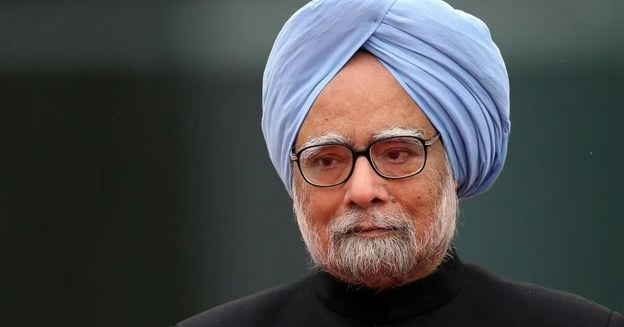


The former Prime Minister’s unwavering humility and groundbreaking reforms transformed India’s economic landscape and embodied the true spirit of democratic leadership
Nice boys do end up at the top. That is what one can say, without any qualms, about the former Prime Minister of India, Dr Manmohan Singh, who left this world of mortals on the 26th of December, 2024. He was 92, having lived his life by the codes of decency, humility, and knowledge. Born in Gah village of Punjab, in what is today Pakistan, to a family of limited means, he rose through the ranks based on unadulterated hard work. Just imagine the insecurities he must have been confronting in his growing-up years, with all kinds of barriers set against him—one only gets goosebumps. His prowess in academics led him to earn a D.Litt in Economics from Oxford University and venture into teaching.
Reams and reams have been written on the trajectory that his career took over the last six decades. But what defined him, devoid of any semblance of contestation, deserves telling and retelling throughout the journey that the Republic of India is to trudge.
There are some 820 crore people, classified as Homo sapiens sapiens, on the planet at the moment. It is quite routine for a great number of people to assert themselves. It is highly difficult, rather impossible, to keep oneself self-effaced, contained, and impersonal. For Dr Manmohan Singh, living as a simple and honest man came almost naturally. There must have been moments when pride allowed him to exult in his private space, but to have completely defanged himself of any prickle of such nature is evidence of the greatness of his character.
He donned many caps in his public life, from being a researcher to a professor to an economist to a bureaucrat to a politician. But it was in teaching that he found his main zone. Take any of his interviews—they are just perspicaciously resourceful. Rather than being long and boring acts of demagoguery, his talks were always laced with knowledge and fluency about the basic scheme of things underlying any policy issue in the country. In this context, he was a calibrated mix of erudition and clarity regarding the fundamental concepts of life, not just economics. His brilliance as a teacher has been attested to by many of his colleagues at Panjab University and the Delhi School of Economics.
Despite being accused, albeit unjustly, of being nonchalant and lazy, he never dithered in taking some of the pathbreaking decisions in his public life. He had a very distinguished tenure as RBI Governor from 1982 to 1985, during which he made some of the finest decisions in the history of the RBI. The 1991 moment, synonymous with him—the second liberation of the country—shook the complacent circles of polity and society at that time. There was severe opposition to the government, but the strength of his character and his innate self-belief ensured that the process of liberalization of the Indian economy did not backtrack at any moment. If India’s economy is close to touching $4 trillion today, up from $266 billion (adjusted for inflation) in 1991, it is primarily thanks to the reforms initiated by Dr Manmohan Singh.
From 2006 to 2008, he faced severe flak not from political opponents but from within the government’s coalition partners for the Nuclear Deal with the United States. However, his steadiness and fortitude ensured that every kind of opposition to the deal remained just a background murmur.
He remained a lifelong reformist, one of the pioneers advocating for the need to reform. While he may not have been dogmatic in his positions and changed them as per the pragmatic realities of life in India, he kept human-faced reforms at the core of his decisions. It is on this count that he sought to reshape the subsidy landscape of the country. His reform-mindedness helped him dismantle the psychological barrier of the License-Permit Raj in one stroke. His tenure gave the country the National Rural Health Mission (NRHM), MGNREGA, the Forest Rights Act, RTI, RTE, the Indo-US Nuclear Deal, and more.
He remained a thorough democrat to his core. He lived by the values enshrined in the parliamentary democracy of the country. His frequent interactions with the media, open to all kinds of incisive questions, ensured that the government of the day was held accountable for its acts and actions. Even when there was a barrage of questions, many of them unfair, he responded with unemotional facts.
Moreover, he was committed to consultative decision-making, rejecting any kind of authoritarian streak. While this may have led to speculation about the reduced efficiency of the government, it allowed the democratic spirit to remain alive and thrive in India.
With each passing day, his candour in engaging with people only grew. Many times, he used his knowledge of Urdu poetry to counter the brickbats directed at him. In the later part of his second term, he and his government came under attack from different quarters for various corruption scandals rocking the country. He bore it all with silent dignity, never losing his composure. Despite the press going hammer and tongs against the government and raising churlish questions about his integrity, he simply carried on.
Being a practitioner of simple living, honesty, knowledge, and courage all his life, he garnered respect worldwide. He spoke out when needed, and history will undoubtedly vindicate him. There hasn’t yet been a full-scale judgment of his legacy. Those who questioned and trumpeted absurdities about him must bury themselves in ashes and sackcloth, given the acquittals after acquittals in the alleged scams (CWG scam, Coal scams, etc.).
While he may have left us physically, Dr Manmohan Singh has left an indelible mark on the fabric of India.
Uzair Qadri
mo*************@***il.com