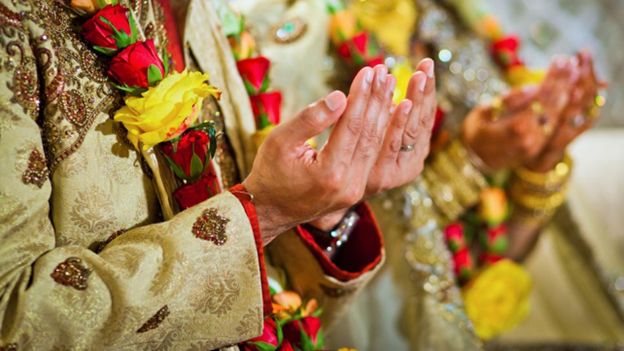


Despite misconceptions, Islam does not sanction or condone forced marriage, and instead emphasises the importance of mutual consent and free will in the marriage contract
Despite numerous contentions to the contrary, forced marriage is not an Islamic tradition; it is a jahiliyya custom (pre-Islamic era), rooted in indigenous cultures, that has persisted in some Muslim communities. Islam does not sanction or advocate any form of forced marriage. Unlike secular law, marriage within the ambit of Islam is not only a civil contract but a religious and spiritual contract between two people – which must be entered into freely and with mutual consent.
According to Islamic custom, parents and guardians have specific rights in this matter; to arrange the marriage ceremony and conduct it as a respectful family event; and give their advice and recommendations for a life partner for their children. These rights are encapsulated within the philosophy of ‘wilayah’. However, Islam does not allow parents, guardians or other relatives to enforce their will or choice on a boy or a girl since it is they who are the real parties to that contract. The right to exercise free will and consent in choosing a spouse is Almighty’s given right.
There are a myriad of reasons for forced marriage. In Muslim communities, misguided religious teachings and perverted interpretations of Islam lead families to believe that they are complying with Islamic ruling. Other factors may include the notion of protecting children; upholding cultural traditions; preserving family honour; and social status; and building stronger families. Forced marriage also is used to prevent so-called “unsuitable” relationships outside regional & ethnic groups.
This is also clearly evident from important commandments given by the Holy Prophet (PBUH) in numerous Hadith, which lay down the foundational principles of formulating a marriage contract.
In the Sahih Al-Bukhari, for example, a chapter in the book of marriage has been given the heading: “No father or mother or any close relation can force his/her children to marry anyone against their free will and consent”.
Within this chapter, Abu Hurairah transmits from the Holy Prophet (PBUH) who said: “No female whether a widow or divorcee will be forced to marry anyone unless her express and categorical consent has been freely taken and in the same way a woman not previously married can never be forced to marry anyone unless her free consent and permission is taken”.
Imam Bukhari has set another chapter heading within the book of marriage: “If parents force their daughter to marry someone against her wish then the marriage will be void”.
Under this chapter, Imam Bukhari (RA) reports a Hadith of the Holy Prophet (PBUH) from Khansa Bint e Hizam Al Ansariyah. She states that her father married her off to someone forcefully whom she did not like. She took her case to the Holy Prophet (PBUH) and upon listening to her; the Holy Prophet (PBUH) rejected the marriage and declared the marriage as void”.
In another Hadith in the Sahih of Imam Bukhari (RA), it is narrated by Abdullah Ibn Abbas (RA) that the Holy Prophet (PBUH) said that if a woman wants to marry and is already a divorcee or widow, her right of free consent and free choice is superior then the right of her guardian. If she is not previously married and this is her first marriage even then her parents or other guardians cannot enforce their choice on her. They are not allowed to force her to marry anyone against her free choice and free consent.
It is thus clearly apparent that forced marriages are totally unacceptable in Islam. Islamic commandments as mentioned above are very categorical. Those who invoke Islam to justify their actions do so for ulterior motives. There is a need to educate all and sundry on these issues.
Common psychological effects of forced marriage are feelings of depressed mood, irritability, low self-esteem, rage and frustration, sleep problems etc. Victims may have other mental health problems and display behaviours such as self-harming, self-cutting or anorexia, as well as drug and alcohol misuse.
Isolation is one of the biggest problems facing victims of forced marriage. Victims have feelings of guilt, as they have run away from their loved ones and families and thus brought shame, leading to social ostracism and harassment from the family and community. In response to the stress, the victims may harm themselves and may have suicidal thoughts. This all is because of cultural pressures, conservative parental values and marriage issues which may clash with the wishes and expectations of the young people themselves. The person who has been forced into a marriage may become trapped in a cycle of abuse, with long-term psychological and physical consequences. Feelings of isolation, depressed mood and on occasion victim self-harm. Victims will find it difficult to confide in their family and close friends. In addition, they may have to cope with financial and accommodation pressures when they leave the family home and have to deal with the reality of independence.
im*******@***il.com