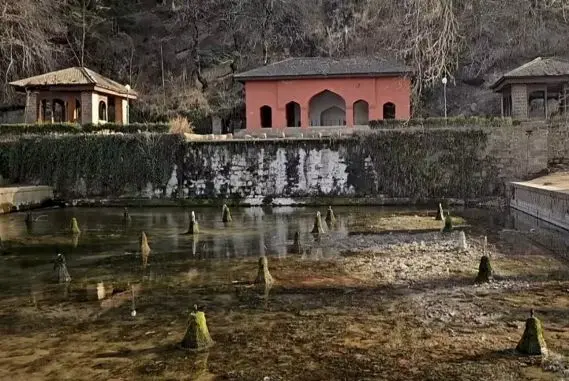


Kashmir has long been celebrated as a ‘paradise on earth,’ not merely for its breathtaking landscapes but for the abundance of freshwater that sustained its civilisation for centuries. Today, however, the springs that once symbolised life and abundance are falling silent. Their disappearance is no longer an isolated environmental concern; it is a warning signal of a looming ecological and humanitarian crisis.
Dr Aashaq Hussain Bhat
Kashmir has long been celebrated as a “paradise on earth”, not merely for its breathtaking landscapes but also for the abundance of freshwater that sustained its civilisation for centuries. Crystal-clear springs emerged from the foothills, streams meandered through villages, and paddy fields flourished under a natural irrigation system perfected by generations. Water shaped our settlements, livelihoods, traditions, and identity. Today, however, an unsettling reality confronts us: the springs that once symbolised life and abundance are falling silent. Their disappearance is no longer an isolated environmental concern; it is a warning signal of a looming ecological and humanitarian crisis. The question before us is stark and urgent: are we witnessing one of the greatest environmental emergencies in Kashmir’s recent history?
Across the Valley, residents are increasingly experiencing water shortages that would have been unimaginable a few decades ago. Villages that once depended on perennial springs now rely on water tankers or irregular piped supplies. Women and elderly people walk longer distances carrying containers in search of drinking water. In several localities, taps remain dry for days. Seasonal shortages have evolved into chronic scarcity, disrupting daily life and eroding the sense of security associated with living in a region historically blessed with abundant freshwater resources. Perhaps nowhere is this transformation more symbolic and heartbreaking than in District Anantnag. The very name “Anantnag” is believed to derive from the Sanskrit words Ananta (infinite or endless) and Nag (spring), reflecting a landscape renowned for its countless perennial springs. For generations, almost every village in the district had its own flowing spring that sustained people, livestock, and agriculture throughout the year. Today, many of these once-reliable sources have diminished dramatically, become seasonal, or disappeared altogether. For a district whose identity itself is rooted in the abundance of springs, the current water scarcity represents not merely an environmental anomaly but a profound ecological and cultural loss.
The impact of this crisis is perhaps most visible in agriculture, the backbone of Kashmir’s rural economy. Rice cultivation has traditionally defined the Valley’s agrarian landscape and food security. Yet, thousands of farmers are now struggling to transplant paddy because irrigation channels fed by springs and streams no longer provide sufficient water. In many areas, paddy fields lie uncultivated during critical growing periods. Increasingly, farmers are abandoning rice cultivation and converting their ancestral paddy lands into apple orchards, vegetable farms, or other crops perceived to be less water-intensive and economically viable under changing conditions. While such adaptations may offer short-term relief, they also signify a fundamental transformation of Kashmir’s agricultural heritage and food systems. A Valley once synonymous with emerald paddy fields now risks losing a tradition deeply woven into its ecological and cultural fabric.
Scientific evidence suggests that the decline of springs is driven by multiple interconnected factors rather than a single cause. Climate change has altered precipitation patterns, reduced winter snowfall, and accelerated the melting of glaciers. Snow acts as a natural reservoir, gradually releasing water that recharges underground aquifers and sustains springs during warmer months. Reduced snowfall therefore directly diminishes groundwater replenishment. Simultaneously, rising temperatures increase evaporation and alter the hydrological balance upon which these ecosystems depend. Human activities have compounded these climatic pressures. Unplanned urbanisation, indiscriminate construction, road expansion, and encroachment upon wetlands and traditional recharge zones have severely disrupted natural water cycles. Concrete surfaces prevent rainwater from infiltrating the soil, thereby reducing groundwater recharge. Forest degradation further intensifies the crisis. Trees regulate local microclimates, reduce erosion, improve soil structure, and facilitate the gradual percolation of water into underground aquifers. Their removal weakens nature’s capacity to store and release freshwater.
Springs are not isolated entities; they are the visible expressions of hidden groundwater systems. They emerge where aquifers naturally discharge water to the surface. When recharge zones are disturbed through deforestation, excavation, pollution, or land-use change, aquifers fail to replenish adequately, and springs begin to dry up. Pollution from domestic waste, excessive fertiliser use, pesticides, and improper disposal of solid waste further threatens both the quantity and quality of available water. The consequences extend far beyond agriculture. Water scarcity affects household hygiene, sanitation, livestock health, and public health. Reduced agricultural productivity threatens household incomes and food security. Declining water availability can intensify social tensions, deepen inequalities, and increase dependence on already strained public infrastructure. Environmental degradation, therefore, inevitably translates into economic hardship and social instability.
Yet despair is neither justified nor productive. The decline of Kashmir’s springs is not entirely irreversible if action is taken without delay. Governments must prioritise scientifically designed spring rejuvenation programmes involving hydrogeological mapping of recharge zones. Wetlands should be restored and protected as ecological assets rather than viewed as wastelands awaiting development. Land-use planning must integrate water conservation principles. Afforestation using native species should be intensified in catchment areas, while groundwater extraction and encroachment require stricter regulation. Community participation should become central to water governance. Equally important, however, is recognising that environmental stewardship begins at home.
Every citizen can contribute to protecting Kashmir’s water future. Households can install simple rainwater harvesting systems to collect rooftop runoff for gardening and non-potable uses. Leaking taps and pipelines should be repaired immediately, as small leakages collectively waste enormous quantities of water. People should avoid washing vehicles with running hoses and adopt water-efficient habits in kitchens and bathrooms.
Communities must refrain from dumping waste into streams, springs, and drainage channels. Local youth groups and residents’ associations can organise periodic clean-up campaigns around traditional water bodies. Every family should plant and protect trees, especially indigenous species suited to local ecosystems. Farmers can adopt water-efficient agricultural practices such as improved field levelling, mulching, alternate wetting and drying methods in paddy cultivation where appropriate, and diversification towards climate-resilient cropping systems. Schools, colleges, mosques, and community centres should actively educate younger generations about the value of water conservation. Children who learn to respect water today become guardians of tomorrow’s springs.
Faith traditions also provide profound guidance on environmental responsibility. The Holy Quran repeatedly reminds humanity of the sacred significance of water: “And We made from water every living thing” (Surah Al-Anbiya 21:30). This verse affirms that protecting water is inseparable from protecting life itself. Allah further commands: “Eat and drink, but do not waste. Indeed, He does not love the wasteful” (Surah Al-A’raf 7:31). In an era of growing scarcity, this divine instruction acquires renewed urgency.
Prophet Muhammad (Peace And Blessings Be Upon Him) embodied environmental ethics through both words and actions. He discouraged extravagance even while performing ablution beside a flowing river, teaching that abundance is never an excuse for wastefulness. He declared, “If the Final Hour comes while one of you has a sapling in his hand, let him plant it.” This extraordinary narration reflects hope, responsibility, and a commitment to future generations even in moments of uncertainty.
The Rightly Guided Caliphs reinforced these principles through governance rooted in justice and stewardship. Hazrat Abu Bakr (RA) instructed armies not to destroy trees or agricultural lands unnecessarily. Hazrat Umar ibn Al-Khattab (RA) emphasised accountability in managing public resources and safeguarding community welfare. Many respected ulema have explained that humanity serves as khalifah—trustees of the Earth entrusted by Allah to preserve rather than exploit creation recklessly.
The environmental crisis unfolding before us is therefore not only a scientific challenge but also a moral test of our stewardship. Other religious traditions echo similar wisdom. The Bible calls upon humanity to “till and keep” the Earth, emphasising care rather than domination. Hindu scriptures revere rivers and natural elements as sacred manifestations deserving protection and gratitude. Sikh teachings encourage living in harmony with nature and serving humanity through responsible action. Buddhist philosophy advocates mindful consumption and compassion towards all living beings. Across faiths and cultures, a shared ethical principle emerges: the Earth is not ours to exhaust but a trust to preserve for generations yet unborn.
Kashmir stands today at a defining moment in its environmental history. Future generations may inherit either living springs that continue to nourish communities or fading memories preserved only in stories and place names. The drying of springs in Anantnag and across the Valley is not merely about disappearing water sources; it is about the gradual erosion of identity, food security, livelihoods, and ecological resilience.
The time for complacency has passed. Saving Kashmir’s springs requires scientific planning, political commitment, community participation, and individual responsibility. Every repaired tap, every harvested drop of rainwater, every protected wetland, every planted tree, every restored spring, and every child taught to value water contribute to a larger movement of ecological renewal. If the springs of Kashmir have sustained our civilisation for centuries, then their protection is among the greatest responsibilities of our generation.
Let history remember that when the Valley’s waters cried out for help, Kashmir chose wisdom over indifference, stewardship over exploitation, and hope over despair. For in saving our springs, we safeguard not only our environment but also our health, heritage, faith, livelihoods, and the future of Kashmir itself.
The writer is an Assistant Professor, Department of Biosciences, Chandigarh University, Punjab. He writes on science communication, environmental sustainability, public health awareness, cybersecurity literacy and emerging societal challenges.
aa***********@****il.in