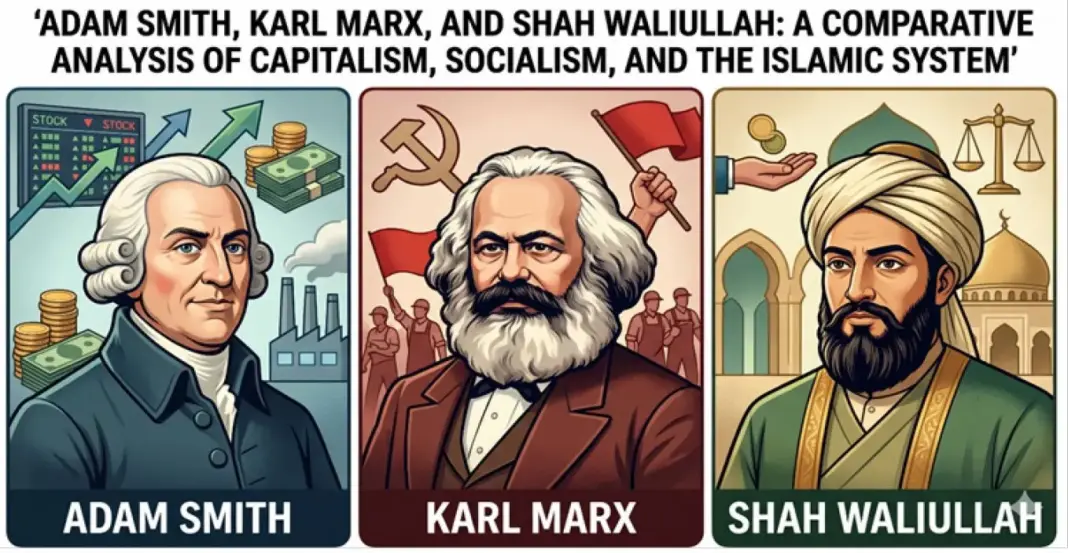


Smith celebrates competition and individual economic freedom. Marx exposes exploitation and inequality. Shah Waliullah transcends both—harmonising material and spiritual welfare, ethics and economics, justice and compassion. Wealth is not an absolute possession but a trust from God. Islam integrates morality into every sphere of life.
Prof Hamid Naseem Rafiabadi
Human civilisation has continuously struggled to establish a social and economic order capable of ensuring justice, prosperity, stability, and human dignity. Throughout history, different intellectual traditions have attempted to answer some of the most fundamental questions of human existence: What is the purpose of wealth? What is the relationship between labour and capital? Should society prioritise individual freedom or collective equality? What role should morality and religion play in economic life? In the modern era, two dominant systems emerged as major contenders for shaping human society: capitalism and socialism. Capitalism found its strongest intellectual foundation in the ideas of Adam Smith, while socialism and communism were articulated most forcefully by Karl Marx. However, alongside these materialistic systems stands the Islamic worldview, represented in the South Asian intellectual tradition by Shah Waliullah Dehlawi, whose thought offers a balanced and morally grounded alternative capable of addressing both the physical and spiritual needs of humanity.
The symbolic dialogue presented above illustrates not merely a clash of economic systems but a profound debate about human nature, justice, morality, and the purpose of life itself. While Adam Smith celebrates competition and individual economic freedom, Karl Marx exposes the exploitation and inequality produced by capitalism. Shah Waliullah, however, transcends both systems by emphasising that human beings are not merely economic creatures but moral and spiritual beings whose worldly and spiritual welfare must be harmonised. His thought presents Islam as a complete civilizational framework that integrates economics with ethics, spirituality, justice, and social responsibility.
Adam Smith, often called the father of modern capitalism, developed his ideas most prominently in his famous work ‘The Wealth of Nations’. Smith believed that society prospers when individuals are allowed to pursue their own interests freely within an open market. According to him, human beings are naturally driven by self-interest, and when individuals compete in a free market economy, the overall welfare of society improves through what he described as the “invisible hand.” In this framework, competition becomes the driving force of economic growth, innovation, and prosperity. Private ownership, minimal state intervention, and unrestricted trade are viewed as essential conditions for progress.
The capitalist system undoubtedly contributed to enormous industrial and technological advancements. It encouraged entrepreneurship, productivity, and economic expansion on an unprecedented scale. Through competition, markets generated innovation, efficiency, and wealth creation. The modern industrial world owes much of its economic dynamism to the principles advocated by Adam Smith. However, despite these achievements, capitalism also produced serious social and moral crises. Wealth increasingly became concentrated in the hands of a small elite while millions of labourers struggled with poverty, insecurity, and exploitation. Human beings were often reduced to instruments of production, valued only according to their economic utility and purchasing power.
Karl Marx emerged as one of the strongest critics of this capitalist order. Through works such as Das Kapital, Marx argued that capitalism is fundamentally based upon exploitation. According to Marx, labour is the true source of value, yet the capitalist class appropriates the surplus produced by workers. The worker becomes alienated from his labour, his humanity, and even from society itself. Marx viewed history as a continuous struggle between oppressor and oppressed classes, culminating in the conflict between the bourgeoisie and the proletariat. In his analysis, capitalism inevitably concentrates wealth and power in the hands of a few while reducing workers to mere tools within the machinery of production.
Marx’s critique resonated deeply because it exposed the harsh realities of industrial capitalism. He correctly identified many of the structural inequalities that characterised capitalist societies. Workers frequently laboured under inhumane conditions while industrialists accumulated immense wealth. Marx’s emphasis on social justice, workers’ rights, and economic equality inspired numerous reform movements across the world. Even many welfare policies in modern democracies emerged partly in response to Marxist critiques of capitalism.
Nevertheless, Marxism itself suffered from profound limitations. One of its greatest weaknesses was its materialistic conception of human nature. Marx largely reduced human beings to economic entities shaped primarily by material conditions and class relations. Spirituality, religion, morality, and metaphysical concerns were treated as secondary or even illusory. His famous characterisation of religion as the “opium of the people” reflected his belief that religion merely served to pacify oppressed classes and preserve systems of exploitation. In rejecting religion altogether, Marx ignored the deeper spiritual and ethical dimensions of human existence.
History also demonstrated the practical failures of many communist experiments inspired by Marxist ideology. While seeking to eliminate economic inequality, communist regimes often produced authoritarianism, political repression, economic stagnation, and suppression of religious freedom. Instead of liberating humanity completely, many socialist states merely replaced one form of domination with another. Marxism successfully criticised the injustices of capitalism but failed to provide a complete understanding of human nature and social harmony.
It is precisely at this point that the thought of Shah Waliullah Dehlawi becomes extraordinarily significant. Shah Waliullah presents a worldview fundamentally different from both capitalism and socialism. Rooted deeply in the teachings of the Qur’an and the Prophetic tradition, his philosophy seeks to harmonise the material and spiritual dimensions of life. Unlike Adam Smith, Shah Waliullah does not reduce human beings to profit-seeking individuals driven solely by self-interest. Unlike Karl Marx, he does not reduce humanity to economic classes engaged in perpetual conflict. Instead, he views the human being as a balanced combination of body and soul, material needs and spiritual aspirations.
According to Shah Waliullah, society can never achieve true justice or harmony unless it acknowledges the moral and spiritual dimensions of human existence. Economic systems cannot function properly when divorced from ethics and divine guidance. Wealth itself is not condemned in Islam; rather, the misuse of wealth, greed, exploitation, and injustice are condemned. Islam recognises private ownership, trade, entrepreneurship, and economic activity as legitimate and even beneficial. However, unlike capitalism, Islam places ethical restrictions upon wealth accumulation and economic behaviour. Wealth is viewed not as an absolute possession but as a trust from God for which human beings will ultimately be held accountable.
One of the central features of the Islamic economic system emphasised by Shah Waliullah is distributive justice. Islam does not permit wealth to circulate only among the rich. Through mechanisms such as zakat, charity, inheritance laws, prohibition of usury (riba), and encouragement of social responsibility, Islam seeks to create balance within society. The Islamic system neither abolishes private property nor allows unrestricted economic domination. It encourages productivity and lawful profit while simultaneously protecting the weak and vulnerable from exploitation.
The prohibition of riba is particularly significant in Islamic economics. Shah Waliullah understood that interest-based systems often lead to the concentration of wealth and perpetual exploitation of weaker classes. Modern global capitalism demonstrates this reality clearly, where debt-driven economies trap individuals and nations within cycles of dependency and financial inequality. Islam, by prohibiting exploitative financial practices, seeks to establish a more ethical economic order grounded in fairness and mutual benefit.
Another remarkable aspect of Shah Waliullah’s thought is his understanding of social cooperation. Capitalism glorifies competition as the primary engine of progress, often encouraging excessive individualism and selfishness. Marxism, on the other hand, emphasises class conflict and revolutionary struggle. Shah Waliullah offers a different vision altogether. According to him, society flourishes not through ruthless competition or perpetual class warfare but through cooperation, justice, compassion, and moral responsibility. Human beings are interconnected, and the well-being of society depends upon mutual care and balance rather than domination and conflict.
In the dialogue above, Shah Waliullah challenges Adam Smith’s assumption that life is fundamentally a struggle in which only the strongest survive. He argues instead that life is not merely a battlefield of economic interests but a journey of collective human development rooted in compassion and justice. The problem is not scarcity of resources alone but the unjust distribution of those resources. This insight remains profoundly relevant today when enormous global wealth coexists with extreme poverty, hunger, and social inequality.
The Islamic worldview also differs sharply from Marxism regarding religion and spirituality. Marx viewed religion primarily as an instrument of oppression used by the ruling classes to pacify workers. While certain historical religious institutions undoubtedly aligned themselves with oppressive systems, Shah Waliullah distinguishes between corrupted religious authority and authentic divine religion. True religion, according to Islam, stands firmly against injustice, oppression, and exploitation. The Qur’an repeatedly commands believers to establish justice, defend the oppressed, protect the poor, and resist tyranny. Islam does not preach passive acceptance of oppression but rather moral resistance against injustice.
Indeed, throughout Islamic history, many reformers, scholars, and spiritual leaders struggled actively against political corruption and social injustice. Shah Waliullah himself lived during a period of political decline and social disorder in the Indian subcontinent. His intellectual project aimed not merely at theological reform but at the moral and social reconstruction of Muslim society. He believed that civilisation declines when morality collapses, when rulers become corrupt, when economic injustice spreads, and when spiritual values disappear from public life.
Unlike capitalism, which often separates economics from morality, and unlike Marxism, which subordinates morality to material class struggle, Islam integrates ethics into every sphere of life. Economic transactions are not morally neutral activities; they carry ethical and spiritual consequences. Honesty, fairness, trustworthiness, moderation, compassion, and social responsibility become essential components of economic life. A merchant in Islam is not merely a profit-maximising individual but a moral agent accountable before God.
Another major strength of Shah Waliullah’s Islamic vision is the balance between individual rights and collective welfare. Capitalism frequently prioritises individual freedom at the expense of social equality, while socialism often sacrifices personal liberty for collective control. Islam seeks equilibrium between the two. Individuals possess the right to own property, engage in trade, and pursue prosperity, but society also possesses rights over individuals. Wealth cannot be used to exploit others or undermine social justice. Thus, Islam avoids both excessive individualism and oppressive collectivism.
Furthermore, Shah Waliullah’s philosophy recognises that material progress alone cannot guarantee human happiness. Modern capitalist societies, despite immense wealth and technological advancement, often suffer from loneliness, anxiety, family breakdown, moral confusion, and spiritual emptiness. Marxist societies likewise failed to provide spiritual fulfillment because they neglected humanity’s transcendent dimension. Islam, however, addresses both material and spiritual well-being. It nourishes the soul alongside the body, emphasising worship, morality, family values, compassion, and inner peace in addition to economic stability.
The excellence of the Islamic system, therefore, lies in its comprehensiveness and balance. It does not reject wealth but regulates it morally. It does not deny human ambition but disciplines it ethically. It does not abolish private ownership but prevents exploitation. It does not encourage passive spirituality detached from worldly concerns but integrates worship with social responsibility and justice. Islam recognises that human beings are neither angels free from material needs nor animals driven solely by economic instincts. They are moral and spiritual beings entrusted with responsibility on earth.
In conclusion, the intellectual comparison between Adam Smith, Karl Marx, and Shah Waliullah Dehlawi reveals three fundamentally different conceptions of humanity and society. Adam Smith emphasised freedom, competition, and individual economic initiative but underestimated the destructive potential of greed and inequality. Karl Marx exposed the exploitation inherent within capitalism and defended the rights of workers, but reduced humanity to material realities and dismissed spirituality altogether. Shah Waliullah, drawing from the Islamic tradition, offered a far more comprehensive and balanced vision capable of addressing both material justice and spiritual fulfilment.
For Shah Waliullah, a truly just civilisation can never emerge solely through markets or revolutions. It can only emerge when economics is guided by morality, power is restrained by justice, wealth is balanced by compassion, and human beings remain connected to divine guidance. The Islamic system thus stands not merely as an economic model but as a complete moral and spiritual framework for human flourishing. Its excellence lies precisely in its ability to harmonise freedom with responsibility, wealth with justice, individuality with community, and worldly success with eternal accountability.
—Dr Hamid Naseem Rafiabadi (also known as Dr Hamidullah Marazi) is a distinguished contemporary Islamic scholar whose work significantly contributes to the dialogue between Islamic philosophy and modern Western thought. He is the author of several books. Through a rigorous comparative methodology and an emphasis on epistemological integrity grounded in Tawhid (the oneness of God), Marazi critiques secular paradigms and advocates for an integrative intellectual tradition. His scholarship not only critiques Western thought but also calls for mutual enrichment between traditions, emphasising Islamic metaphysics, ethics, and educational reform as central to contemporary challenges.
ha*********@***il.com