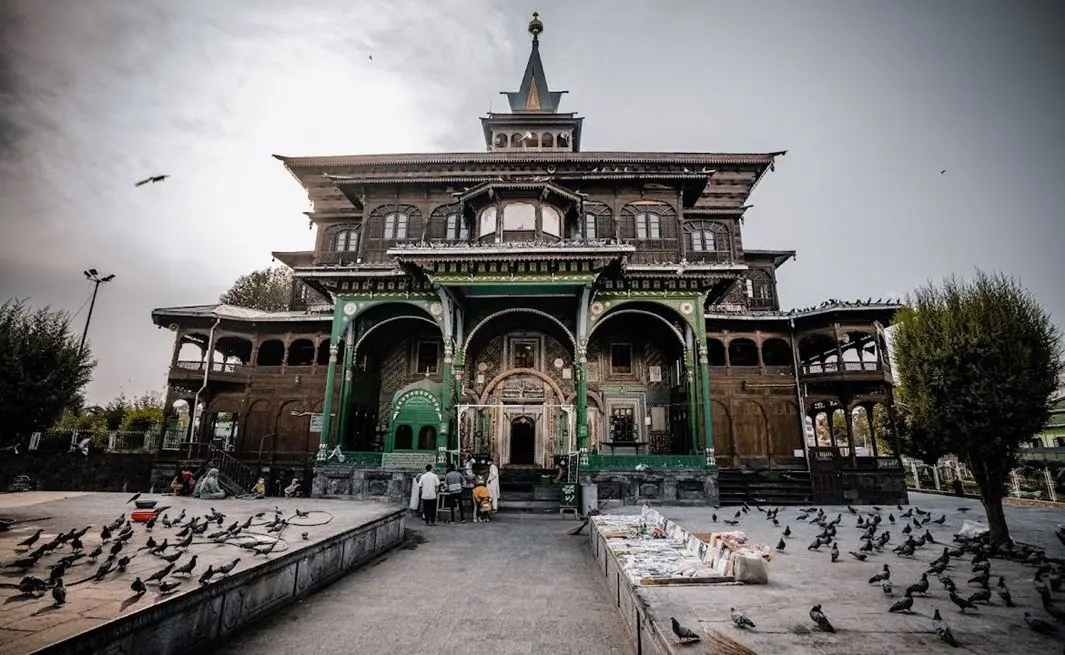


Srinagar needs to be remembered in the language of its own shrines. Mandating heritage architecture creates a permanent, high-value market for local craftsmen, retaining wealth within the community.
Haris Mashooq Zia
If the recently inaugurated Bab-ul-Sultan-ul-Arifeen is the threshold to our history, we must ask: what does the path beyond it lead to? In my previous analysis, I cautioned against “decorative curtains”—urban projects that offer aesthetic polish while leaving the city’s structural and cultural core untouched. To truly honour the ₹190-crore investment in our capital, we must move beyond the “Gate” and toward a Shrinocentric Ecosystem: a model where our Sufi shrines act as the gravitational centre for a total urban, economic, and psychological revival.
The Nucleus: Spiritual Urbanism
In the traditional morphology of Srinagar, a shrine was never an isolated monument; it was the heart of a living organism. Historically, the surrounding markets (souks), schools, and homes were built in a “Centripetal” design—everything flowed toward the sacred centre.
Today, this flow is broken. We see the wooden majesty of a 14th-century Khanqah choked by the visual noise of Alucobond signage and concrete verticality. I propose the establishment of Sacred Precincts: zones within a 500-metre radius of major shrines where every building—public or private—must adhere to a strict “Heritage Code.” This is not an aesthetic whim; it is a restoration of the city’s Psychological Equilibrium. Architecture dictates behaviour; a harmonious, uniform environment reduces the “sensory friction” of urban life, returning a sense of dignity and peace to the residents of Sheher-e-Khaas.
The Engine: An Artisan-Led Economy
The most potent argument for this model is material. A mandate for architectural uniformity is, in reality, a Massive Job-Creation Engine.
The Fez and Florence Model: Look at Morocco’s Fez Medina or Italy’s Florence. These cities don’t just “preserve” buildings; they mandate them. Because every door, window, and wall must meet heritage standards, there is a permanent, high-value market for local master-craftsmen.
Local Wealth Retention: By requiring Khatamband ceilings, Pinjra-Kari screens, and Devri stone masonry, the city’s development funds stay within the community. We stop importing glass and steel from distant industrial hubs and start investing in our own carpenters, masons, and stone-carvers. Heritage thus becomes a Self-Sustaining Economic Circle.
The Technical Blueprint: Beyond The Facade
To achieve this, we must look at the “bones” of the city. Modern “Smart City” interventions often prioritise the road (the artery) over the neighbourhood (the organ). A Shrinocentric plan would focus on:
Utility Arteries: Instead of digging up heritage streets every six months, we need “Deep Restoration”—underground tunnels for drainage, electricity, and fibre optics, topped with traditional cobblestone that respects the water table.
Seismic Wisdom: We must re-institutionalise the Taq and Dhajji Dewari systems. These aren’t just “old styles”; they are indigenous earthquake-resistant engineering. Incorporating these into modern institutional buildings around the shrines proves that we are a city that values its own scientific heritage.
The Global Precedent: Success Through Uniformity
Critics might call this impractical, but global data proves the opposite. Cities that enforce strict visual and material uniformity around their “Sacred Nuclei” see a 300% higher “Value-Per-Acre” than those with haphazard growth.
Vatican City and Kyoto thrive not because they are “modern,” but because they are relentlessly themselves.
When a tourist or a devotee enters a Shrinocentric zone, they should feel a “Climatic and Acoustic Shift.” The wood-and-brick architecture naturally regulates temperature and dampens the roar of traffic, creating a sanctuary that is both environmental and spiritual.
Conclusion: The Living Museum
Srinagar should not be a “Smart City” in the generic, digital sense. It should be a Living Museum where the material serves the spiritual. If our markets reflect the geometry of our mosques, and our institutions mirror the resilience of our shrines, we create a city that is immune to the “placelessness” of the 21st century.
We have built the gates; now we must build a world worthy of them. Let us transform Sheher-e-Khaas into a place where the economy is driven by the artisan, the soul is nourished by the architecture, and the “Gilded Gate” finally opens into a reality as golden as its name.
Srinagar does not need to be ‘rebuilt’ in the image of a foreign dream; it needs to be ‘remembered’ in the language of its own shrines. If we fail to make our markets reflect our mosques, we will be left with a city that has a gilded gate, but no soul to protect.
ha***************@***il.com