

Behind the ‘flexibility’ of food delivery apps lies old exploitation, where workers, not employees, bear all risks, face algorithmic control, and internalise their own precarity
Masroora Jan
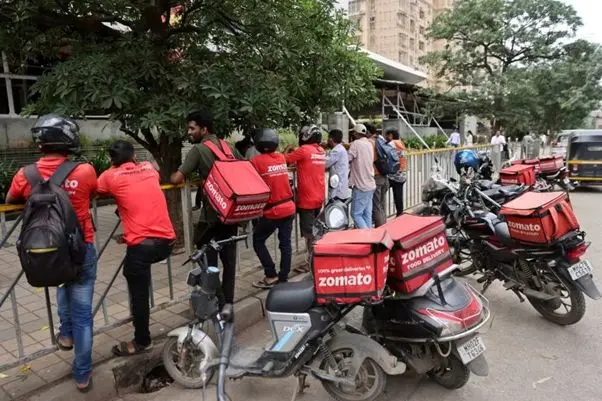
If you spend ten minutes on any street corner in urban India, you will see a sea of orange, red, and blue shirts weaving through gridlocked traffic on electric vehicles. These are riders for Swiggy, Zomato, Zepto, and Blinkit, whose job is to deliver our convenience at breakneck speed. On our screens, the interface appears clean, friendly, and efficient, designed by product managers and engineers from reputed universities across the country.
Through a Marxist lens, however, we see a very old and predatory story.
The gig economy is not a new way of working; it is capitalism stripped of its mask. It represents a perfection of exploitation, hidden behind a “login” button. Workers are labelled “service partners” or “independent contractors”, never employees. This linguistic sleight of hand allows companies to escape obligations related to minimum wages, workplace safety, provident funds, insurance, and pensions.
Marketing sells the gig worker a dream of “flexibility” and “being your own boss”, but this is what Marx identified as the trap of piece wages. Workers are paid per delivery, not per hour. What is handed to them is not freedom, but all the risks. Companies transform them into output machines, forcing workers to ride faster and longer to stay afloat. Far from granting autonomy, the system creates a structural incentive to push oneself to the breaking point merely to survive the day.
Algorithm As The Boss
In the gig economy, the boss is a ghost – an algorithm that doesn’t care if you are sick or facing adversity. This algorithm surveils every trip, often using AI for hyper-supervision. Recalling Marx’s concept of alienation, the worker becomes completely detached from the value they create. If a worker misses a target for any reason, the algorithm penalises them. There is no human authority to appeal to – only an opaque system designed to make the worker feel entirely replaceable.
The theory of scientific management, developed by Frederick Taylor in the late 19th century, finds its perfected form in these platforms. While intended to maximise efficiency, its modern application—through algorithmic control—has led to the deskilling of labour, intense worker surveillance, and the dehumanisation of workers, reducing them to cogs in a machine.
The Reserve Army Of Labour
Marx emphasised that capitalism depends on a reserve army of labour – a mass of unemployed or underemployed workers that disciplines those currently employed. In India, this reserve army is vast. With high unemployment and a shrinking informal sector, gig platforms thrive on desperation. Companies need not negotiate; they simply tweak the algorithm to onboard a thousand more waiting individuals. This precarity is not accidental; it is structural. It actively discourages collective organisation and solidarity.
The Endless Hustle
One of the most insidious aspects of gig capitalism is how exploitation is normalised and internalised. Workers begin to accept unsafe delivery targets, unpaid waiting time, and arbitrary penalties as part of the job. Customers, too, normalise the expectation that food should arrive in ten minutes, regardless of the human cost.
Workers internalise the logic of capital: the idea that they must work harder to succeed. They blame themselves for low earnings rather than the system that sets impossible conditions, nurturing a notion of “survival of the fittest.” Productivity becomes a moral duty; exhaustion becomes a personal failure. This is how exploitation reproduces itself, not only economically, but psychologically.
Beyond Surface Appearances
From a Marxist perspective, the question is not how we “fix” the apps or optimise ten-minute deliveries. The question is whether we are willing to accept a society that builds its convenience on the bones of a permanent, unprotected underclass. Through the prism of the gig economy, we see that even the most advanced algorithm cannot extinguish the human impulse for dignity. Technology may have changed, but the struggle for a fair life remains exactly the same.
Marxist theory is built on analysing the underlying structural causes – the “behind-the-scenes” forces – of social, economic, and political phenomena, rather than merely observing their outward appearance. For the gig worker, what lies “behind the stage” is the process of exploitation and the extraction of surplus value pocketed by capitalists. While the market appears as a fair space of equal exchange, the workplace is where the worker is systematically stripped of the value they produce.
We do not need a magic wand to curb this exploitative culture, nor should we look to a few capitalists as saviours. The onus lies with the ruling dispensation to regulate the labour market and ensure a social safety net for workers. It is essential to fulfil the vision and conscience of the Constitution, which enshrines India as a socialist, secular, democratic, and welfare society.
The writer is from Jawaharlal Nehru University
ja*********@***il.com