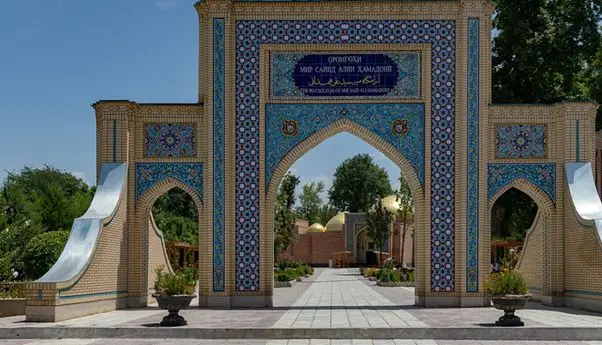


A revered reformer and scholar, Hamadani’s (RA) teachings, artistic influence, and social reforms continue to inspire Kashmir’s identity, guiding principles of justice, education, and community development
By Prof Hamid Naseem Rafiabadi
Syed Ali Hamadani (RA) (1314–1384 CE), widely revered as Amir-e-Kabir, Qutub-e-Zaman, and Sheikh-e-Salikan-e-Jehan, was a transformative figure whose life and teachings left an indelible mark on Kashmir’s spiritual, cultural, social, and political landscape. Born in Persia, his paternal lineage traced back to Imam Zain-ul-Abedein and Hazrat Ali (RA), while his maternal lineage connected him directly to Prophet Muhammad (SAW), giving him both spiritual authority and noble heritage. From a young age, he demonstrated exceptional scholarship and spiritual insight, later becoming a central figure in the Kubarawi Sufi order and serving as a Murshid-i-Ma’anawi. His influence extended far beyond spiritual guidance, encompassing social reform, education, culture, and political counsel, making him a luminary in multiple spheres of life.
On 14th October 2025, the Government Degree College Women, Baramulla, organised an extension lecture to commemorate his life and contributions under the guidance of Principal Prof (Dr) Neelofar Bhat. The guest speaker, Prof Hamid Naseem Rafiabadi, former Head of the Department of Islamic and Religious Studies at the Central University of Kashmir, former Director of the Shah-i-Hamadan Institute of Islamic Studies, Dean of Schools of Social Sciences and Media Studies, and Visiting Researcher at ISTAC, International Islamic University Malaysia, delivered an insightful lecture highlighting Hamadani’s pivotal role in shaping Kashmir’s spiritual, cultural, and economic development. Dr Faiz Qaziabadi, Dr Tariq Ahmad Wani, Prof Nazir Mehdi, and other faculty members attended, reflecting the scholarly and communal significance of the event.
Hamadani’s (RA) spiritual teachings emphasised mystical illumination, ethical conduct, and the integration of spirituality into daily life. Central to his philosophy was the concept of Wajud-i-Haqiqi, the Absolute Real Being, and he outlined the soul’s journey from the heart to the lamp, to light, to the prophetic soul, and finally to the sacred soul. Drawing inspiration from classical Sufi mystics like Mansur al-Hallaj and Bayazid Bistami, he emphasised that spiritual ecstasy should always be guided by Shariah, ensuring that mystical experience was inseparable from moral discipline. He bridged mainstream Sufism and the Kashmiri Rishi tradition, gradually Islamizing local spiritual practices while respecting indigenous customs and emphasising the harmonious integration of faith and ethics in societal life.
In addition to his spiritual role, Hamadani (RA) was a social and economic reformer who promoted lawful livelihood and self-reliance, rejecting dependence on charity for his disciples. Recognising Kashmir’s potential in craft and industry, he introduced and popularised cap-making, papier-mâché, and the shawl industry, famously called “Kar-i-Amir”. His khanqahs became centres for spiritual, educational, and economic activity, training artisans, students, and scholars in skills that combined devotion with productivity. These initiatives transformed Kashmir into a hub of artisanal excellence, enhancing both its economy and social cohesion.
Syed Ali Hamadani (RA) also enriched Kashmir’s cultural and artistic landscape by introducing Persian calligraphy and literature. He developed scripts such as Khat-i-Shikasta, Khat-i-Naskh, and Khat-i-Nastaliq, which influenced manuscripts, architecture, and literary production. Prof. Rafiabadi highlighted during the lecture that Hamadani’s promotion of arts, literature, and Persian culture not only enhanced aesthetics but also created sustainable economic opportunities, merging spiritual and cultural enrichment with practical livelihood. Through these efforts, he created a lasting fusion of intellectual, spiritual, and artistic life in Kashmir.
In the political realm, Hamadani (RA) provided guidance rooted in justice, ethics, and Shariah. His treatise, Zakhiratul-al-Muluk, outlined principles of governance for rulers, emphasising accountability, fairness, and service to society. He corresponded with Sultan Qutbu’d-Din, influenced Sultan Sikandar’s Shariah-based administration, and played a mediatory role in reconciling the Kashmiri and Tughlaq armies at Firozpur, demonstrating a rare combination of moral authority and practical diplomacy. Scholars recognise him as one of the three pioneering political theorists of the Delhi Sultanate, alongside Fakhr Mudabbir and Zainuddin Barani, whose contributions shaped governance and ethical statecraft during a crucial period in the subcontinent’s history.
Education and mentorship were central to Hamadani’s (RA) vision. His illustrious son Mir Muhammad Hamadani (RA) trained disciples such as Sheikh Nooruddin (Nund Rishi), promoting Shariah-centred mystical education and influencing Kashmiri poets like Lal Ded to integrate spiritual insight with literary creativity. His holistic approach to education encompassed intellectual, moral, and social development, ensuring that knowledge, ethics, and spirituality were inseparable. The Baramulla lecture emphasised that Hamadani’s legacy continues to inspire contemporary educational and cultural institutions, guiding scholars, artisans, and spiritual seekers alike.
The legacy of Shah Syed Ali Hamadani (RA) in Kashmir is comprehensive and enduring. Spiritually, he bridged Sufism and the Rishi tradition, guiding generations of disciples toward ethical mysticism. Socially and economically, he promoted self-reliance, productivity, and community cohesion. Culturally, he enriched literature, calligraphy, arts, and architecture. Politically, he advised rulers on justice and ethical governance, ensuring that society benefited from fair and morally grounded leadership. His integrated approach created a society where spirituality, culture, education, and ethics flourished together.
The 2025 lecture at Government Degree College Women, Baramulla, reaffirmed Hamadani’s continuing relevance, drawing attention to his role in shaping Kashmir’s intellectual, spiritual, and cultural identity. Attendees reflected on his influence on spiritual life, cultural development, education, and governance, underscoring that his principles remain instructive in contemporary society. In a time when the secular and the spiritual are often viewed in isolation, Shah Syed Ali Hamadani (RA) provides a timeless model for integrating faith, work, knowledge, and culture. He is remembered not only as a saint but also as a visionary reformer whose life and teachings illuminate Kashmir and beyond, demonstrating that true leadership harmonises spirituality, social responsibility, cultural vision, and practical governance, leaving a legacy that continues to inspire generations.
—Dr Hamid Naseem Rafiabadi (also known as Dr Hamidullah Marazi) is a distinguished contemporary Islamic scholar whose work significantly contributes to the dialogue between Islamic philosophy and modern Western thought. He is the author of several books. Through a rigorous comparative methodology and an emphasis on epistemological integrity grounded in Tawhid (the oneness of God), Marazi critiques secular paradigms and advocates for an integrative intellectual tradition. His scholarship not only critiques Western thought but also calls for mutual enrichment between traditions, emphasising Islamic metaphysics, ethics, and educational reform as central to contemporary challenges.
ha*********@***il.com