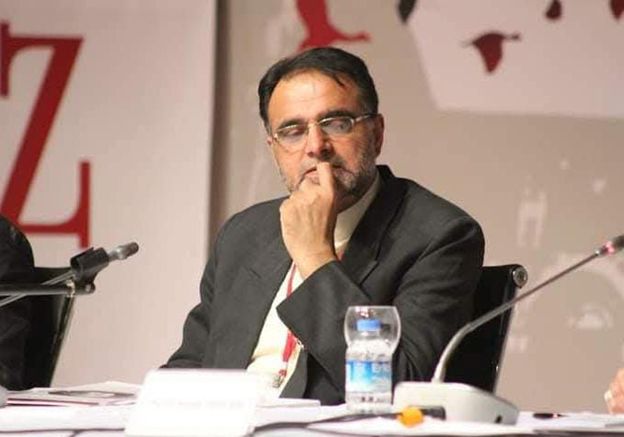


The visionary scholar’s profound contributions remind us of the urgent need to value true intellectual capital for societal progress
In the intellectual topography of Kashmir, few names resonate with such lucidity and sound knowledge as that of Professor Hamid Naseem Rafiabadi. A scholar of exceptional calibre, he has long stood as a torchbearer of Islamic thought, blending traditional Wahy (revelation)-based epistemology with a rigorous academic framework. He authored more than 30 significant books on Islam and culture, as well as hundreds of research articles. He introduced Imam Ghazali’s approach and the critical analysis of Allama Ibn Taimiyah among his students as a serious research methodology in the domain of Islamic studies.
However, his contribution is not merely confined to the classroom or academic journals; it reflects a living engagement with the spiritual and intellectual crises of our time.
Having served with distinction at the Shah-i-Hamdan Institute of Islamic Studies, University of Kashmir, and later as the Head of the Department of Religious Studies at the Central University of Kashmir, Professor Rafiabadi has influenced generations of students and scholars. His scholarship spans a wide range of subjects, from the Islamisation of knowledge and religious awakening to interfaith dialogue and social work. His call for a ‘knowledge-based dialogue’ remains one of the most pertinent responses to the fragmented discourse within Muslim society today.
Yet, despite his monumental contributions, Professor Rafiabadi — like many serious scholars of our region — has not received the recognition he deserves. There lies a deep and painful irony in our societal preferences: we extol comedians, social media influencers, and populists, whilst our true intellectual assets are sidelined, often deliberately ignored. This cultural shift, where entertainment overshadows enlightenment and intellectual awakening, has created a vacuum that breeds both spiritual stagnation and intellectual decline.
In a time when the Muslim Ummah faces complex challenges requiring tradition-based yet forward-looking wisdom, scholars like Professor Rafiabadi offer a framework for understanding and a vision of unity and peace. If we fail to appreciate such personalities, we fail ourselves — and risk perpetuating a cycle of ignorance disguised as engagement or scholarship.
Therefore, it is high time that we reclaim and recuperate our respect for knowledge, honour our scholars, and seek to reinvest in the intellectual capital that thinkers like Professor Hamid Naseem Rafiabadi so selflessly embody.
The writer is an Assistant Professor (Islamic Studies) at Amar Singh College, Cluster University Srinagar
Tahir Iqbal
ti*******@***il.com