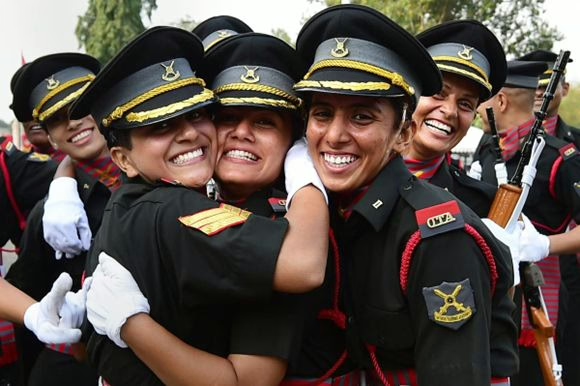


From historic NDA milestones to transformative policies, India’s journey towards gender equality is reshaping society and inspiring a new generation of women leaders
Women’s empowerment in India is more than a policy objective; it is a transformative journey reshaping the fabric of Indian society. For decades, Indian women have strived to overcome cultural, economic, and social barriers to assert their rightful place in every domain, from politics and education to science, entrepreneurship, and defence. In recent years, India has witnessed several landmark moments that symbolise this journey, but few have been as powerful as the inclusion of women in the National Defence Academy (NDA).
The graduation of the first batch of women NDA cadets in 2025 marked a pivotal chapter in India’s history. These young women, many from rural and non-military backgrounds, have shattered stereotypes and blazed a trail for future generations. This event is not only a military milestone but also a strong emblem of women empowerment, echoing a broader narrative supported by progressive legal reforms, visionary government initiatives, and a growing societal commitment to gender equality.
The Supreme Court Verdict: Laying the Foundation
Until 2021, the NDA remained a male-exclusive bastion in India’s defence architecture. However, in a landmark judgment in August 2021, the Supreme Court of India ruled that women must be allowed to appear for the NDA entrance exam. The court declared the exclusion of women unconstitutional and emphasised that opportunity and merit must not be gendered.
Justice Sanjay Kishan Kaul, one of the presiding judges, noted that “gender equality must be a lived reality.” The ruling sparked immediate policy changes and prompted the armed forces to restructure their recruitment, training, and infrastructure to welcome women cadets. It wasn’t just a legal decision; it was a societal leap forward.
The First Women NDA Batch: A Historic Breakthrough
In May 2025, India proudly witnessed the commissioning of the first-ever women NDA graduates. Seventeen women cadets, selected through the same rigorous entrance examination and subjected to identical training protocols as their male counterparts, marched with pride at the passing-out parade.
Why This Moment Matters
- Redefining Aspirations Across Rural India: Many of these cadets came from remote villages and tier-2 towns, where traditional gender roles often limit female ambition. Their presence in uniform sends an unmistakable message: courage, discipline, and leadership know no gender or geography.
- From Civilian Homes to Military Ranks: Unlike the sons of army officers who often follow in their fathers’ footsteps, these girls came from non-military households. Their success reflects changing mindsets within Indian families, where daughters are now encouraged to dream big and challenge norms.
- Institutional Evolution: The NDA revamped its physical infrastructure, including separate dormitories, washrooms, and safety mechanisms, to accommodate women. Training modules were redesigned to maintain standards while ensuring inclusivity.
- Inspiring the Nation: These 17 cadets have become symbols of resilience and progress. Their journey is inspiring thousands of schoolgirls to consider careers in the armed forces, thus opening avenues once deemed impossible.
Training and Challenges
The NDA training is famously gruelling, combining academic studies with physical endurance, survival skills, weapon handling, and leadership development. These young women did not receive special privileges. From dawn-to-dusk drills to fieldcraft lessons and tactical warfare classes, they were held to the same standards as male cadets.
Their successful completion of the program highlights the importance of equal opportunity. When given a level playing field, women not only participate but excel.
Historical Context: Women In The Indian Armed Forces
Though women have served in the Indian Armed Forces since the 1990s in various support roles, they were often restricted from combat and leadership positions. Key milestones include:
- 1992: Women officers were inducted into the Indian Army on a short-service commission.
- 2015: Indian Air Force opens fighter pilot roles to women.
- 2020: Supreme Court orders a permanent commission for women in the Indian Army.
- 2021: Supreme Court opens NDA to women.
The NDA milestone stands out as it enables women to begin their defence careers at the same foundational level as men, setting them up for long-term leadership roles.
Government Initiatives For Women Empowerment
India’s commitment to gender equality is underscored by a range of schemes and reforms aimed at empowering women across social, economic, and political dimensions.
- Beti Bachao Beti Padhao (BBBP) Launched in 2015, this campaign addresses the declining child sex ratio and promotes girl child education. With slogans like “Educate the Daughter, Save the Daughter,” it has led to increased awareness and improved school enrollments.
- Mission Shakti: This umbrella programme focuses on the safety and empowerment of women through its two components:
- Sambal: Ensures protection with women helplines and One Stop Centres.
- Samarthya: Promotes economic independence through skill training, digital literacy, and access to entrepreneurship.
- Stand-Up India: Encourages women from marginalised communities to start businesses by providing loans between Rs. 10 lakh to Rs. 1 crore. Over 80% of beneficiaries are women.
- Mahila E-Haat: A government e-commerce platform that allows women entrepreneurs to market and sell their products directly, fostering digital inclusion.
- Sukanya Samriddhi Yojana: A high-interest savings scheme that supports the financial needs of a girl child, especially for education and marriage.
- PM Ujjwala Yojana: Though primarily a health program, it has helped rural women by reducing their exposure to smoke and improving family well-being, which in turn enhances their status in households.
- Women’s Reservation Bill (2023) The 106th Constitutional Amendment reserved one-third of seats for women in the Lok Sabha and State Legislative Assemblies. This bold move ensures stronger representation in political decision-making.
Gender Equality In A Broader Perspective
- Education: India has made significant progress in bridging the gender gap. According to UDISE+ (2023), the Gross Enrollment Ratio of girls in secondary education has surpassed that of boys in several states.
- Employment: The government is promoting women’s participation in non-traditional sectors like STEM, manufacturing, and defence. The MUDRA loan scheme and self-help groups (SHGs) have facilitated financial inclusion.
- Digital Empowerment: Initiatives like PMGDISHA (Pradhan Mantri Gramin Digital Saksharta Abhiyan) are helping bridge the digital divide for rural women.
Global Context: India On The World Stage
India is a signatory to several international conventions promoting gender equality, including:
- Convention on the Elimination of All Forms of Discrimination Against Women (CEDAW)
- Beijing Platform for Action
- UN Sustainable Development Goals (SDG 5: Gender Equality)
India’s policies are increasingly aligned with global best practices, and the inclusion of women in NDA showcases India as a leader in challenging gender stereotypes in traditionally male-dominated sectors.
Voices of Change: Stories That Inspire
One cadet from the first NDA batch shared in an interview, “I come from a village where girls rarely step out for college. Now, I’m a commissioned officer. My journey is not just mine; it’s my village’s, my state’s, and every girl’s who dared to dream.”
Another said, “We were not seen as weak. We were trained as equals. That is true empowerment.”
These voices resonate with a new India that believes in the strength, talent, and potential of its daughters.
Societal Impact: Ripple Effects Of Representation
- Family Mindsets Are Changing: With visible role models in the armed forces, parents in conservative societies are now encouraging daughters to explore careers in uniformed services.
- Media Representation: Films, books, and documentaries are now highlighting stories of female officers, creating a feedback loop of inspiration and aspiration.
- Youth Movements: Coaching centres for NDA and SSB exams have seen a surge in female candidates, with new batches being trained across cities and towns.
Challenges That Remain
- Workplace Equality: Even with entry-level access, glass ceilings remain in promotions and postings.
- Safety: Women in rural areas still face safety issues, affecting mobility and education.
- Cultural Resistance: In some pockets of India, regressive norms still deter women from stepping into non-traditional roles.
However, the success of the first NDA women batch shows that change, though slow, is real and possible.
Conclusion: Marching Toward An Empowered Future
The graduation of the first women’s NDA batch is more than a headline. It is a turning point. It embodies the spirit of India’s constitutional promise of equality and reflects the aspirations of a new generation of women who are bold, capable, and unstoppable.
Empowerment comes not from symbolic gestures, but from structural changes that open doors and level the playing field. Through progressive court judgments, robust government schemes, and evolving societal mindsets, India is taking definitive steps toward creating an inclusive nation.
Let this achievement not be seen as an isolated incident, but as a benchmark for what India can accomplish when it puts faith in its daughters. With the first march of women cadets from NDA, India marches forward too, toward a future where no dream is denied by gender, and every girl believes: “I can. I will. Watch me.”
The writer is a research scholar at Central University of Jammu, with a focus on economics and development studies
Sumaya Jan
su*********@***il.com