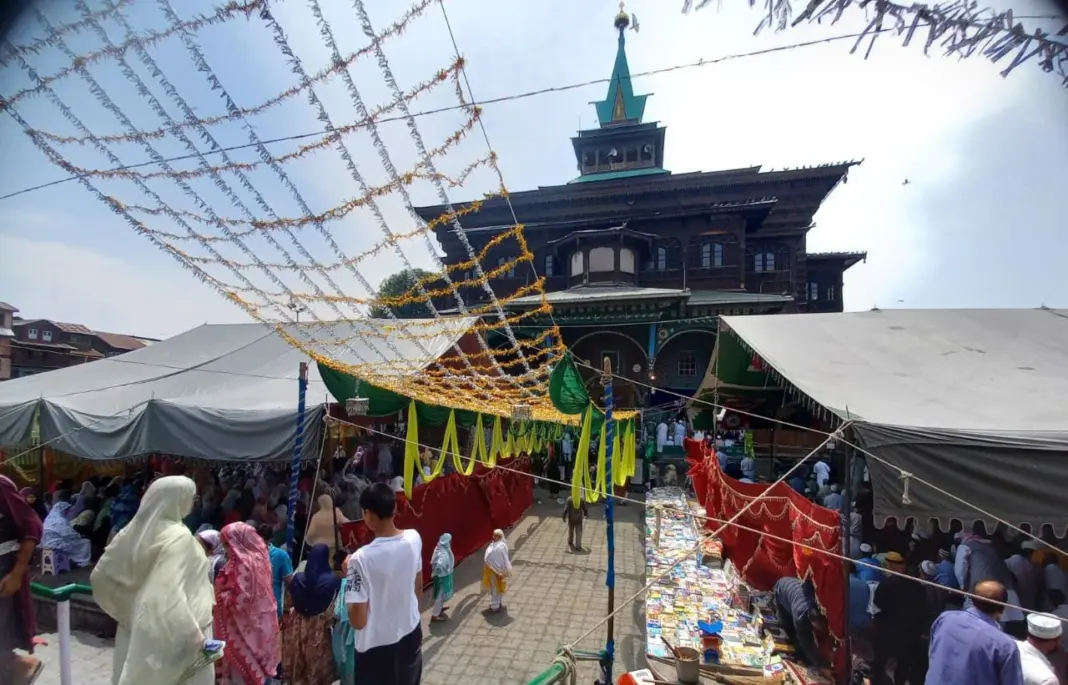


The 14th-century Persian mystic transformed the valley through spirituality, architecture and a legacy that still stands after 650 years
Hazrat Amir Kabir Mir Syed Ali Hamdani (RA), often referred to as the founder of Islam in Kashmir, came to the valley with a large group of comrades of Sayyids who were all Amirs. Since he was their leader, he is known as Amir-i-Kabir.
Hazrat Shah-i-Hamdan was born on the 21st of October, 1314 AD, into a noble and pious family. Both his parents, Syed Shahabuddin and Syeda Fatima, were direct descendants of the Holy Prophet Muhammad (SAW). His father was an administrator of Hamdan, and his maternal uncle, Syed Alluddin Simnani, took responsibility for his upbringing. Under his guidance, Shah-i-Hamdan learned and memorised the Holy Quran.
An eminent scholar and Sufi of the time, Sheikh Sharfuddin Mazdaqani, initiated him into the Kubrawi order. He became his Murshid (preceptor) and was involved in his religious, educational, and spiritual upbringing.
A brutal Tatar, Zulchu, invaded Kashmir in the early 14th century AD. He and his companions created havoc for eight months, bringing death, destruction, and misery to the people. Only eleven families survived in the city. After his departure in 1320 AD, a Buddhist from Ladakh, Rinchan Shah, became the king of Kashmir. During his reign, Syed Sharfuddin Abdul Rehman Suharwardi (RA), also known as Bulbul Shah from Turkistan, came to Kashmir. It was through him that Rinchan Shah accepted Islam and was renamed Sadruddin.
Before arriving in Kashmir, Shah-i-Hamdan sent his two followers/cousins, Syed Tajuddin Simnani and Mir Syed Hussain Simnani, to the valley to assess the situation.
Shah-i-Hamdan made three visits to the valley. His first visit was in 1372, when the ruling king, Sultan Shahabuddin, had gone on an expedition to Attock. The companions of Shah-i-Hamdan, who were fewer than a hundred in number, were received by Sultan Qutubuddin, who later became his disciple. He stayed for six months, after which he left for Makkah.
During his second visit in 1380, he was accompanied by 700 Sayyids who were warmly welcomed by Sultan Qutubuddin. This large group settled on the banks of the river Jhelum near the present-day Khanqah-e-Moula of Srinagar. At that time, the place was called Allaudin Pora. Shah-i-Hamdan and his disciples would offer prayers there; later, the foundation of the Khanqah was laid at that spot. On this visit, Shah-i-Hamdan stayed for thirty months in the valley, travelling across its length and breadth to propagate the true teachings of Islam along with his companions.
His third visit to Kashmir is recorded in 1384 AD, during which he fell ill after spending less than a year and then left. Shah-i-Hamdan and his party left Kashmir for Turkistan via Ladakh. They stayed at Shey village of Leh, constructed a mosque there for worship, making it the first Muslim site of worship in Ladakh. Travelling through the town of Pakhli, the party arrived at Kunnar. Its king, Khazar Shah, pleaded with him to stay for a few days as a royal guest. However, due to illness, his soul departed for the heavenly abode on the 19th of January, 1385 AD. Due to harsh winter weather, his body was buried at Swat, but in accordance with his wish, he was later laid to rest at Koulab on the 4th of July, 1385. His entire family is buried there.
Wherever Shah-i-Hamdan (RA) went, he left his imprints in the form of mosques and Khanqahs. Such Khanqahs were built in different parts of the valley during his visits. These constructions were undertaken under the direction of his beloved son, Mir Mohammad Hamdani (RA). These include Khanqah Faizpanah Tral, Khanqah-i-Amirya Pampore, Khanqah-i-Walla Wachi, Khanqah-i-Amirya Monghama, and the Khanqah of Shey Ladakh near Leh. However, the largest and most important one is the Khanqah-e-Moula of Srinagar.
Khanqah-e-Moula is the most revered—not only as a place of worship but also as a representation of more than six hundred years of our heritage. The architecture of the Khanqah is distinctively Central Asian, with wood, sculpted stones, and small bricks used as building materials. The foundation and the stone plinth of the Khanqah were laid by Shah-i-Hamdan himself, while the task of building was undertaken by his beloved son, Mir Mohammad Hamdani, when he visited the valley in the 8th century AH during the reign of Sultan Sikandar. Its construction began in 1396 AD and was completed in 1399. The cooperation and generosity of Sultan Sikandar and Seh Butt were instrumental in the timely completion of the grand project.
Mir Mohammad Hamdani (RA) came to Kashmir to continue the mission initiated by his pious father. The generosity and cooperation of the reigning king, Sultan Sikandar, helped him to extend a network of Khanqahs and mosques in every corner of the valley.
Rayees Ahmad Kumar
ra***********@***il.com