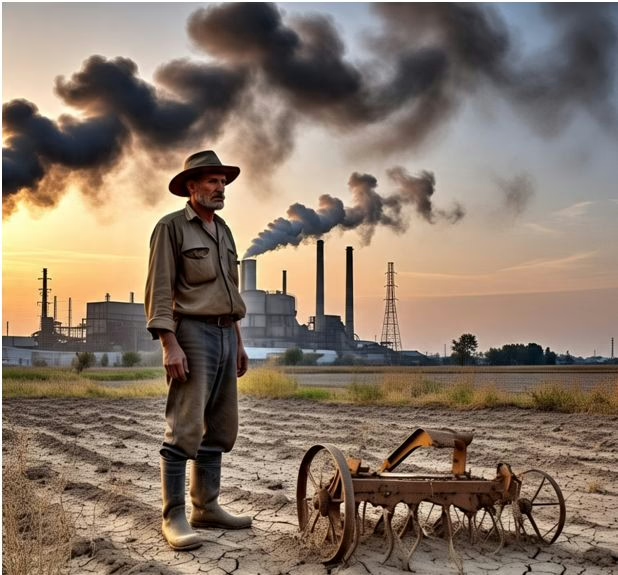


With 15% of J&K’s cultivable land lost in 12 years, a way of life—and food security—hangs in the balance. As elderly farmers in Kashmir and beyond sell their ancestral fields, a nation risks losing more than crops; it’s losing centuries of wisdom, one bulldozed acre at a time.
Once vibrant with the sounds of ploughs, rustling crops, and birdsong, the farmlands of India are today increasingly silent. Where golden wheat once swayed and buffaloes bathed in canal water, now stand steel warehouses, factories, and concrete industrial complexes. For many elderly farmers, this transformation is not a sign of development, but a painful reminder of a disappearing way of life.
Across India, land that was lovingly cultivated for generations is being sold off or acquired for industrial use. With it, not only is the agricultural output declining, but a cultural and ecological loss is also unfolding. Elderly farmers, once the backbone of India’s food economy, now watch helplessly as their heritage turns into commercial zones.
Agriculture: The Declining Backbone
Agriculture has historically been the mainstay of Jammu and Kashmir’s economy. Crops like rice, maize, wheat, saffron, and vegetables thrived across the Kashmir Valley and parts of Jammu. The region’s apples, walnuts, and almonds were once symbols of its agrarian strength and cultural pride.
But over the past decade, agricultural land has been shrinking rapidly. According to government data, over 15% of cultivable land has been diverted for non-agricultural use in the last 12 years. This includes land allocated for industrial estates, government offices, brick kilns, road expansion, and private construction.
The trend is most noticeable on the outskirts of cities like Srinagar, Anantnag, Pulwama, Jammu, and Udhampur — where lush farmland is being flattened to accommodate commercial warehouses, cement plants and malls.
The loss of agricultural land may not be immediately visible amid the new buildings and roads, but its impact will be deeply felt in food supply, employment, culture, and ecology.
The Shift to Industry
The economic lure of converting farmland into industrial zones is undeniable. As cities grow, their demands for infrastructure, logistics parks, and factories push urban boundaries deeper into rural areas. State governments, eager to attract investments and create jobs, often promote the development of industrial estates and special economic zones (SEZs) on agricultural land.
While these developments may create employment in the short term, they often come at the cost of self-sustaining local economies and food security.
According to a 2024 report by the National Agriculture Commission, India has lost over 12 million hectares of farmland to non-agricultural use in the past two decades — a significant portion of which came from smallholder farmers, many of them elderly.
Elderly Farmers: A Dying Breed
Elderly farmers possess knowledge that has been passed down for generations — knowledge of soil health, natural pest control, crop timing, and water conservation. But with the decline of farming, this wisdom is being lost. Few young people are willing to inherit this profession, preferring urban jobs and lifestyles.
“There’s no one to carry forward what we know,” laments 75-year-old Kamalamma from Karnataka. “Our children say farming is hard work and gives nothing. But without food, what will their industries eat?”
In many villages, ageing farmers now live alone on shrinking plots or survive on government pensions after selling their land. They feel abandoned, not just by their families, but by a country that once celebrated them as “annadatas” — providers of food.
Environmental and Food Security Concerns
The rapid conversion of farmland into industrial zones also poses serious environmental threats. Factories bring pollution, deplete groundwater, and often make surrounding areas unfit for cultivation. The disappearance of green cover also contributes to rising temperatures and climate imbalance.
Moreover, with fertile land disappearing, India’s agricultural output is under strain. The country, which once boasted self-sufficiency in food, is now facing increasing reliance on imports for pulses, edible oils, and even some cereals.
Dr Arvind Rao, an agricultural economist, warns, “If we continue to trade agriculture for industry without balance, we are risking both food security and rural livelihoods. Elderly farmers know how to farm sustainably. Their knowledge is an asset we are discarding.”
A Cry for Balance
Activists and rural development experts are urging governments to protect agricultural land through stricter zoning laws, offer better incentives for sustainable farming, and create programs that involve elderly farmers as mentors and guides.
In some states like Kerala and Himachal Pradesh, grassroots initiatives have started to reclaim abandoned land for organic farming, with elderly farmers leading the way. They’re training young volunteers and reviving indigenous crops — but these efforts are still limited and need broader support.
Conclusion
The story of elderly farmers and their lost lands is not just about economics — it’s about identity, sustainability, and respect for those who built the foundations of the nation’s food systems.
Elderly farmers are not just watching their fields vanish — they’re witnessing the erasure of an entire way of life. In the race for industrialisation, let us not forget the quiet wisdom in the fields we leave behind. Because when the last elder hangs up their plough, it may be more than farming that we lose — it may be our roots.
The writer is an environmental researcher and columnist
Sahil Jahangir
sa***************@***il.com