

Despite strategic location and agricultural wealth, encroachments, governance failures and political inertia choke the district’s development—can bold reforms rewrite its future?
Shopian, a historic place at the foothills of the Pir Panjal range, gracefully nestles the southern hemisphere of Jammu & Kashmir, which stands as a region of profound promise. It is renowned for its pristine landscapes and agricultural vitality that rightfully lead it to be known as the “Apple Bowl of Kashmir”, particularly for producing some of the premium apple varieties that anchor a substantial segment of the Union Territory’s horticultural economy.
Despite this pastoral and agrarian identity with natural assets and economic potential, there lies a stark paradox in why Shopian continues to struggle with chronic underdevelopment. In a telling historical coincidence, Shopian and its neighbouring district Kulgam were accorded district status on the same day in 2007. However, while Kulgam has since registered measurable growth in road connectivity’s, infrastructure, education, healthcare and economic diversification, Shopian appears shackled to systemic stagnation.
The reasons for this are as much political and institutional as they are infrastructural. Geographically, Shopian enjoys a unique strategic location. Bordered by Pulwama to the north, Kulgam and Anantnag to the east, Budgam to the west, and Poonch-Rajouri to the south, it occupies a critical position as a potential socio-economic and trade conduit between Kashmir’s heartland and its frontier regions. However, this latent advantage remains woefully underutilized due to fragile infrastructure, legacy conflict impacts and weak governance frameworks.
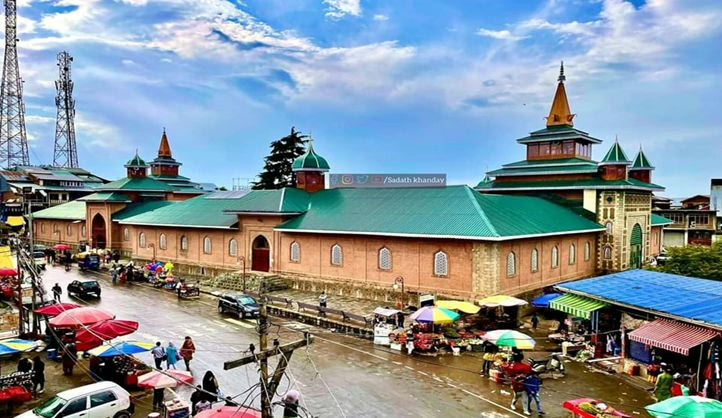
In recent past, the district, specifically Shopian constituency, witnessed a notable political shift, where developmental rhetoric emerged as the centrepiece of electoral discourse. The newly elected MLA of Shopian, riding a strong public mandate, drew attention to a deeply unsettling reality revealing therein that nearly 80% of commercial constructions in the town are encroached upon, illegally occupying public space. From unauthorised stalls to unchecked concrete sprawl, encroachments have choked Shopian’s urban fabric, stalling vital civic development. A bulldozer model of justice was subtly hinted, triggering sharp political backlash.
Critics accused the MLA of seeking extortion, but the controversy unearthed a deeper truth: Is Shopian’s urban chaos incidental or deeply systemic? The revelations, though politically polarizing, cracked open a necessary debate particularly on the failed urban planning, institutional inertia and the ethics of governance. Shopian can no longer stand at crossroads where accountability gets replacedwith silence and reformsstall with rhetoric.
Encroachments and chronic traffic congestion in Shopian are not isolated grievances but vivid indicators of a deeper systemic malaise. At a time when global cities are embracing smart mobility, sustainable urban planning and decentralized governance, Shopian remains tethered to outdated administrative models and visionless execution. This stagnation is worsened by a culture of bureaucratic inertia, political appeasement and a performative approach to public service. Alarmingly, when the High Court of J&K, acting on a Public Interest Litigation (PIL), ordered the government to publish the names of individuals illegally occupying state, forest, and Kahcharai lands, many names were either misrepresented or withheld thereby shielding violators and eroding public trust. The rule of law, instead of being upheld, is selectively applied, reinforcing impunity. In this dysfunctional ecosystem, public service has been reduced to photo ops and social media spectacle, while substantive governance is conspicuously absent. Genuine public service demands lawful conduct, transparency and accountability. Unless this entrenched culture of delay, denial and incompetence is dismantled, Shopian’s potential will continue to be stifled by systemic neglect and political inertia.
A recent op-ed by Er Raja Ishfaq Lateef analysing Shopian’s traffic crisis in light of global urban mobility trends identified a troubling triad that appears fuelling the district’s stagnation in infrastructural deficiency, institutional lethargy and political inertia. The article exposed how building permissions were historically granted without enforcing zoning laws or mandatory No Objection Certificates (NOCs), fostering a culture of impunity and unchecked construction. Alarmingly, even in the digital era, construction continues in violation of land-use norms and planning principles, signalling systemic decay with far-reaching consequences.
This pattern points to an urgent need to address collusion within public institutions, meant to safeguard, not exploit, public resources. Further aggravating the situation is the illegal occupation of public spaces, including areas designated for parks and recreational zones (designed under town plan), now converted for commercial use. A comparison between sanctioned building permits and ground realities reveals gross violations of planning ethics. Disturbingly, there have even been allegations that some public officials paid bribes to secure postings in Shopian, exploiting administrative lapses for personal enrichment. This calls for institutional introspection, stringent accountability and a return to lawful, citizen-centric governance.
It is worth mentioning here that Shopian’s crisis is not rooted in resource scarcity but in the absence of will, vision and governance rooted in the rule of law. Despite its strategic location, natural bounty and human capital, the district remains paralysed by policy stagnation, rampant illegality and performative politics. To unlock its true potential, Shopian needs structural reforms, not symbolism. This begins with enforcing strict zoning laws and mandatory NOC compliance to prevent further encroachments. Digitally mapping and reclaiming encroached public spaces is essential and that these reclaimed lands must be repurposed for public welfare through health facilities, educational hubs, research centres and recreational zones. Holding public servants accountable for inaction, misconduct, and ethical lapses is critical to re-establishing the rule of law. A citizen-led urban renewal mission aligned with Smart City principles should be launched, promoting participatory governance. Independent monitoring bodies must oversee planning, development and land use integrity. Developmental narratives must shift from populist slogans to measurable outcomes.
In light of the above, it transpires that Shopian stands at a defining crossroads caught between persistent decay and untapped promise. Its revival lies not in rhetoric but in courageous, ethical governance rooted in law, transparency and people-first planning. With collective resolve and institutional integrity, Shopian can no longer rise as a symbol of neglect, but as a beacon of transformative change in Jammu and Kashmir.
The writer is a cofounder and chairman at RADISAT Foundation (Research And Development In Science Art &Technology), working at the intersection of science, justice and social development.
Dr Sami Ullah
sami786.us@gmail